Get Full Government Meeting Transcripts, Videos, & Alerts Forever!
Get email alerts on the Budget topic
No spam. Unsubscribe anytime.
Dallas officials begin FY26 budget work amid property-tax uncertainty and pension pressure
Summary
City staff briefed the Dallas City Council on the FY2024 budget implementation and the development path for the FY2026–27 biennial budget, detailing a small shortfall this year, continuing expense pressures — notably pension and public-safety hires — and a shift to priority‑based budgeting to close gaps before formal proposal in August.
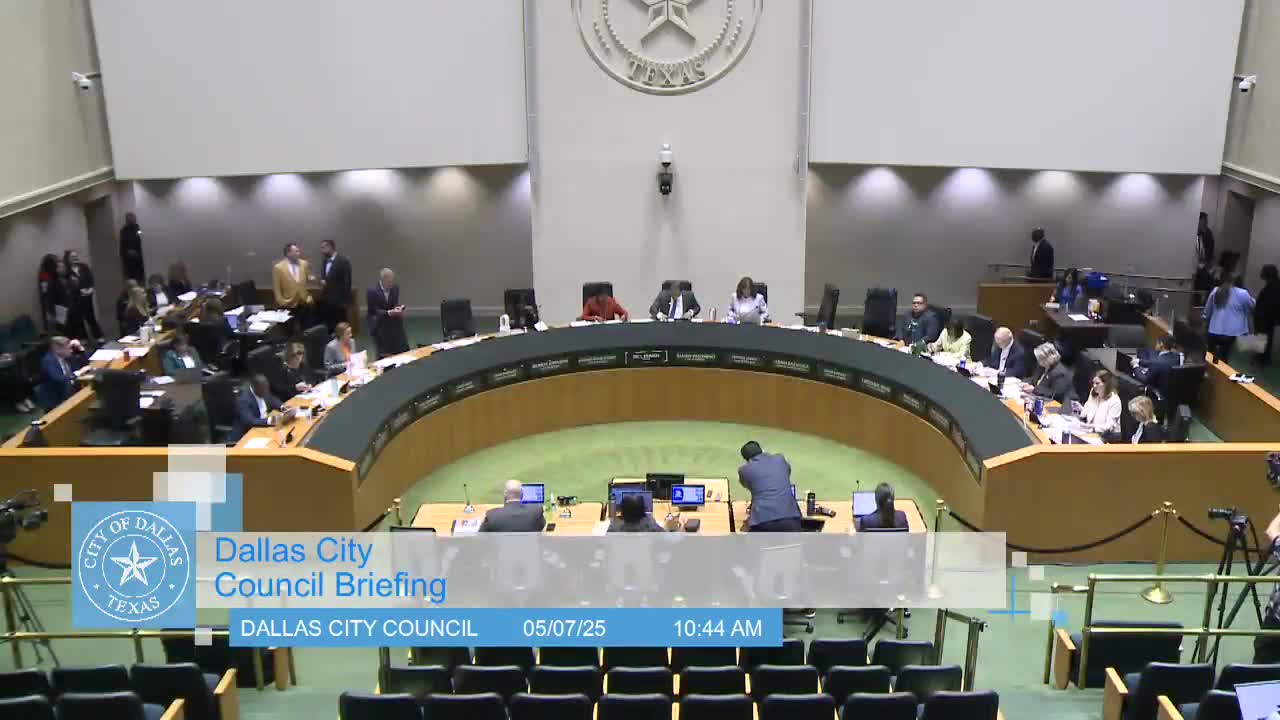
City officials on May 7 told the Dallas City Council they are revising revenue and expense forecasts for the fiscal-year 2026 budget and will present an updated proposal in August after additional public input.
The city manager’s office, Chief Financial Officer Jack Ireland and Budget Management staff outlined a mixed picture: staff currently project a roughly $6.5 million shortfall in general‑fund revenues for FY2025 and about $1.1 million of overages in general‑fund spending, while emphasizing several larger structural pressures that will shape next year’s proposal.
Those pressures include reduced taxable values tied to ongoing litigation with appraisal districts, an updated forecast for pension contributions and council direction to accelerate police hiring. CFO Jack Ireland said property tax revenue is expected to come in about $7 million below the adopted budget “primarily due to a $700,000,000 reduction in taxable value following the settlement of litigation with the appraisal districts.” He added that roughly $50 billion in assessed value remains under protest and could affect future revenue projections.
The presentation noted other specific variances: Planning and Development is forecasting nearly $12 million less in revenue this year and has taken hiring freezes and spending reductions to limit the gap, while department‑level cost drivers include Dallas Animal Services, Park and Recreation and the Office of Homeless Solutions.
The briefing also highlighted an ongoing structural policy requirement for FY2026. City staff reminded the council that the November 2024 charter amendment (known as Proposition U) requires the city to dedicate at least 50 percent of year‑over‑year growth in unrestricted revenues to the Dallas Police and Fire Pension System and then to police starting pay and sworn headcount, if funds remain. Jack Ireland summarized staff assumptions used last summer: the Dallas Police and Fire pension contribution is assumed at about $221.2 million for FY2026 and $240.7 million for FY2027 under the funding plan adopted last year.
Council members pressed staff on detailed accounting and assumptions. Council member Gaye D. Willis asked whether projected FIFA and convention‑center activity had been built into sales‑tax forecasts; staff said the forecast so far reflects historical norms and that any FIFA impact would be modeled before the June update. Council member Paul Ridley and others focused on the unfinalized appraisal litigation and asked whether the city should raise its erosion (collection) factor; staff said they are re‑evaluating the collection assumptions in light of unusually high value reductions this cycle.
To close structural gaps staff announced a change in the budget development process: departments will inventory services at the program level and prioritize funding by program rather than simply by department. City Manager Kimberly Beiser Tolbert described the shift as “priority‑based budgeting,” saying it is meant to align limited resources with the highest‑value programs and to surface duplication, inefficiency and opportunities to reallocate funds.
Other expense drivers flagged by staff include: meet‑and‑confer salary negotiations that will be resolved this summer; a step‑up in civilian pension funding ($5.3 million assumed for FY2026 in the plan presented last year); a planned 5 percent increase in city health‑insurance contributions in the five‑year forecast; and deferred building maintenance that staff say requires ongoing attention.
Staff outlined the near‑term calendar: a June briefing with updated forecasts, continued departmental program reviews in May–July, and delivery of a balanced biennial budget recommendation to council in August with final readings in September. Council members asked for additional follow‑up materials before the June briefing, including a more detailed breakdown of property‑tax math, contractual‑services and capital‑outlay variances, and an updated list of ARPA allocations. CFO Ireland said staff will provide those memoranda ahead of the next meeting.
Why it matters: Dallas’s general‑fund budget is heavily reliant on property tax (roughly 58 percent of general‑fund revenue), and state rules that cap reappraisal revenue growth (SB2, 2019) constrain how the city can respond to rising costs. With pension obligations rising and council direction to accelerate police hiring, officials said they will rely on program‑level prioritization, operational efficiencies and targeted fee and contract reviews to produce a sustainable budget proposal.
Looking ahead: staff reiterated that the budget before council today is a working starting point. The city manager and budget team said they will return with revised revenue and expenditure forecasts in June, and a formal proposed biennial budget in August.