Get Full Government Meeting Transcripts, Videos, & Alerts Forever!
Get email alerts on the Public Health Funding topic
No spam. Unsubscribe anytime.
Austin public health workers say federal funding cuts threaten services and jobs
Summary
At a May public-health committee meeting, union leaders, clinic nurses and APH staff said recent federal funding cuts risk core services — immunizations, refugee medical care and outreach — and urged the city to prioritize retaining frontline workers while the council considers budget options.
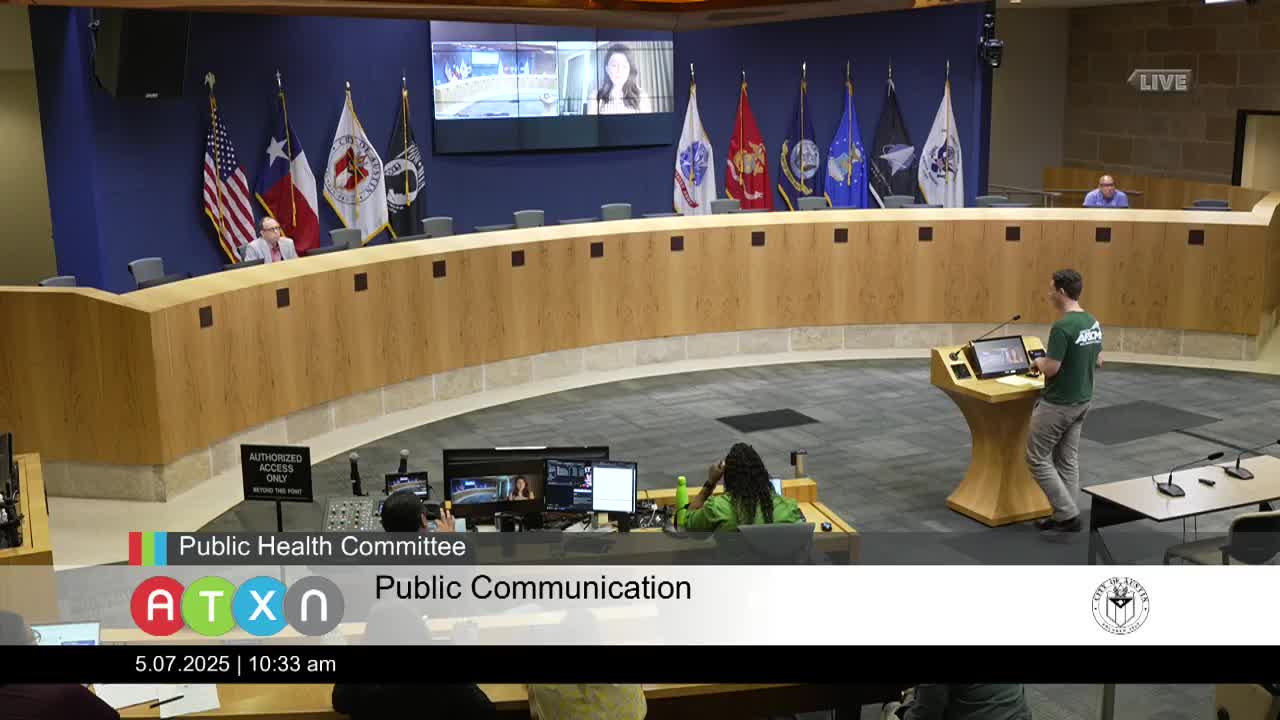
At a May 15 meeting of the Austin City Council Public Health Committee, union leaders and Austin Public Health staff warned that recent federal funding cuts have put immunization programs, the Austin Refugee Clinic and dozens of public-health jobs at risk.
Bryden Summers, president of AFSCME Local 1624, said the city lost $22,000,000 in federal funding and urged council to ‘‘prioritize the preservation of community critical health programs and frontline jobs.’’ He said workers already trained and delivering services face “tremendous uncertainty.”
The testimony, delivered during the committee’s public-communication period, included multiple accounts from clinic staff. Beth Savarkle, a registered nurse at the Austin Refugee Clinic, told the committee the clinic is “100% federally funded” and provided nearly 17,000 vaccines last year, including more than 1,200 measles vaccinations for nonimmune adults. Savarkle said the federal funding lapse in March led the city to terminate current full‑time employees at the clinic effective May 30 and to begin training temporary staff. “This is setting the clinic up for failure,” she said, saying temporary staff told her they “are not gonna be able to perform competently by the timeline given.”
Nicole Doggett, an RN supervisor in the APH immunizations program and an Austin resident from District 7, described program cuts that have reduced the mobile vaccination team from 15 people to six and the education and community outreach team from 12 to two. She said the department lost grant funding that supported 20 employees on March 24 and that “we no longer have the enhanced infrastructure to quickly react to an outbreak of an infectious disease.”
Zachary Newton, a community health worker who began at APH during the COVID response, said many clients rely on APH because they lack insurance; he warned that cuts would send “a very clear message to the people of this city…that you do not care about their health, safety, or well‑being.” Several other speakers, including Asha (a District 1 resident) and Ben Suddabee of AFSCME Local 1624, repeated union requests that the city prioritize direct employees when deciding budget tradeoffs.
Committee members acknowledged the urgency. Chair Mark Duchin said the reductions keep him “up at night,” referencing briefings that identified “300 plus employees and $40,000,000 that we've been alerted to that are at risk.” Councilmember Natasha Harper‑Alter and Mayor Pro Tem Fuentes expressed appreciation for testimony and said public‑health staffing and programs are being considered in the city’s budget deliberations.
Votes at a glance: The committee approved the minutes from the April 2 meeting and a special‑call April meeting. Motion to approve the minutes was made by Councilmember Harper‑Alter and seconded by Councilmember Clarice Velasquez; chair called for aye/raise‑of‑hands and, with no objections, the motion was approved (voice/hand vote; no roll call tally recorded in the transcript).
Why it matters: Speakers and staff described immediate operational impacts — fewer outreach events, reduced ability to vaccinate uninsured residents, and potential loss of federal grant compliance if specialized staff are replaced too quickly. Committee members repeatedly urged continued advocacy and said the matter will be prioritized in upcoming budget hearings.
What the committee did next: The meeting moved from public testimony to scheduled briefings; no further formal actions on staffing or funding were taken at the hearing.