Get Full Government Meeting Transcripts, Videos, & Alerts Forever!
Get email alerts on the Public Defense topic
No spam. Unsubscribe anytime.
Defender Association urges $15 million boost, warns office underfunded and seeks immigration-defense staff
Summary
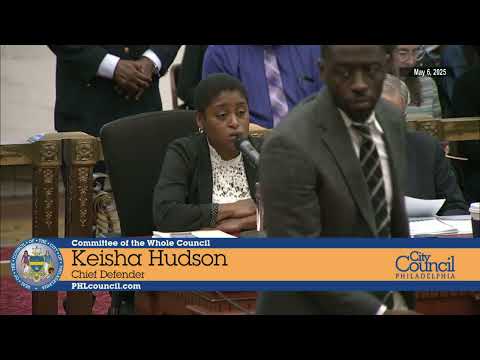
Keisha Hudson, chief defender at the Defender Association of Philadelphia, told City Council the office needs $15 million in transitional funding, highlighted pay and staffing gaps compared with other city legal offices, and urged immediate funding to start immigration-defense services for detained and at‑risk clients.
Keisha Hudson, chief defender at the Defender Association of Philadelphia, pressed City Council on the office’s fiscal 2026 request and asked for immediate steps to expand legal and social-service capacity.
Hudson told the Committee of the Whole that the association’s base city-funded budget is $66,000,000 and that she presented a separate $15,000,000 “transition” ask this budget cycle to expand staff, services and immigration representation. “We are critically underfunded,” Hudson said. She listed staffing and compensation shortfalls and said the association represents nearly 34,000 adults and about 2,900 children across dependency and delinquency matters last year.
Why it matters: The Defender Association provides constitutionally required indigent defense for people who cannot afford lawyers; Hudson argued the office’s funding and benefits lags—starting salaries and benefits—hamper recruitment and retention and limit services such as social-work‑led wraparound and juvenile reentry supports.
Hudson cited specific shortfalls to illustrate her request. “Starting salary for a public defender at the Defender Association of Philadelphia is $64,000 a year. The starting salary at the district attorney’s office is $70,000 a year. And the starting salary at the law department is $79,000 a year,” she said. She told councilmembers the association has 530 defenders but only 29 social workers for its adult client population and five social workers assigned to juvenile delinquency clients. She also said the association paid about $330,000 in real estate taxes last year and receives no city benefits such as pensions or city‑paid healthcare.
Hudson described several program priorities that would use the requested funding: lower caseloads for dependency and juvenile attorneys, more social workers to provide reentry and wraparound services, expanded homicide representation, and an immigration-defense program to represent detained and non‑detained noncitizen clients in removal proceedings. On immigration defense, Hudson said the association had discussed taking on that work with national providers and proposed a start-up staff of 10 attorneys plus mitigation and administrative support if the city allocates funding. “Our proposal would have a staff of 10 lawyers,” she said. “I would have to post and and hire, but I could be up and running in a month.”
Council reaction and context: Council members from across the chamber expressed support and pressed for details. Several members, including Council President Kenyatta Johnson and Appropriations Chair Mark Squilla (identified in testimony), thanked Hudson for the briefing and asked for follow‑up materials. Multiple council members said the defender funding gap is a priority and raised the possibility of covering certain operating costs or benefits to create parity with city agencies.
Hudson said some program expansions already started with grant funding—the office has launched reentry practice work for adults and an education advocate position for dependent youth—but said those efforts are too small relative to need.
Ending: Hudson closed by repeating the request for $15,000,000 and asking council to approve the funding so the Defender Association can expand representation, social supports and immigration defense services as removals and client needs rise. The association’s written testimony and the CFO’s estimate of operating and benefits needs were submitted to council as part of the hearing record.