Get Full Government Meeting Transcripts, Videos, & Alerts Forever!
Get email alerts on the City Budget topic
No spam. Unsubscribe anytime.
Council hears mayor’s FY26 budget proposal; residents press for housing, public safety and transit funding
Summary
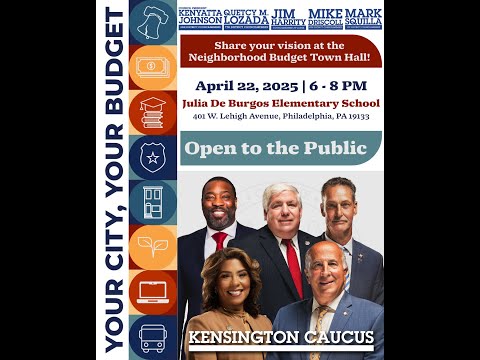
At a Kensington "Your City, Your Budget" town hall, City Council members heard the mayor's FY26 proposal overview — including a $6.7 billion operating plan and proposed tax changes — and fielded resident requests for more housing, tenant protections and transit funding.
Philadelphia City Council members and city finance staff presented an overview of the mayor’s fiscal year 2026 budget proposal and answered neighborhood questions at a "Your City, Your Budget" town hall in Kensington. Council President Kenyatta Johnson and Helen Lawhead, the council chief financial officer, described the proposal as an administration plan that council will negotiate.
"This is only a proposal from the administration. This is the mayor's vision," Council President Kenyatta Johnson said at the start of the meeting. Helen Lawhead said, "The budget is the city of Philadelphia's yearly plan that shows how much money will be spent on different programs and services."
Why it matters: The council must approve the final FY26 budget after hearings and negotiations with the mayor's office. Residents used the town hall to press for specific investments — especially in housing, tenant enforcement and transit — that they said affect everyday life in neighborhoods such as Kensington.
Key numbers and priorities described by Lawhead: the proposal shows roughly $6.7 billion in operating spending for FY26 and about $7.2 billion on the capital side. City staff said the plan projects $360 million in new operating spending and $340 million in new capital investments for the year. The presentation noted a projected revenue figure (about $6.3 billion) and a budgeted gap covered by the city's fund balance (a reserve cited as about $514 million). Lawhead also flagged ongoing fiscal pressures including federal uncertainty, rising debt service and upcoming union contract negotiations.
Major program highlights in the administration proposal cited at the meeting include: significant operating and capital investments directed at public safety (Lawhead cited roughly $186 million allocated to public safety in the operating request), $67 million over five years for a new forensic science center, $25 million for anti-violence grants to community organizations, Vision Zero street safety projects, and expanded cleaning/beautification work. On housing, the proposal includes a major initiative the administration called "Housing Opportunities Made Easy," which Lawhead said would direct about $800 million to create and expand housing opportunities. The proposal also sets aside funds (described as $550 million) to help cover costs tied to renegotiating union contracts.
Tax and revenue changes described in the presentation include proposed reductions in the city’s business income and receipts tax and the wage tax, removal of the exemption for the first $100,000 of business tax liability (as presented), elimination of the construction impact tax, increases to the realty transfer tax and document recording fees, and a proposal to increase the portion of real estate tax routed to the school district beginning in a later fiscal year. Lawhead said part of the revenue proposal directs new money toward small-business technical support and grant programs; she noted a proposal that would provide roughly $30 million per year for small-business support as part of the package.
Transit and events: Council members and residents raised SEPTA funding and the city's planned investments tied to major upcoming events. Council members said the city has budgeted $135 million for transit support in the current package and that Philadelphia will continue to lobby state officials in Harrisburg for additional support; they also noted a separate $100 million city commitment to events associated with 2026 and additional investments planned by other public agencies (for example, the airport's separate commitments).
What council members said about next steps: Council members repeatedly reminded the audience that the mayor had presented a proposal and that council will review and negotiate line items. Johnson and other members encouraged residents to attend additional hearings and to submit specifics on priorities they wanted the council to elevate during negotiations.
Ending: The town hall moved into a long public-comment period during which residents pressed for more detailed commitments on housing production, tenant enforcement, transit stability and neighborhood infrastructure. Council members said they will pursue follow-up meetings and hearings and that the final budget will reflect negotiations between the mayor’s office and City Council.