Get Full Government Meeting Transcripts, Videos, & Alerts Forever!
Get email alerts on the Climate Action Plan topic
No spam. Unsubscribe anytime.
San Ramon planning commission forwards draft Climate Action Plan to council, urges clear work plan and funding
Summary
The San Ramon Planning Commission voted unanimously May 6, 2025 to forward the draft Climate Action Plan to City Council, after a Rincon Consultants presentation and public comment, while asking council for a clear staffing and funding work plan.
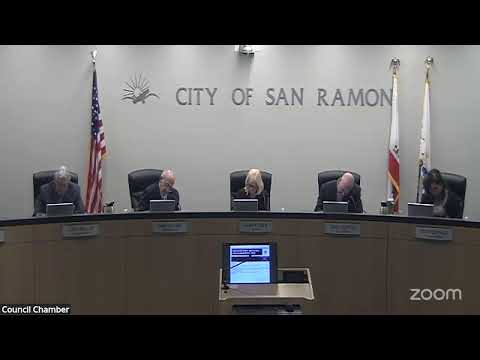
San Ramon — The San Ramon Planning Commission voted unanimously at its May 6, 2025 meeting to forward the city’s draft Climate Action Plan (CAP) to the City Council with a set of commissioner comments stressing the need for a staffing-and-funding work plan and clearer implementation timelines.
Rincon Consultants and city staff presented the CAP update during the meeting. Kelsey Bennett, environmental sustainability planning director with Rincon Consultants, told commissioners that “this item is for the updated climate action plan or CAP for short. You can think of the CAP as essentially a road map for the city to achieve its long term greenhouse gas reduction targets, through, the years 2030 and 2045.” Emily Saul, also with Rincon Consultants, summarized the plan’s structure and measures and said the draft contains 24 measures across seven strategies and an implementation chapter to guide monitoring and updates.
The draft uses 2019 as the baseline year and reports a community-wide inventory of 437,784 metric tons of carbon dioxide equivalent (CO2e). The plan’s 2030 target shown in the draft is 332,995 metric tons CO2e, leaving a reduction gap of about 99,462 metric tons CO2e to close by 2030. Consultants said the majority of near-term reductions in the draft come from on-road transportation and building natural gas measures. The consultants and staff noted the CAP is projected to achieve the 2030 target with the proposed measures but still falls short of the 2045 carbon‑neutrality target and will require future updates and new technologies to close that longer-term gap.
The draft CAP frames measures in seven strategy chapters — a cornerstone strategy, building energy, transportation, solid waste, water and wastewater, nature-based carbon sequestration and implementation. Each measure in the draft is paired with actions, an implementation pillar (structural change, feasibility, equity, funding, education, partnership), and either a quantified 2030/2045 reduction or a designation as “supportive” of the overall plan. The CAP also includes local CEQA greenhouse gas thresholds and a checklist intended to streamline environmental review for housing and commercial projects that meet the CAP’s performance criteria through 2030.
Commissioners focused their questions on specifics and on implementation. Commissioner Wallace said the report shows “52% of our greenhouse gas emissions really amount from 2 areas. 1 is transportation and the other is energy, natural gas, and electricity.” Commissioners asked staff and consultants to clarify what “community-scale” renewable energy means, how often inventories and the CAP should be updated, and what role the Planning Commission plays in adoption. Consultant staff and city staff responded that community-scale examples include microgrids and non‑rooftop solar pilots, that inventories have reporting lags and are typically updated on multi‑year cycles (the CAP calls for periodic updates and biannual progress reports), and that the Planning Commission’s role in this case is advisory — the City Council has final authority.
Public commenters included John Larson, a longtime San Ramon resident who said he works in energy fields and urged adoption, and Sue Subak, a member of the CAP Task Force and representative of the San Ramon Valley Climate Coalition, who spoke in support of the CAP and urged attention to walkability and bikeability. Larson said adopting the CAP would help the city “step up and be a leader.” Subak noted the task force’s endorsement and asked commissioners to prioritize walkable and bikeable improvements.
Commissioners repeatedly returned to implementation and costs. Several commissioners asked that the staff report to council include a clear work plan, staffing recommendation (a sustainability coordinator was discussed), and funding options. Commissioners also pressed for clearer phasing and near-term priorities so the council can weigh budget and staffing tradeoffs. Staff and consultants said many measures are low to moderate cost for the city, that community-level costs vary (the CAP includes cost-category summaries), and that some actions are already being implemented in the city. The staff presentation and the CAP materials note that measures will be prioritized and that the CAP includes implementation phases, monitoring, and the ability to update measures if San Ramon is off track.
After discussion and public comment, Commissioner Albert moved that the commission forward the draft CAP to City Council with the commissioners’ comments captured. Commissioner Wallace seconded the motion. The commission approved the motion by voice vote; no members objected.
The draft CAP was published for a 30‑day public review period on April 16; written public comments are being accepted through May 15, 2025 at 5 p.m. City staff and the consultant team plan to revise the draft to incorporate public and commission input, then present a final document to the City Council at a tentative June 10, 2025 hearing. The CAP document and the consultant’s greenhouse‑gas threshold report are posted on the City’s Plan San Ramon webpage.
The commission’s vote forwards the CAP and the commissioners’ concerns about staffing, budgeting, and implementation to the City Council but does not adopt any land‑use regulations; adoption of reach codes, building standards, funding allocations or other regulatory measures would be separate policy actions the council must approve.