Get Full Government Meeting Transcripts, Videos, & Alerts Forever!
Get email alerts on the Agency Operations And Safety topic
No spam. Unsubscribe anytime.
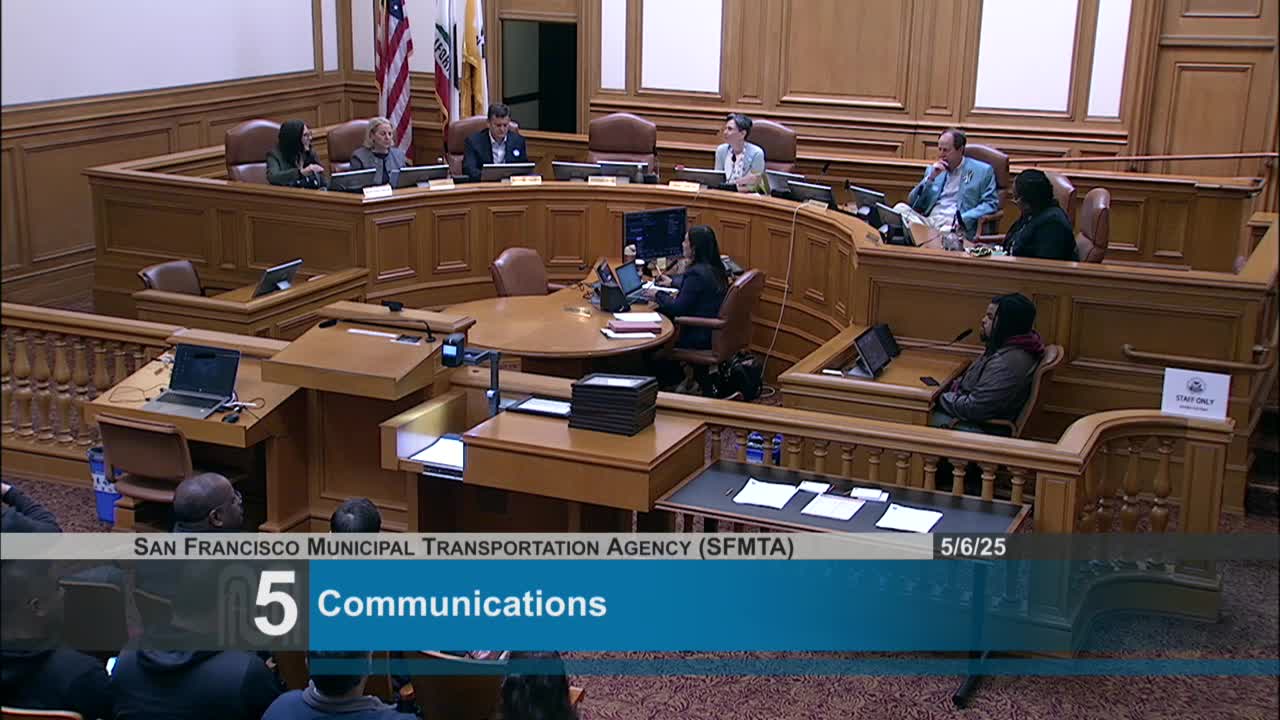
SFMTA director honors sign shop, rolls out reorganization, EV curbside charging pilot and school daylighting progress
Summary
Director Kirschbaum recognized the SFMTA sign shop’s work, announced an organizational restructuring and described new pilot programs including curbside EV chargers and expanded daylighting near schools.
Director Kirschbaum opened her report by recognizing the SFMTA sign shop for its work maintaining the city’s traffic control devices and then outlined an agency reorganization, a curbside electric-vehicle charging pilot and expanded daylighting near schools.
Kirschbaum told the board the sign shop has 37 dedicated staff who maintain an estimated 250,000 street assets, including about 11,000 stop signs, 44,000 parking signs and 54,000 street-name signs. She singled out sign shop manager Noel Laffey and thanked the crew for work on projects including Vision Zero speed‑limit changes and the Valencia project.
The director said the agency consolidated its administrative functions and reduced direct reports to six divisions to improve agility and better address the SFMTA’s financial pressures. She also noted operational priorities including Bike and Roll to School Week (55 schools registered as of April 30) and the agency’s role in launching curbside EV chargers as part of a city pilot.
Kirschbaum reported that the city launched its first curbside chargers at 55 Filmore Street as part of the Department of the Environment-led pilot; the chargers are operated by It’s Electric and intended for residents who lack private charging at home. She said these chargers complement existing off‑street charging and follow a feasibility study on network design.
On school safety, Kirschbaum said the agency has daylighted about 57% of crosswalk approaches within 600 feet of schools and will continue to expedite that work. In public comment and board discussion, advocates and residents raised concerns about some daylighting installations that are shorter than the statutory 20 feet to preserve parking. Commenters noted AB 413 allows shorter treatments in certain circumstances.
Victoria Wise, the city’s director of streets, and Director Kirschbaum explained the agency’s approach: the daylighting law permits less-than-20-foot clear zones in specific field conditions (for example, where a driveway lies closer than 20 feet or at certain T-intersections). Ricardo Olayo, the city traffic engineer (referenced during the discussion), has prepared technical guidance and a slide presentation explaining the variations; Kirschbaum’s office offered to brief the board and update website materials so the public can see the engineering rationale for particular installations.
Public commenters thanked the agency for outreach events tied to daylighting, urged more community events, and asked for clearer documentation explaining when the agency applies shorter daylighting distances.
No formal board action was required on the director’s report. The board asked staff to provide additional public-facing materials explaining when and why daylighting zones shorter than 20 feet are used and to offer a briefings session for supervisors and community groups.
Ending: The director’s report also acknowledged internal reorganizations and upcoming community events; staff said they would follow up with more detailed public materials about the daylighting rationale and the EV pilot.