Get Full Government Meeting Transcripts, Videos, & Alerts Forever!
Get email alerts on the Small Business Workforce topic
No spam. Unsubscribe anytime.
OCII reports $234.1M in contracts, 45% SBE construction participation for FY2023–24
Summary
OCII reported $234.1 million in design and construction contracts for FY2023–24 and said construction contracting reached 45% small‑business enterprise participation.
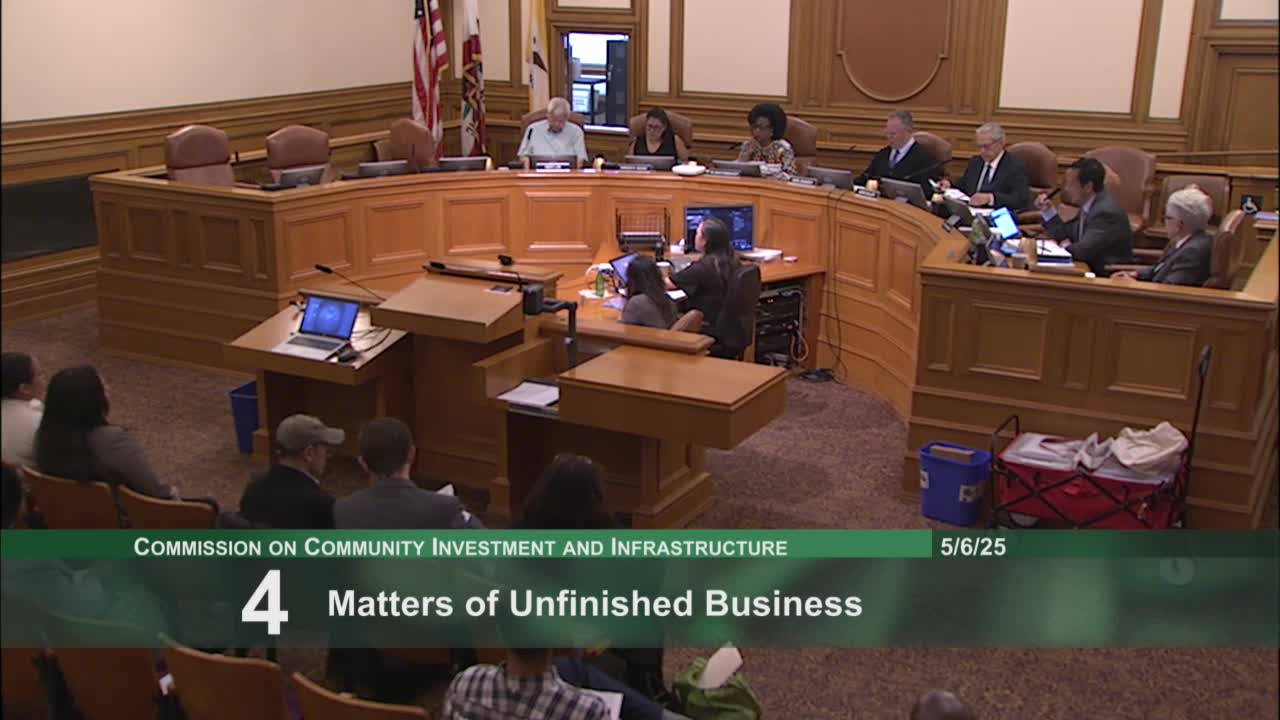
The Commission on Community Investment and Infrastructure during its May 6 meeting heard OCII staff present the agency’s annual small-business enterprise and workforce report for the 2023–24 fiscal year.
OCII said $234,100,000 in design and construction contracts were awarded within the agency’s project areas during the reporting period and that construction contracts achieved 45% SBE participation during that time. Professional services contracts achieved 29.8% SBE participation, the agency said, noting the latter figure reflected a single, highly specialized environmental review contract valued at about $450,000.
The report, delivered by Maria Picot, senior contract compliance specialist, and Julia Hernandez, contract compliance specialist, described OCII’s SBE policy, which sets a 50% SBE participation goal and gives first consideration to project-area SBEs in ZIP codes 94124, 94134 and 94107, followed by San Francisco-based SBEs. Non–San Francisco SBEs may be used only if local firms are unavailable, unqualified, or significantly more expensive. OCII requires developers and contractors to document “good faith efforts” to meet SBE goals, which can include breaking scopes of work, encouraging joint ventures, and holding mandatory pre‑bid meetings.
The staff presentation placed last year’s awards in the context of pandemic disruption: OCII reported contracting dipped to about $41 million in FY 2020–21, then rose to $136 million in FY 2021–22, $161.5 million in FY 2022–23 and $234.1 million in FY 2023–24 as the construction market recovered.
OCII also issued race and gender breakdowns for awarded contracts, saying that 17.3% of professional services contract dollars and about 33% of construction and supply contract dollars were credited to women‑ and minority‑owned SBEs in FY 2023–24 — roughly $77,200,000 of the year’s contract dollars.
On workforce metrics, Julia Hernandez summarized OCII’s local hiring practice, which establishes a 50% local hiring goal for construction workforce hours on a contract‑by‑contract basis with the same ZIP‑code priority. OCII partners with the Office of Economic and Workforce Development’s CityBuild program for worker referrals and compliance monitoring, including mandatory kickoff meetings, referral forms, weekly certified payroll reporting, and monthly compliance reviews.
CityBuild representatives at the meeting said their academies placed graduates into local construction jobs: CityBuild cycles 39 and 40 produced 88 graduates with 71 placements (an 81% placement rate), and CityBuild reported 641 total placements historically on OCII‑administered project sites. OCII also described its Architecture & Engineering training program, which in 2024 completed its ninth cycle and placed seven local college students at design firms.
Commissioners and partner speakers praised the outreach and the partnerships with contracting assistance and mentorship programs that aim to give local residents and small firms more access to OCII projects.
OCII staff said they continue outreach through OCII materials, the City procurement website and community partners including the National Association of Minority Contractors, Bayview Renaissance Entrepreneurship Center, and Hunters Point Shipyard/Candlestick community advisory committees.
Although commissioners praised the improvements documented in the report, staff noted that recovery from the pandemic remains ongoing and that some categories — notably professional services — reflect specialized procurements that limit SBE participation opportunities.
The presentation was informational and did not require a commission vote.