Get Full Government Meeting Transcripts, Videos, & Alerts Forever!
Get email alerts on the Development Agreement Storage topic
No spam. Unsubscribe anytime.
Council delays vote on DAI storage‑facility development agreement to clarify end‑of‑term, drainage and infrastructure language
Summary
The council continued a proposed development agreement and rezoning for a storage facility (DAI) to the May 20 meeting after members asked staff and the applicant to clarify post‑term use language, detention/utility responsibilities and some exceptions to landscaping and setback rules.
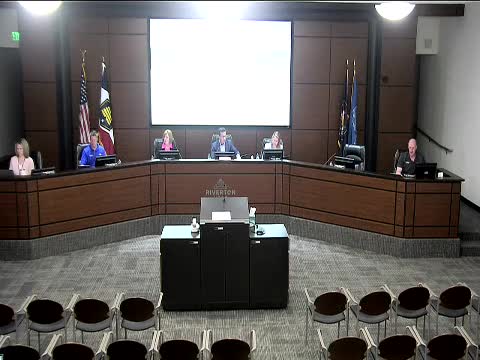
The Riverton City Council continued consideration of a development agreement filed by DAI that would rezone a platted, undeveloped subdivision off 4000 West and 126 South for a storage facility with accessory outdoor vehicle storage. Council member McDougall moved to continue the item so staff and the developer could clarify language on responsibility for detention infrastructure, what happens when the agreement’s term expires and a few technical exceptions; the motion passed unanimously and the hearing was continued to the May 20 meeting.
Jason, planning staff, said the property was platted as third‑acre residential lots in 2006 but never built. The applicant proposes phased development: Phase 1 would construct single‑story storage buildings along Fortieth West and vehicle storage north of the buildings; Phase 2 would build additional unit buildings. The draft development agreement would rezone the parcels to Commercial Regional (CR) but limit permitted uses on the site to a storage facility with outdoor vehicle storage (the agreement would restrict other CR uses from the site).
Key points in the draft that staff highlighted and that council members asked to clarify: the agreement proposes exceptions to three standard code requirements — removal of a 7‑foot landscape buffer along a segment of the site where mature landscaping already exists on the neighboring church property; a reduced building setback from 40 feet to 36 feet for two buildings; and replacement of a typical pole sign with a low “signage tower” integrated into the building architecture. The draft also limits building heights for storage buildings (single story/16 feet in Phase 1; no storage building to exceed two stories or 32 feet). The development agreement language also incorporated drainage arrangements with an adjacent LDS church property and stated that certain improvements (curb, gutter and sidewalk) along the Fortieth frontage would be required.
Applicant representatives (Joe Salisbury for DAI) said they were willing to work with staff to tighten contract language. Several nearby residents, including Matt Yore, addressed the council and urged caution about traffic impacts on 4000 West and asked what would happen at the end of the agreement’s 15‑year term. Jason and the applicant told the council they could return with clarified language describing whether the use would be grandfathered or what permitted uses would apply on the site after the agreement’s expiration.
Council member McDougall moved to continue (seconded by Council member Broker); the roll‑call vote was recorded in favor by council members present and the item was continued to the May 20 council meeting for finalization of development‑agreement language and related infrastructure clarifications.