Get Full Government Meeting Transcripts, Videos, & Alerts Forever!
Get email alerts on the Judicial Protection topic
No spam. Unsubscribe anytime.
House Judiciary Committee hears bill to shield judges' personal data after attacks
Summary
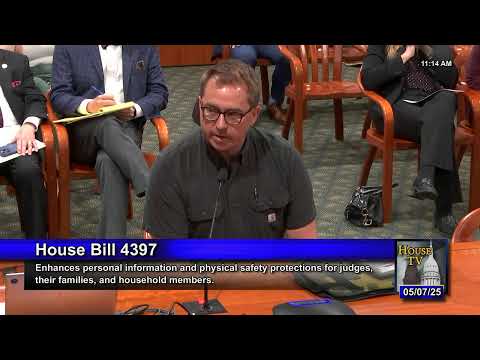
The Michigan House Judiciary Committee heard testimony on House Bill 4397, the Judicial Protection Act, a proposal to let judges request that certain personal identifying information be withheld from public disclosure to reduce threats and targeted harassment.
The Michigan House Judiciary Committee heard testimony on House Bill 4397, the Judicial Protection Act, a proposal to let judges request that certain personal identifying information be withheld from public disclosure to reduce threats and targeted harassment.
U.S. District Judge Esther Salas described the 2020 attack at her home that killed her son and wounded her husband and urged lawmakers to act. "By protecting judges' personally identifiable information and sealing that information, you are going to ensure that your judges in Michigan are safer," Judge Salas told the committee.
The bill's supporters and stakeholders, including Judge David McKeague of the U.S. Court of Appeals for the Sixth Circuit and Nathan Triplett, director of public policy and governmental relations for the State Bar of Michigan, told the committee the legislation mirrors federal protections and fills gaps for state and local judges.
What the bill would do House Bill 4397 would allow judges — state, federal and tribal — to submit a written request on a form prescribed by the state court administrative office to restrict public posting or display of certain personal identifying information. The bill, as presented during the hearing, limits the protected information to items with a demonstrated link to safety and security, for example a permanent residential address, license-plate numbers and information about a judge's children's school or daycare.
If a public body or private person does not comply with a written request within five business days, the judge may file a civil action to compel compliance, according to testimony. The version discussed at the hearing does not create new criminal penalties or civil fines for violations; supporters said the aim is compliance rather than punishment. Nathan Triplett said, "Our goal is to protect judges and their families by ensuring compliance, not to generate fines or unduly burden those that are subject to the act's requirements."
Scope and exceptions Witnesses described negotiated exceptions intended to accommodate Michigan-specific needs. Judge McKeague told the committee the bill would permit publishing or verifying limited information in certain situations — for example, listing a judge's city or township (but not the full address) and a date of birth when required to verify a candidate satisfies the Michigan Constitution's age requirement for judges. The bill also exempts information voluntarily disclosed by a judge and information on matters of public concern, according to testimony.
Why supporters say it is needed Judge Salas recounted the 2020 attack that killed her son and wounded her husband and warned of escalating threats to judges nationwide, including incidents of menacing deliveries and doxxing. "This is a threat that judges are now contending with," she said, describing deliveries of food to judges' homes and to their children's homes as part of a pattern of intimidation.
Judge McKeague said federal legislation that limits access to federal judges' personally identifiable information does not cover most state-held records, and urged Michigan to implement similar protections at the state level. He told the committee the bill is "closely modeled on the Daniel Andruil Act" as referenced in testimony and that more than 30 states have considered or enacted similar laws.
Implementation and cost Testimony said the state court administrative office would administer the request form and could act on judges' behalf. Committee witnesses said funds had already been appropriated in a prior budget cycle for related work and that a vendor had been identified to support implementation. Supporters said the bill would not require deletion of records; rather it would prohibit public posting or display of covered personally identifiable information while keeping records available for legitimate governmental use.
Questions and concerns from lawmakers and the public Committee members asked whether similar protections should extend to prosecutors, police or other public servants. Nathan Triplett said the bill was narrowly focused on the judiciary and that broader programs would require more extensive technical systems and resources. "If the legislature were to want to pursue legislation to broaden that out to other public servants, it inevitably would require a different scale of resources," he said.
A public commenter, Brad Dorland, a precinct delegate, said he did not oppose protections for judges but urged caution in implementation, citing his personal experience in a high-conflict family court case tied to a judge in his county. "I don't disagree. The judges need protection, but I do ask for a word of caution, a moment of pause on the implementation," he said.
What happened in the committee The committee heard testimony from judges, bar association and court officials and read in several written cards of support from organizations including the Michigan Association of Registers of Deeds, the Consumer Data Industry Association, the State Bar of Michigan family law section, the Michigan District Court Judges Association, the Michigan Probate Judges Association, the State Court Administrative Office, the Michigan Judges Association and others. No formal committee vote or final action on House Bill 4397 was taken during the hearing. The committee adopted the April 30 minutes by unanimous voice when Representative Wozniak moved to adopt them and no member objected.
The committee adjourned after testimony and the chair read the list of witness cards received for the record; next steps were not announced during the hearing.
Ending Supporters framed the bill as a targeted measure to protect the independence of the judiciary and reduce judge-targeted intimidation. Opponents and questioners urged caution about implementation details and whether comparable protections are needed for other public servants. The bill will proceed through the legislature according to the committee and chamber rules; no vote on the bill occurred at this hearing.