Get Full Government Meeting Transcripts, Videos, & Alerts Forever!
Get email alerts on the Nurse Practitioner Full Practice topic
No spam. Unsubscribe anytime.
Heated testimony on HB 4399: proponents cite access, opponents warn of safety and cost risks
Summary
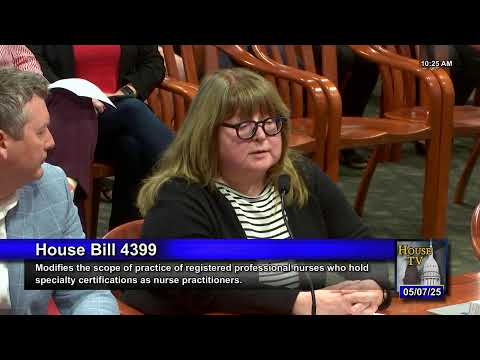
The House Health Policy Committee heard hours of testimony for and against HB 4399, which would give nurse practitioners full practice authority by removing Michigan’s physician collaborative requirement.
The House Health Policy Committee heard hours of testimony both supporting and opposing House Bill 4399, which would remove Michigan’s physician collaborative/supervisory requirements and grant nurse practitioners independent practice authority.
Proponents argued the change would expand access to primary and behavioral health care, especially in underserved and rural areas. Anne Sheehan, assistant dean for faculty practice at Michigan State University College of Nursing, described a nurse‑run family medicine clinic that reduced new‑patient wait times from about 45 days to eight days and said securing physician contracts for nurse practitioners cost her clinic roughly $35,000 a year. She said those contracting costs and administrative burdens make it harder to expand access and lead some nurse practitioners to leave the state.
Lisa Rutledge of Western Wayne Family Health Centers, representing federally qualified health centers, told the committee that a psychiatrist’s departure forced the center to send many patients to community mental health, increasing waits for care. She said the center would hire a psychiatric nurse practitioner if a collaborative agreement requirement did not block hiring.
Frank Waters of the Michigan Primary Care Association said health centers treat underserved patients regardless of insurance and that workforce shortages are the primary driver of access problems the bill aims to address.
Opponents, including the Michigan State Medical Society and the Michigan Osteopathic Association, urged caution. A legal witness and MSMS representatives said the bill “says a lot and does not say a lot” and raised concerns about training, oversight, and patient safety. Dr. Edward Canfield, speaking for the Michigan Osteopathic Association, contrasted physician training pathways with nurse practitioner programs and warned that permitting independent practice without supervision “goes too far,” citing online training prevalence in some NP programs and risks related to prescribing controlled medications.
MSMS witnesses cited studies that, they said, show higher utilization of testing, prescriptions and referrals in some settings without physician supervision and presented comparative cost data for Midwestern states; they argued that full practice authority has been associated in some analyses with higher per‑capita health expenditures.
Committee members asked detailed legal and operational questions. A counsel‑type witness explained statutory distinctions among LLC, PLLC and corporate structures, saying that under current law nurse practitioners generally cannot form professional entities labeled as practices of a learned profession unless the statute is amended; the witness said HB 4399 would remove physician delegation and supervision and thereby change how entity formation and ownership would be interpreted under state corporation and LLC law. Questions also covered malpractice insurance, billing and credentialing, the content and duration of NP education, and whether independent practice would affect prescribing of controlled substances.
Members on both sides described patient stories and local workforce shortages. Representative Morgan (who said her first name is Morgan and asked to be identified as Representative Foreman in one exchange) described a positive personal experience with a nurse practitioner who identified a condition physicians had missed, and Representative Schmaltz pressed opponents on whether fears about opioid prescribing were borne out by the evidence.
No committee vote was taken. Committee leadership ended testimony and said the panel will continue its work on the bill in a future meeting.