Get Full Government Meeting Transcripts, Videos, & Alerts Forever!
Get email alerts on the Forest Management topic
No spam. Unsubscribe anytime.
Timber industry urges state support after ice storm devastates red pine stands
Summary
Representatives of the Michigan Association of Timbermen told a House appropriations subcommittee that a recent ice storm destroyed large red pine stands, creating immediate salvage, seed and replanting needs and posing risks to mills, jobs and related local economies.
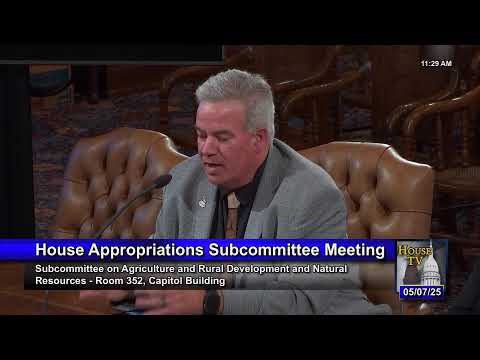
Representatives of the Michigan Association of Timbermen told the Michigan House Appropriations Subcommittee on Agriculture, Rural Development and Natural Resources at a committee hearing that an ice storm damaged large swaths of red pine across northern Michigan and created an urgent need for seed, replanting and market support to salvage timber and sustain mills and jobs.
"We represent over 800 logging and trucking companies throughout the state," said Jim Mader, vice president of the Michigan Association of Timbermen, describing the group’s membership and economic footprint. The association cited Michigan Department of Natural Resources figures that its sector directly employs more than 40,000 people and supports nearly 90,000 jobs statewide, generating about $12 billion annually.
The association’s witnesses — Jim Mader; Vaughn West, president of the Michigan Association of Timbermen; and Joe Doyle, past president — told legislators the storm caused heavy damage to red pine stands that do not regenerate without replanting. "It does not regenerate on its own," Mader said of red pine. The testimony said delays in securing seed and replanting capacity risk removing a generation of red pine from Michigan’s timber supply for decades.
Joe Doyle read from a Michigan Department of Natural Resources (DNR) notice that the agency will reassess timber sales damaged by the storm and issue limited schedule relief: "One free extension will be issued to contractors who choose to continue harvesting a sale that receives storm damage. One free extension will also be issued to contractors who purchase new salvage sales." Doyle told the committee the DNR is trying to "get their arms around" the damage but that access problems and the scale of debris complicate assessments.
The witnesses urged swift action on two fronts: salvage harvesting to recover wood before insect damage and fungal "stain" degrade value, and an accelerated replanting effort. Speakers said red pine plantations typically see a first thinning at about 30 years and that replanting is necessary to preserve species-specific supply chains, including specialty markets such as utility poles and red-pine mass-timber products.
The group described constraints on salvaging and marketing the storm-affected material. Doyle and other witnesses said markets for lower-grade wood — pallet lumber, pulp and industrial wood — could be overwhelmed. "If you have no market for it, you're not gonna go do it," Doyle said, describing how storage and processing costs can make salvage uneconomic.
Testimony also addressed the role of biomass power plants in using residuals from salvage operations and reducing wildfire risk from fuel loads on the forest floor. The witnesses identified existing plants in Cadillac, McBain, Flint/Genesee and Manistee-area facilities and said they would like to see some plants operate at higher capacity (one figure mentioned was 38 megawatts) to increase demand for slash and tops. They said some plants are not operating at full capacity because biomass is, at times, more expensive on the grid than other generation sources.
Association leaders opposed conversion of productive state forestland to solar arrays. "We really do not want to take in any manner productive timberland out of productive timberland to a different use," Vaughn West said, arguing that the state should favor rooftop, brownfield and other nonproductive sites for solar rather than forested public land. Chair Borden said that, following conversations with the DNR, the department agreed to halt proposed solar projects on state forestland and to instruct contractors to seek legislative approval before advancing such projects.
Committee members asked about seed supply, federal and state assistance, and private-land owners' role in salvage and replanting. Witnesses pointed to seed shortages caused in part by earlier declines in state replanting demand, and they urged that replanting be ramped above the DNR’s historical average of roughly 4,000 acres per year to restore capacity (one witness suggested increasing planting to 7,000–8,000 acres annually for several years).
The association asked lawmakers for help in several forms: better coordination with the DNR, potential emergency funding or designation to support seed procurement and replanting, and consideration of an industry development fund to offer low-interest loans or grants to help family-owned, multigenerational operations buy equipment and remain viable.
The committee approved routine minutes and excused absent members by voice consensus; no formal votes on timber-specific funding or programs were recorded at the hearing. Witnesses said next steps include further assessments by the DNR, potential requests for state or federal emergency assistance, and follow-up with the legislature on replanting and market-support measures.