Get Full Government Meeting Transcripts, Videos, & Alerts Forever!
Get email alerts on the Enforcement Peer Review topic
No spam. Unsubscribe anytime.
Board authorizes consent orders and strengthens enforcement focus on out‑of‑state and repeat review violations
Summary
The licensing and enforcement committees approved four candidate score extensions, multiple consent orders tied to contractor licensing referrals and a larger push to revise the discipline matrix and explore recovering investigative/legal costs from respondents.
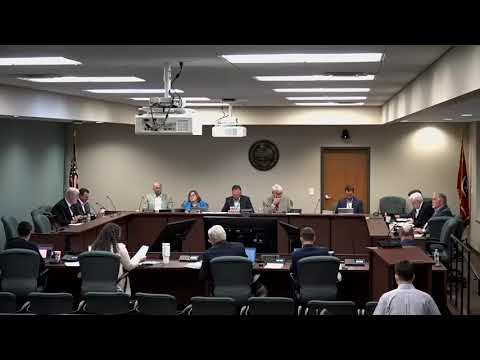
The Tennessee State Board of Accountancy approved a collection of committee recommendations Tuesday that include candidate extensions, consent offers on review/compilation violations, and a directive to staff to revisit the board's discipline matrix and cost allocation practices.
The licensing committee moved to approve four individual requests for score or deadline extensions and the board adopted the committee recommendation by voice vote. The committee narrative and staff materials presented to the board identify the four cases as:
- Gabriel Bren: request to extend REG and AUD scores from an expiration date of 06/30/2025 to 08/31/2025 for documented medical treatment; committee recommended approval. - Michael Montgomery: request to extend REG and BEC from 06/30/2025 to 12/31/2025 after COVID‑era furloughs interrupted his qualifying experience; committee recommended approval. - Samuel Laws: request to extend REG from an expiration of 08/06/2025 to 12/31/2025 due to a heart condition and surgery; committee recommended approval. - Ziriga (foreign transcript evaluation via WES): staff noted the applicant's degrees from Ivory Coast University were evaluated by WES, the applicant meets the 150‑hour threshold, and the committee recommended approval of the application path used previously to approve exam eligibility.
The enforcement committee presented consent items (closures, litigation monitoring placements and one letter of warning) and proposed discipline cases stemming largely from referrals by the Tennessee Contractors Licensing Board for review/compilation reports issued without peer review or a firm permit. The enforcement committee recommended — and the board approved — the staff recommendations for consent‑item closures and monitoring placements by voice vote.
Two matters drew extended discussion and a separate board vote. First, a case originally recommended for a letter of warning (case 5 in the legal report) concerned a review report issued on a Tennessee entity by an out‑of‑state firm. The committee concluded that identical conduct affecting Tennessee‑based clients should be treated consistently regardless of the respondent's residence and recommended a settlement offer via consent order with a $750 civil penalty. The board approved that change in recommendation.
Second, the board authorized formal action in a repeat‑violator case (case 13). The respondent had a previously adjudicated matter in 2024 in which the board accepted a $5,000 civil penalty under a consent agreement; staff told the board the prior penalty remains unpaid and the respondent allegedly issued another review report without a firm permit or peer review. The board approved a settlement approach that would require payment of the outstanding $5,000 penalty, require conditions for any future reinstatement under the board—s rules (including completion of the NASBA three‑part ethics course if the respondent later seeks reinstatement), and directed counsel to notify the attorney general and other appropriate law‑enforcement entities under Tennessee statute 62‑1‑114.
The board also approved the proposed discipline cases numbered 12 and 14–20 (each involving unauthorized review/compilation/audit reports) with civil penalties and standard matrix remedies, as recommended by staff and the committee.
On process and policy, several board members and staff members discussed whether and how to recover investigative and legal costs from respondents. Board members asked legal staff to develop options that would (a) document investigative/legal hours, (b) propose reasonable cost allocations to include with consent orders where appropriate, and (c) consider collection mechanisms consistent with Department of Commerce & Insurance rules. Board counsel noted most boards only impose collection at the hearing stage; staff recommended documenting costs first and returning with a proposal to avoid arbitrary assessments.
Board members also urged continued collaboration with the Contractors Licensing Board and TSCPA to add upstream checks (for example, requiring peer‑review documentation at contractor application) to reduce downstream complaints and enforcement costs. Staff said they are engaged in ongoing discussions with the contractors board on possible application or process changes.
The enforcement and licensing committee recommendations and the specific consent orders described above were approved by the board in voice votes; the record notes committee recommendations were adopted without recorded roll‑call tallies in this session.