Lifetime Citizen Portal Access — AI Briefings, Alerts & Unlimited Follows
Judiciary Committee backs State Bar audit after chaotic February bar exam; applicants describe crashes, proctoring failures
Loading...
Summary
The California Senate Judiciary Committee advanced SB 47 to require an audit of the State Bar’s February 2025 bar exam after multiple applicants described technical failures, repeated proctor interruptions and premature exam submissions; the State Bar acknowledged missteps and said it will pursue remedies, investigations and changes for July.
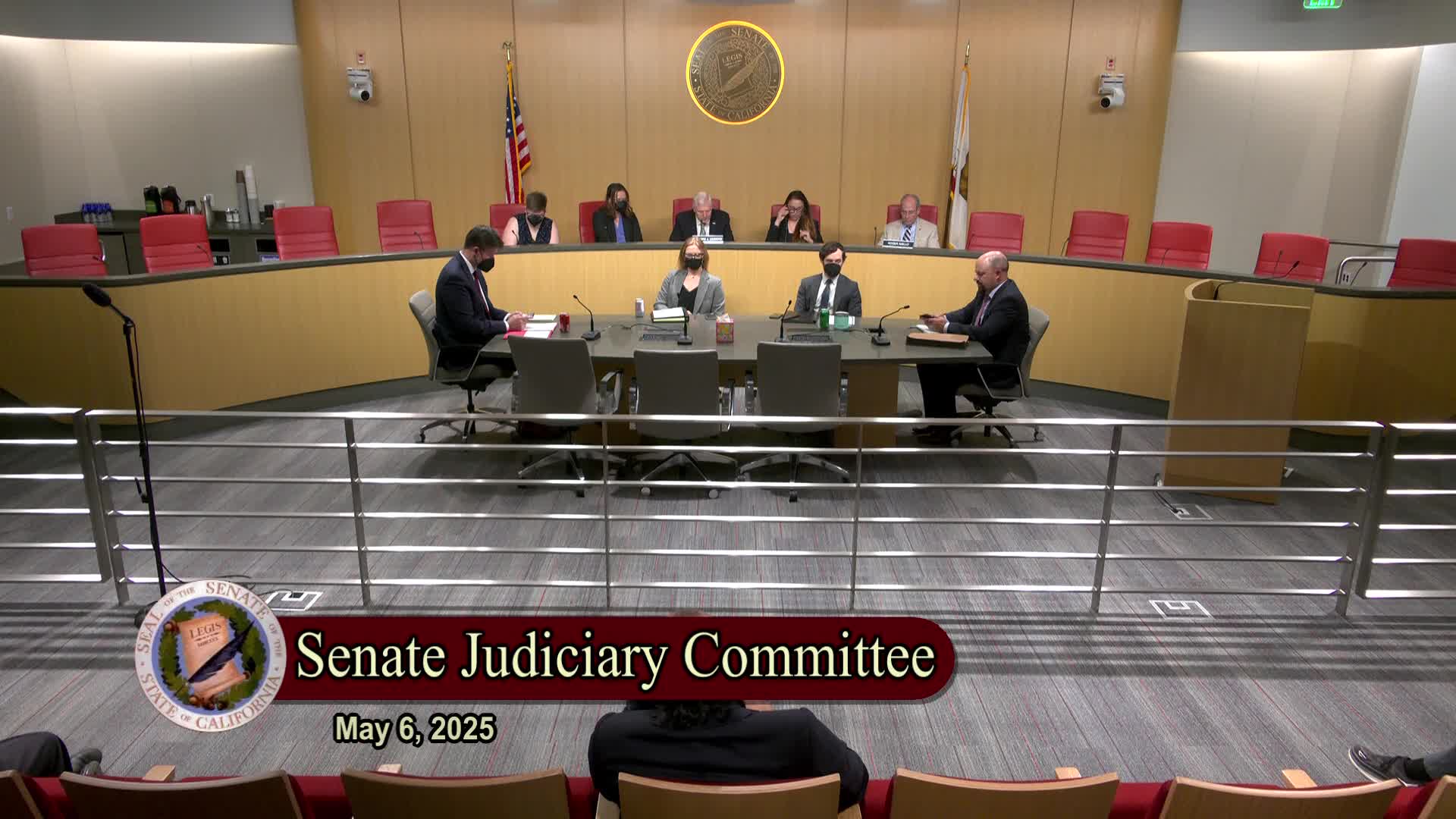
The Senate Judiciary Committee voted to advance SB 47, a bill to require an audit of the State Bar of California’s administration of the February 2025 bar exam, after test takers and legal educators described widespread technical failures, disruptive proctoring and unclear question development.
The bill’s author, Senator Thomas J. Umberg, opened the hearing by telling the panel that SB 47 would “require an audit of the February bar exam by the state auditor” and said the legislature has “an obligation … to protect Californians” by ensuring licensed attorneys are competent.
Four examinees who sat the February exam told the committee they experienced severe disruptions. Andrea Lynch, who identified herself as an exam taker, said proctors repeatedly interrupted her remote session, took control of her mouse without consent and that a software crash cost her roughly 20 minutes of testing time. “As I prepared to begin session 4 … I was met with a message stating, congratulations. Your exam has been submitted to the State Bar of California. My exam had been submitted on my behalf prematurely,” Lynch testified. She said she waited “25 agonizing minutes” and that the incident left her “traumatized.”
Amy Cassini (testifying as Amy Kasuni in the transcript) cited Business and Professions Code section 6046.6 and told the committee the State Bar failed to provide adequate notice to schools after changes to the exam. She described repeated platform crashes, “save pauses” in the essay interface, nonfunctioning cut-and-paste on the performance test and what she called “disastrous” performance-test crashes that left her “completely demoralized.”
Steven Zendejas said he was told his testing mode would change from remote to in‑person with little advance notice, forcing travel and lodging costs. He described repeated disconnects during multiple‑choice sections and said some questions “seemed oddly worded.” He told the committee he attended the State Bar’s public comment session and heard test takers with disabilities describe possible ADA violations related to extra‑time accommodations.
Tanya Sahili testified she had participated in an earlier Measure Learning pilot and warned the State Bar that the platform would not scale to the more than 4,000 February applicants.
Law deans and academics told the committee the failures reflected both content and administration problems. Jessica Willenberg, dean of University of California, Davis School of Law, said the state had not allowed enough time to develop valid, reliable question content or to field‑test a new delivery format. “We need time and we need transparency,” she told the committee, adding that other bar exam providers such as the National Conference of Bar Examiners take years to develop and test new questions. Professor Mary Basic of UCI Law testified about test validity and questioned the process used to draft and vet multiple‑choice questions for the February exam. She told the committee that some question panels excluded subject‑matter experts and that the State Bar had released a content map that, she said, was “embarrassingly bad.”
Representatives of the State Bar acknowledged failures and described near‑term remedies. Brandon Stallings, chair of the State Bar Board of Trustees, apologized to affected applicants and said the bar had reimbursed fees and travel costs, enabled free retakes and retained an independent investigator, former U.S. Attorney Matt Jenkins. Leah Wilson, the State Bar executive director, told the committee the bar would return to in‑person administration and use ExamSoft and the NCBE multiple‑choice product for the July exam.
Alex Chan, chair of the Committee of Bar Examiners, said the committee recommended psychometric scoring adjustments and that the California Supreme Court adopted those recommendations. Chan said the committee’s adjustments were “psychometrically sound, narrowly tailored” and intended to protect the public while responding to “unprecedented and well‑documented technical failures.” The committee also considered non‑scoring remedies; Chan said the Committee of Bar Examiners recommended provisional licenses that would allow supervised legal work and a pathway for some out‑of‑state attorneys to be admitted on motion.
Committee chair Senator Umberg highlighted the unusual deviation in the February pass rate. He told the panel the pass rate for the February administration was 55.9 percent versus a five‑year February average near 32.6 percent; a committee mathematician told the chair that the change was “about six standard deviations from the norm,” a statistical anomaly that demanded scrutiny.
State Bar staff described litigation and contract steps: the bar has initiated a lawsuit against Measure Learning, retained outside counsel, and said it will continue cooperating with an independent review. The State Bar said some questions were drafted or redrafted using a variety of sources and that 29 multiple‑choice questions were created by the bar’s psychometrician when vendor‑provided materials were incomplete; the transcript includes sworn testimony that ChatGPT (or similar AI) was used in drafting some questions and that the bar notified the public and the court after the exam.
Committee action and next steps
After hearing arguments and testimony the committee advanced SB 47. The roll call recorded ayes from multiple members; the clerk announced the file passed with the vote recorded in the hearing. Committee members asked the State Bar for additional data, including what the pass rate would have been without psychometric and November‑pilot adjustments, and for more detail on which multiple‑choice items were AI‑generated and how those items were validated. Senator Umberg asked the State Bar to provide the alternative pass‑rate models the Committee of Bar Examiners considered.
Why it matters
California is one of the largest licensure jurisdictions in the country. The bar exam is the state’s primary gatekeeper for attorney licensure; failures in administration can cause financial, emotional and career harm to applicants and raise questions about public protection and the process used to test professional competence.
What the bill would do
SB 47 would require an audit of the February 2025 bar exam to examine administration, proctoring, psychometrics, vendor procurement and communications with stakeholders. The committee asked for timeliness and transparency and requested the State Bar provide requested statistics and documentation to the panel.
Ending note
Committee members voiced a shared desire to avoid revisiting admissions for those already admitted while seeking remedies for those harmed by the February administration. The State Bar’s combination of reimbursement, free retakes and legal action, plus the committee’s directive for an audit, is intended to address both immediate harms and longer‑term systemic issues.