Get Full Government Meeting Transcripts, Videos, & Alerts Forever!
Get email alerts on the K 3 Literacy Curriculum topic
No spam. Unsubscribe anytime.
Darien curriculum committee recommends Into Reading v3 as K–3 core, retains Heggerty for phonemic awareness
Summary
After a two-year review and a district pilot, the Darien Board of Education curriculum committee recommended adopting HMH's Into Reading version 3 as the district's primary K'3 literacy resource and keeping Heggerty as a supplemental phonemic-awareness routine; the recommendation will go to the full board for vote.
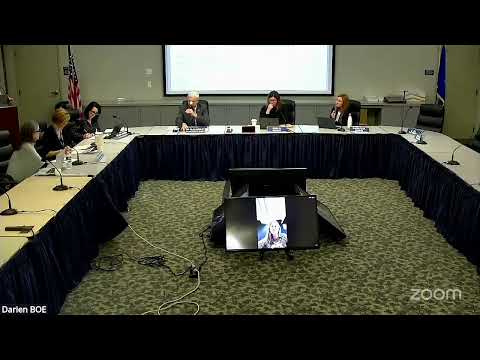
Darien, Conn. ' The Darien Board of Education curriculum committee on May 7 recommended that the district adopt HMH's Into Reading (version 3) as its primary K'3 literacy resource and continue using Heggerty as an additional, short phonemic-awareness routine. The committee asked that the full board consider the recommendation at its next meeting.
The recommendation follows a multiyear review that included a district steering committee, a smaller core review team and a pilot of Into Reading across 10 classroom teams in all five elementary schools. Committee members said the review spanned about two years and combined surveys, focus groups, classroom observations, student data and a one-district site visit to inform their analysis.
Committee leaders told the panel that Into Reading v3 offers an integrated teacher's manual, updated presentation platform, module-aligned decodable texts for K—2 and class sets for small-group work. The subgroup that made the recommendation said it used a consensus protocol: seven members agreed, four agreed with reservations and one stood aside. The reservations related to student engagement, differentiation, implementation fidelity, the timeline and the time required for professional learning.
The committee framed the recommendation as adopting Into Reading as the district's primary core Tier 1 resource while retaining Heggerty for a brief, daily phonemic-awareness routine. The committee also recommended that district staff develop a comprehensive literacy curriculum framework and a robust, ongoing professional-learning plan to support consistent instruction across schools.
Implementation steps described to the committee include: providing K—2 teachers with access to the digital platform and teacher guide, developing a model module 1 curriculum guide over the summer, using PLCs and district professional days for training, and a full rollout to all K—2 classrooms in the fall. Staff said pilot teachers will support summer and August professional learning and that some colleagues will open classrooms for instructional rounds and embedded coaching.
Committee members described a 120-minute weekly literacy block with recommended time allocations (examples provided by presenters): phonemic awareness (about 10—2 minutes), Into Reading phonics routines (around 11 minutes), a short Heggerty routine (5— minutes), handwriting and high-frequency-word work, and combined reading-comprehension and vocabulary time. Writing blocks of about 45 minutes in K—2 were also described, with explicit grammar instruction and scaffolded independent writing time.
On assessment, staff said the district will continue required universal screeners such as AIMSweb and that the summer review team will recommend which existing measures to keep or replace. Presenters described using decodable running records for students below Fountas & Pinnell (F&P) Level F and retaining F&P-level assessments for Level F and above, while noting Into Reading includes updated module assessments.
Special education staff and pilot teachers told the committee they see Into Reading's multisensory routines, scaffolds and graphic organizers as helpful for aligning specialized instruction with general education lessons and for preteaching skills in small groups.
The committee noted budgetary readiness but did not specify a purchase amount in the meeting record. Staff said they expected to receive at least the first teacher manual before the end of the school year and that district purchases will include a decodable text library aligned to Into Reading.
No formal board vote occurred at the committee meeting. Instead, staff will forward the recommendation and supporting materials to the full Board of Education. Board members asked that teacher materials and the teacher's manual be made available for review; staff agreed to provide access to current version materials and samples of decodable texts. Committee and staff members said they will bring a fuller implementation and professional-learning plan to the board for consideration.
Next steps: the curriculum committee asked members to be prepared to discuss and vote on the recommendation at the full-board meeting scheduled by the district; staff will supply the board with teacher-guide/material access and a summer timeline for curriculum guide development.