Get Full Government Meeting Transcripts, Videos, & Alerts Forever!
Get email alerts on the Transportation Policy topic
No spam. Unsubscribe anytime.
Albemarle County planning commission reviews transportation chapter, staff proposes separate multimodal plan
Summary
At a May 6 work session the Albemarle County Planning Commission heard staff present the transportation chapter of AC44 and discussed priorities for development and rural areas, safety, microtransit, funding, and next steps; staff recommended a separate multimodal transportation plan and will return with implementation details in coming weeks.
ALBEMARLE COUNTY, Va. — At a May 6 special work session, the Albemarle County Planning Commission reviewed the transportation chapter of the countycomprehensive plan update (AC44). Planning staff presented a chapter overview and community feedback, then commissioners debated priorities for the countydevelopment areas and the rural area, safety needs, and how to fund and implement projects.
Tanya Swartzendruber, planning manager in the countyCommunity Development Department, joined by Kevin McDermott, led the presentation. McDermott said staffrecommend returning with a detailed multimodal transportation plan separate from the comprehensive plan: "Our recommendation is to come back and work on that detail in a separate plan," he said, outlining elements such a plan would include: long-term prioritization, delineated modal-emphasis networks for transit, pedestrian and bicycle routes, typical roadway cross sections developed with VDOT, and a project prioritization system.
Why it matters: staff and commissioners repeatedly cited projected growth and limited roadway capacity as core reasons the county must prioritize. Commissioners noted the plan is intended to help the county accommodate projected population growth in activity centers and to guide where limited funds and county or developer resources should be spent.
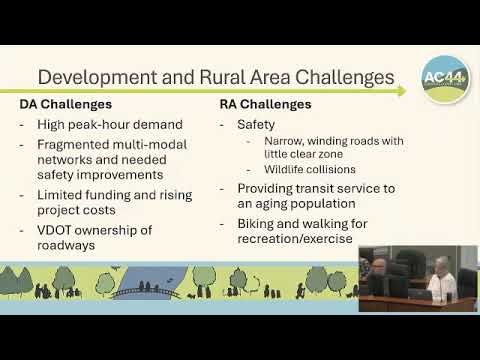
What staff told commissioners - Development area: staff said the development-area goal is to increase "safe, comfortable and accessible multimodal options for all users," focusing investments where density will support walking, biking and transit use. Staff noted fragmented pedestrian and bicycle networks, high peak-hour traffic, rising project costs driven by right-of-way and utility relocations, and VDOT-owned roads that reduce flexibility. - Rural area: staff described narrow, winding roads with limited clear zones and higher rates of severe crashes. Priorities listed include safety improvements (widened shoulders and signage), incremental low-cost improvements, better paratransit and commuter connections to development-area services (examples cited: Afton Express and existing commuter routes), and protecting rural character. - Community input summarized by staff included requests for separated sidewalks/bike facilities in development areas, more frequent reliable transit and microtransit in denser places, reduced parking requirements, and small-scale rural safety improvements such as shoulder widening and off-street trail connections.
Key discussion points among commissioners - Flooding and resilience: several commissioners asked whether road flooding and culvert capacity were addressed. Staff and commissioners agreed that flood resilience and culvert sizing are safety issues that should be more explicitly integrated with rural safety actions and coordinated with VDOT. - Rural paving and growth: commissioners debated wording that appeared to discourage new roads or paving in the rural area. Several members warned that paving gravel roads can accelerate development and fragment unbroken forest and agricultural lands. Commissioners urged rewording to avoid an absolute ban on roads while preserving rural character and protecting core habitats. - Small, quick projects: commissioners repeatedly favored pursuing "low-plan/no-plan" improvements (field-constructed, small fixes such as short sidewalk ramps or extending turn lanes) where practical to provide rapid safety and operational benefits without multi-year engineering efforts. - Microtransit and transit access: commissioners discussed MicroCAT/microtransit-style services and on-demand models (including examples from UVA) as potentially more cost-effective than fixed routes in less-dense areas. Several commissioners also asked staff to consider better transit connections to Charlottesville Amtrak and to the regional airport as part of the regional/inner-city transportation objective. - Funding and implementation: commissioners and staff discussed limited state and federal funding and the need to pursue multiple approaches, including developer contributions, partnerships (P3s), revenue-sharing, local funding, and being prepared to respond when grant opportunities arise (SmartScale and other programs were discussed). Commissioners urged staff to include prioritized, actionable projects and measurable outcomes in the implementation plan.
Direction to staff and next steps Staff said the transportation chapter will remain a high-level policy chapter in AC44 but urged creating a separate multimodal transportation plan to provide the technical detail needed for implementation and prioritization. Commissioners requested clearer, less-vague action language where possible, and recommended: (1) identifying priority projects and measurable outcomes; (2) clarifying how the multimodal plan will coordinate with land use, zoning and the countys activity-center strategy; and (3) strengthening cross-jurisdiction and city-county coordination (including MPO, TJPDC/DRPT, and CAT/UVA coordination) for regional transit issues.
No formal votes or policy adoptions were taken on the transportation chapter during the session; the session was a work session for comment and direction. Staff said they would take the commissions feedback, revise wording where requested and return with implementation materials and more detailed multimodal planning work in the coming weeks (staff referenced a June timeframe and noted the county planned to present to the Board of Supervisors about transportation on May 28).
Quotes - "Our recommendation is to come back and work on that detail in a separate plan," Kevin McDermott, staff member, said when describing the proposed multimodal transportation plan. - "I don't wanna talk about multimodal. I want to talk about how we're gonna move these people more efficiently," said Commissioner Bivens, voicing concern that multimodal goals must be linked to realistic strategies for moving a majority of commuters now using single-occupancy vehicles.
Clarifying details extracted from discussion - Staff cited a county growth-management objective and referenced AC44 (the comprehensive plan update) as the policy context for the transportation chapter. - Staff said the county could accommodate roughly 30,000 additional people in future growth scenarios and that current commuting mode shares discussed included roughly 66% single-occupancy vehicle travel and about 20% working from home (figures cited from the presentation slides). - Staff and commissioners identified May 28 as a date when staff would brief the Board of Supervisors on transportation; staff said they planned to return with more detailed implementation content in a June timeframe. - Small implementation tools discussed included: "low-plan/no-plan" quick-build projects, shoulder widening and culvert upgrades, signage, designated park-and-ride/multiuse lots in rural areas, a potential greenways/parks fund as an alternate to building facilities ad hoc, and incentives or developer contributions to support EV charging, transit stops or multimodal connections.
Community and geographic relevance Commissioners referenced Crozet, North of the Rivanna, Batesville, Fox Mountain, Miller School Road, Patterson Mill, Route 29, Route 250 and Ivy as examples where rural or development-area interventions differ. Impacted groups discussed included rural residents, commuters, paratransit users, cyclists, pedestrians and elderly residents.
What staff will do next Staff said it would revise language per the commissions feedback (including clarifying rural-paving wording and tightening vague verbs such as "investigate" or "explore" where commissioners requested actionable language), develop the separate multimodal transportation plan with prioritized projects and measurable metrics, and return to commission and the Board with more implementation detail.