Get Full Government Meeting Transcripts, Videos, & Alerts Forever!
Get email alerts on the Economic Development topic
No spam. Unsubscribe anytime.
Goose Creek ISD board OKs conditional support for NRG Cedar Bayou 5 tax-incentive application
Summary
After a public hearing, the Goose Creek ISD Board of Trustees approved a declaration of conditional intent supporting NRG Cedar Bayou 5 LLC’s application for a state tax-incentive program that would cover parts of a new combined-cycle natural‑gas power plant planned for Chambers County.
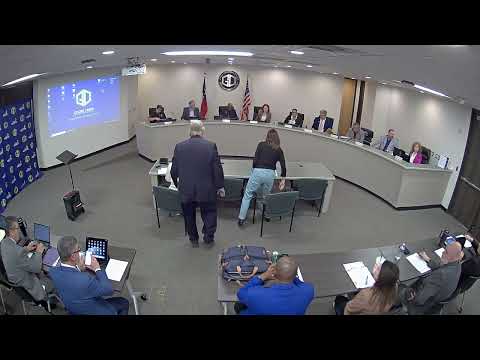
The Goose Creek CISD Board of Trustees on Tuesday approved a declaration of conditional intent supporting an application by NRG Cedar Bayou 5 LLC for a state tax-incentive program tied to a planned expansion of the NRG Cedar Bayou power complex.
The board’s vote followed a public hearing on the company’s Comptroller application (J0012) and a presentation from consultants and local economic‑development partners. The board approved the item by voice vote after administration recommended consideration earlier in the meeting; the motion to add the item and approve it was moved by Ms. Scott and seconded by Mr. Renteria.
The project presented to the board is an additional 721‑megawatt electric generation unit to be built at the existing NRG site near the Baytown Industrial Park in Chambers County. Consultants said the project would be a single‑shaft combined‑cycle natural‑gas configuration with one combustion turbine, an estimated capital cost of about $825 million and a target commercial operation date in 2029.
Why it matters: the company is seeking a state tax‑incentive agreement through the Jobs, Energy, Technology and Innovation (JETI/JEDI) program. Under that program — created at the end of the Chapter 313 era, the presenters said — a qualifying project can receive an incentive that can affect local maintenance & operations (M&O) tax revenue but is designed to be offset by the project’s contribution to the tax base over time.
According to consultants, the comptroller has already found the application eligible and that a 20‑year revenue analysis indicates the project should generate state or local tax revenue sufficient to offset the school district’s loss of M&O revenue. Presenters said the project was selected through a competitive site‑selection process and is not located in a federal qualified opportunity zone.
What presenters told the board: consultant Kevin O’Hanlon said the required investment threshold for Chambers County (a county under 99,999 population) is a $20 million minimum, and that the NRG project’s size and investment exceed that. He also told trustees the state’s template and statutory rules narrowly constrain negotiable terms: “most of this is constrained by statute, not even the Governor’s office,” he said, and called the program’s financial structure less generous than the Chapter 313 deals the district saw in prior decades.
District staff clarified tax treatment during construction: while interest & sinking (I&S) taxes would be fully taxable during construction, M&O taxes would not be assessed during the construction period, a change consultants noted compared with the old Chapter 313 structure.
Next steps: consultants said, if the board indicates agreement, the Governor’s Office would prepare a draft agreement that would be negotiated among the company, the district and the state; if the governor approves and the district and governor execute an agreement, it must be submitted to the comptroller within seven days of execution. The board’s declaration Tuesday expressed conditional support for entering that process.
Board action: the board moved to add the NRG item for consideration and to approve the declaration of conditional intent; the motion was moved by Ms. Scott and seconded by Mr. Renteria and carried on a voice vote.
Who spoke: presenters included Kevin O’Hanlon (consultant, O’Hanlon & Associates) and Kathy Mathias (Oak & Casey); board members and district leaders asked questions about tax treatment, timelines, and whether the project met statutory thresholds.
What the district will see: presenters said the project would add M&O revenue on roughly half the value (the presenters used a 50% illustrative figure to show the project will put some value on tax rolls but not as much as prior chapter‑313 pilots), and they emphasized job creation and an increased bond capacity that accrues from I&S revenue. Final incentives and terms will be defined in the agreement drafted by the Governor’s Office if both the governor and the district move to execute the contract.