Get Full Government Meeting Transcripts, Videos, & Alerts Forever!
Get email alerts on the Zoning topic
No spam. Unsubscribe anytime.
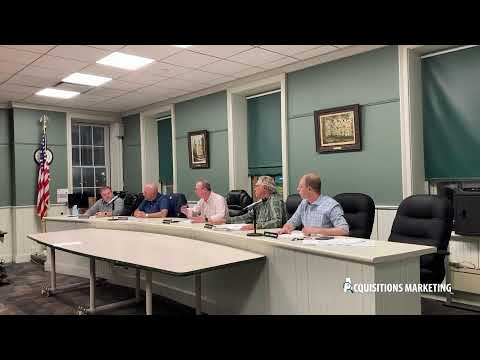
Goshen zoning board hears neighbor dispute over outdoor storage, farm exemptions at 39 Everett Road
Summary
The Goshen Zoning Board heard extended testimony over outdoor storage and farm exemptions at 35 and 39 Everett Road during a public hearing brought by the owners of 35 Everett.
The Goshen Zoning Board heard extended testimony over outdoor storage and farm exemptions at 35 and 39 Everett Road during a public hearing brought by the owners of 35 Everett. Attorneys for the 35 Everett owners asked the board to allow the town’s code enforcement officer to determine whether vehicles and outdoor materials on 39 Everett violate local zoning rules requiring screening and setbacks for commercial vehicles.
The request, made by attorney Matt Behrens on behalf of Carrie Bu and Sean Bu of 35 Everett, focused on enforcement of two zoning provisions: section 97-59(b)(1), which requires screening of outdoor storage from neighboring properties, and section 97-59(b)(4), which prohibits parking commercial vehicles where visible from adjoining properties unless those vehicles are demonstrably used in legitimate farming operations. Behrens said the vehicles and other materials along the immediate property line were placed deliberately to harass his clients. "This is a clear zoning code violation," Behrens said, asking the board to confirm that the code enforcement officer may investigate and issue violations.
The Bu homeowners described ongoing, personal impacts. "I no longer access our backyard where we put a huge fire pit. We have a koi pond ... we no longer do that," Carrie Bu told the board, describing removed screening plantings, trucks parked near the fence line, and dust and noise that have reduced use of their outdoor space.
The owner of 39 Everett, who identified himself as Tony (surname reported in materials as Laspinara), defended his operations as a working farm and said the trailers and vehicles cited in the complaint are used for breeding, showing and transporting horses. "The trailers are staying," he told board members. He said some trailers are used to move animals to shows across the country and that equipment on the property is not "junk." He also described storing fence panels and other materials for ongoing property maintenance.
Frank Love, the town building inspector and code enforcement official, told the board that the central legal question is the interaction between Chapter 97 of the zoning code and protections for farm operations under state law. Love read from section 97-47(f) and cited Agriculture and Markets Law §305‑a, noting that the zoning code "shall not be administered or interpreted in a manner that unreasonably restricts or regulates farm operations" unless public health or safety is threatened. "I think that's a key piece here," Love said, and cautioned that the code's protection for farm operations makes enforcement a discretionary, fact-specific determination that could be challenged in court.
Board members pressed both sides for more factual detail before deciding whether the code's screening and setback rules can be applied in this case. Questions the board raised included whether the vehicles are demonstrably used in farming, whether agricultural license plates or farm‑equipment designations apply, whether there are other level or appropriate storage areas elsewhere on the roughly 37–38‑acre parcel, and whether the items now at the fence line are active, fallow or permanently stored. One member asked for a mapping or inventory of current items and additional photographs with dates and locations.
Behrens and the Bu homeowners offered several specific claims and clarifications: that portions of screening plantings were removed, that some photographs dated to August 2004 (as provided in the hearing packet), that they have spent about $10,000 planting replacement trees along the property line, and that they spent about $80,000 addressing an electrical issue they said arose from work connected with attachments on the neighbor’s property. Tony disputed the characterization of many items as non‑farm or permanently stored and said some trailers sit there only when loaded or between uses.
Board members noted practical enforcement challenges if violations involve movable items: how compliance would be monitored if vehicles are moved temporarily, and how the town would enforce setbacks if equipment is shifted. Love responded that the code focuses on whether outdoor storage is visible from adjoining properties and whether farming exemptions apply; if the board concludes buffering or set‑back requirements apply, Love said he could pursue violation notices, though he warned of the potential for legal challenge under state farm‑protection law.
After extended discussion, the board closed the hearing without rendering a final interpretation. Members directed both sides to submit additional factual material — including up‑to‑date photos, a mapped inventory of items, and details about the alleged farming operations and vehicle registrations — and said the matter will be put back on the agenda for a subsequent meeting.
Separately, the board postponed action on a separate public hearing for 6 and 8 Gumwood Drive at the applicant’s request and agreed to place that matter on the May 20 agenda. The board also delayed approval of minutes that had been merged incorrectly in the meeting packet and said the minutes will be considered at the next meeting.
The board did not vote to require immediate removal of any equipment at the hearing and made no final finding on whether the items at 39 Everett are protected farm operations or subject to setback and screening requirements. The hearing record will be supplemented with the additional fact‑finding the board requested and revisited at the next meeting.