Get Full Government Meeting Transcripts, Videos, & Alerts Forever!
Get email alerts on the Utility Billing Tax Roll topic
No spam. Unsubscribe anytime.
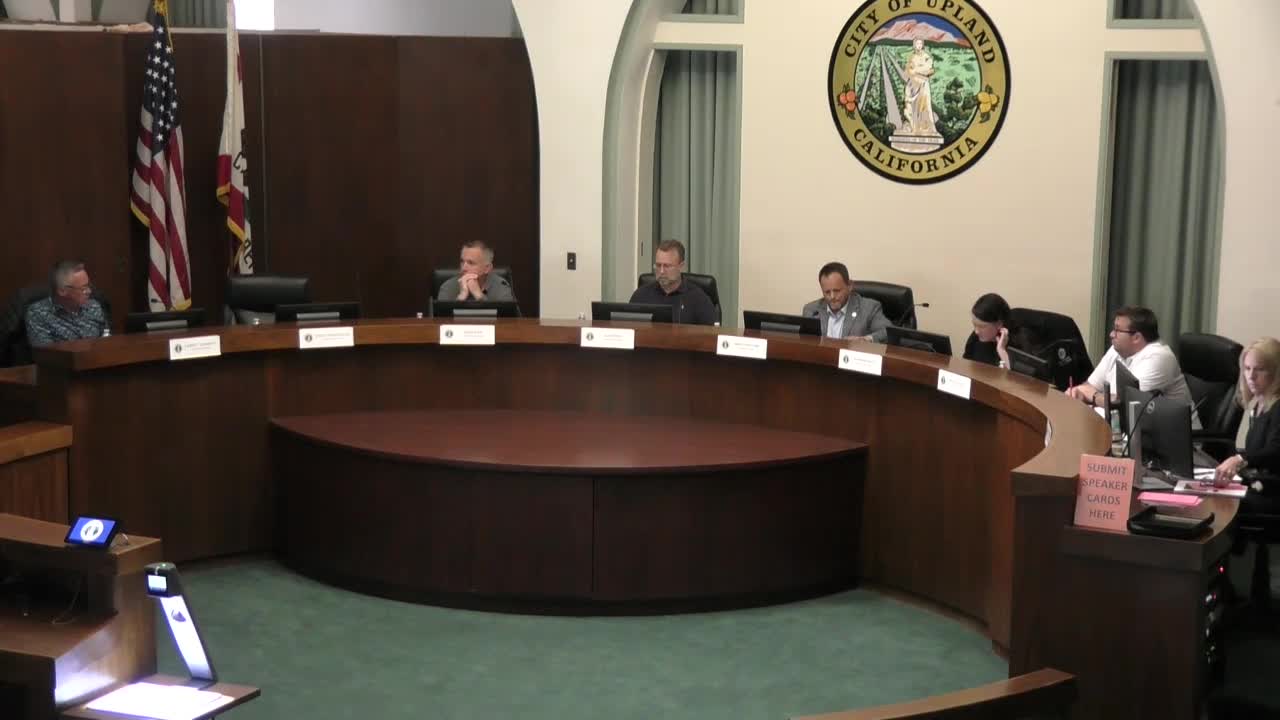
Upland staff propose moving sewer, storm drain and trash charges to county tax roll; committee hears concerns
Summary
Upland staff on May 6 presented a plan to place residential sewer, storm drain and solid-waste charges on the San Bernardino County property tax roll, consolidating current bimonthly utility invoices into two yearly charges and aiming to reduce delinquencies and administrative costs.
Upland staff on May 6 presented a plan to place residential sewer, storm drain and solid-waste charges on the San Bernardino County property tax roll, consolidating current bimonthly utility invoices into two yearly charges and aiming to reduce delinquencies and administrative costs.
The proposal, presented by public works consultant Chris O'Lanese, would keep rate-setting authority with the City of Upland but collect residential utility charges through the county tax bill beginning July 1 if the City Council approves the administrative change. O'Lanese said the shift would reduce the number of mailed bills from 18 per year to two and "most importantly the city of Upland retains full control over rate setting, any future increases, and the policies that govern utility services." He told the Public Works Committee staff recommended passing estimated administrative savings directly to residents.
Committee members and speakers questioned whether the change would meaningfully reduce delinquency and how the timing of county remittances would affect the city and residents. Resident Mark Walters said he opposed the change, asserting "I vehemently oppose this. There's nothing good to come of this." No formal committee vote was taken; staff will report the discussion to the City Council ahead of a scheduled public hearing.
Why this matters: City staff said delinquent utility balances climbed after state restrictions on water shutoffs (Senate Bill 998) limited the city's prior enforcement options. Staff presented delinquency figures of roughly $392,507 in sewer and $530,178 in trash for a combined total near $923,000. Officials argued that placing charges on the tax roll would allow the county's existing collection mechanisms to recover unpaid charges more effectively, reduce write-offs and help stabilize funding for capital projects the city has postponed because of revenue shortfalls.
Proposal details and resident impacts - Timing and appearance on tax bill: Staff proposed placing residential solid waste, sewer and storm drain charges on the county tax roll beginning July 1. Paperwork cutoff dates cited in the presentation include a July 1 deadline for changes and an August 10 submission to the county; charges would then appear on the county tax bill in the normal tax cycle. - Paper and administrative savings: Staff estimated about $225,000 in annual administrative savings from fewer mailed bills and reduced processing; they recommended passing an initial one-time rebate to residents of $14.04 per household (to be mailed in July 2025) and applying remaining savings as a future rate offset. The storm-drain administrative fee was described as 90 cents per month (about $10.80 annually) and would be removed from monthly water bills and shown instead on the tax bill. - Opt-out options: Staff proposed opt-out programs with eligibility screening. Trash opt-outs would be handled by the contractor (BurTec/BurTech Waste) at no additional charge to the resident; sewer opt-outs were discussed as a possible pilot that could carry an administrative fee if participation were too low to cover costs; storm-drain charges were described as not financially viable for standalone billing (estimated $35 per account in standalone billing costs for a $10.80 service) and therefore ineligible for opt-out.
Collection, liens and timing concerns Staff outlined how state law and COVID-era executive orders changed the city’s enforcement toolbox and said those changes contributed to higher delinquencies. The presentation referenced California Senate Bill 998 (water shutoff protections) and earlier executive orders, and described how those rules reduced the city's ability to disconnect service as a collection tool.
Committee members raised several practical concerns: county collection means the city (and its enterprise funds) would receive lump-sum remittances twice a year instead of monthly or bimonthly receipts; residents with impounded mortgage escrow accounts may see no immediate change in monthly cash flow because mortgage servicers commonly pay tax-billed charges from escrow; and homeowners who do not use escrow could face the practical challenge of paying 12 months of utility service in a short tax-payment window. Staff responded that the city maintains a reserve policy to smooth timing differences and that county payment schedules and options (including whether the county allows monthly payments for non-escrowed homeowners) are still being confirmed with the county assessor/tax office.
Equity and practical implementation Committee members asked how changes in service levels (for example, changing trash can size) would be reflected on the tax roll. Staff said service changes entered before the July 1 cutoff and August 10 submission would appear on the subsequent tax roll; changes after the cutoff would appear the next year. Staff also said billing errors would continue to be handled by the city (residents should contact the city, which would advocate with the county on their behalf).
Several committee members urged robust public education about the change and clarity on opt-out rules, deadlines and how escrow accounts will be handled. Staff committed to additional outreach materials and to a single-purpose meeting with county assessor staff to confirm payment options and other operational details before the public hearing.
Next steps and outcome The Public Works Committee conducted extensive discussion and public comment but took no formal recommendation; staff said it would prepare a report for the City Council and provide updated outreach materials and answers to outstanding county questions prior to the council's public hearing on May 12. Implementation details discussed by staff included a proposed July 1 start, an August 10 submission deadline to the county for the tax-roll list, and a one-time resident rebate in July 2025 if the council approves the change.