Get Full Government Meeting Transcripts, Videos, & Alerts Forever!
Get email alerts on the Coastal Management topic
No spam. Unsubscribe anytime.
Council authorizes revised 7‑day offshore sand exploration plan; OCTA pledges additional funding for higher‑probability sites
Summary
Following presentations from city consultants and public comment, the council directed consultants to pursue an alternative 7‑day exploration plan focused on Dana Point, San Mateo and other higher‑probability sites, with flexibility to add days if OCTA funding is finalized.
After an extended technical briefing and public comment, the San Clemente City Council instructed consultants and staff May 6 to proceed with an alternative seven‑day offshore sand exploration plan that prioritizes higher‑probability sites offshore of Dana Point and San Mateo and then works down the coast toward Camp Pendleton and Las Pulgas.
Greg Herron of Coastal Frontiers and other consultants presented two approaches: (1) a “close‑in” screening that tests numerous near‑shore locations and (2) an alternative that eliminates several low‑probability, close‑shore cells and devotes more coring time to sites with higher historical probability of dredgeable deposits. Herron said the alternative plan keeps Dana Point and San Mateo as initial options, then focuses additional time at San Onofre, Camp Pendleton/Las Pulgas and other sites if early cores show suitable beach‑quality sand.
“Based on the direction that we got from the city to make sure we turn over every stone, we recommended a exploration plan where we kind of do a screening level search at these close‑in sites,” Herron said. He added the revised alternative reduces time on the lowest‑probability cells while increasing the number of cores on medium‑ and higher‑probability sites.
Consultants also confirmed a commitment from the Orange County Transportation Authority (OCTA) to contribute funding for three additional vessel days, contingent on OCTA’s priorities. City staff and consultants said OCTA’s funding would likely be targeted to sites OCTA deems higher probability for producing the volumes needed to meet emergency replenishment permits.
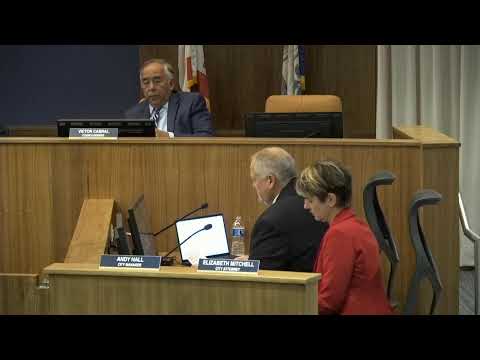
Council discussion focused on balancing the city’s stated interest in finding “close‑in” borrow material against the scientific reality of available deposits. Councilmember Cabral urged the team to follow the data and historical studies to maximize the chance of finding borrowable sand rather than spending days on low‑probability cells close to town. Other members asked consultants for flexibility; consultants advised the vessel and Vibra‑core program can adapt the sequence on the water when field data are available.
The council voted to direct staff and the consultants to proceed with the alternative exploration plan, allow consultants to determine whether to start exploration from the north or south based on logistics, and to accept OCTA’s additional funding and incorporate OCTA direction when confirmed. The motion included a rider that staff should use professional judgment to modify the exploration sequence if OCTA funding arrives with site‑specific direction.
Consultants cautioned that a successful permitable borrow site must meet both sediment grain‑size and dredgeability tests; prior cores in some coastal cells show either unsuitable fine sand or cobble layers that make mechanical dredging infeasible. The field program will collect multiple Vibra‑cores per candidate site (typical target 5–10 cores depending on the site) and then analyze grain size, sediment thickness and contaminants prior to any permitting decisions.
The council recorded a 4–1 vote in favor of proceeding with the alternative plan (one councilmember voted no). The city will work with OCTA and other regional partners on schedule and funding as the field work proceeds.