Get Full Government Meeting Transcripts, Videos, & Alerts Forever!
Get email alerts on the School Funding topic
No spam. Unsubscribe anytime.
Assembly approves supplemental school funding after finance debate; district warns of possible June cash shortfall
Summary
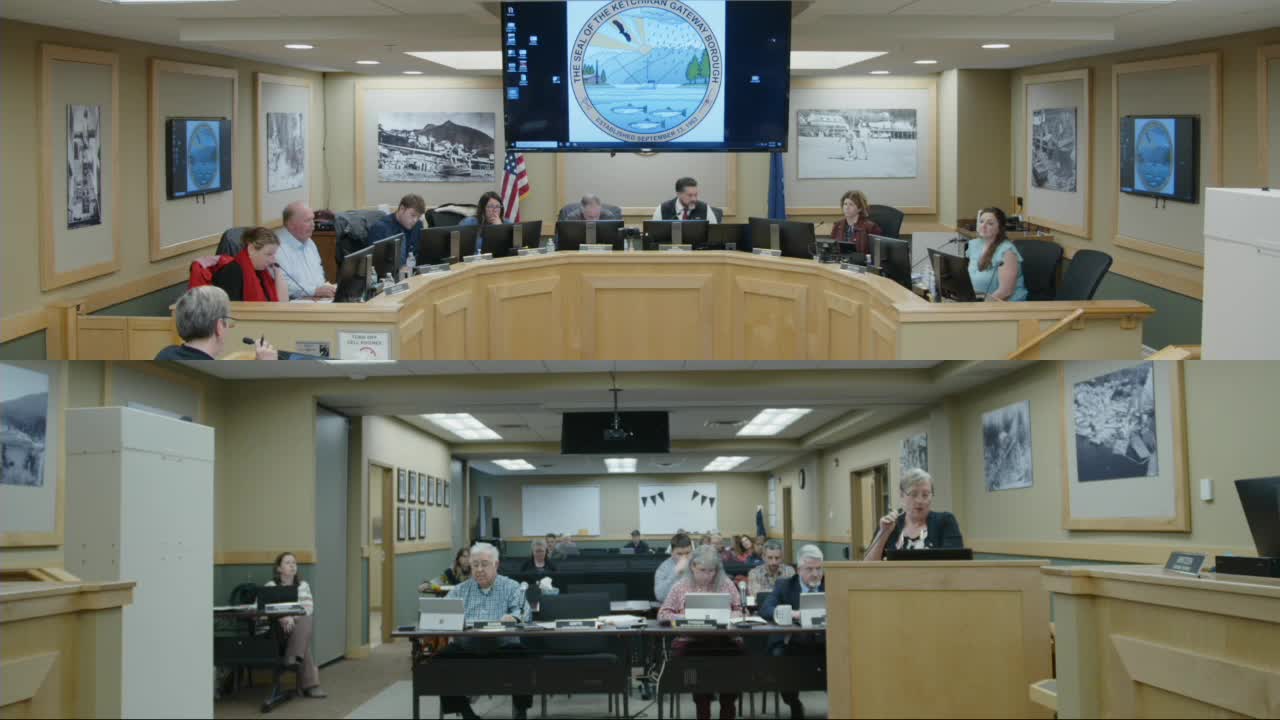
The Ketchikan Gateway Borough Assembly on May 5 approved a supplemental FY25 local education payment and set the FY26 local funding determination for further hearings after lengthy questioning about the school district's cash flow and recurring deficits.
The Ketchikan Gateway Borough Assembly on May 5 approved a supplemental FY25 local education payment and moved a FY26 local funding determination forward for additional hearings after prolonged questioning about the school district's cash flow and recurring deficits.
The Assembly voted 5-1 to adopt ordinance 20-65 to increase the FY25 local contribution by $939,156, paid partially in cash ($453,405) and partially as an in-kind payment to district health insurance (not to exceed $485,751). The vote followed extended questioning of the school district's business manager and borough staff about projected shortfalls and the timing of state entitlement payments.
The action comes after the district provided a cash-flow analysis showing a potential shortfall around mid-June if timing of state payments does not shift earlier. District business staff told the Assembly the projection assumed existing expenses, anticipated entitlements and recent changes in special-education counts; they said moving June entitlement payments earlier could avoid a short cash gap.
Assistant Borough Manager Cynna Smith told the Assembly staff would use "not to exceed" language on the in-kind insurance payment so the borough would not exceed its legally allowable cap if final enrollment or state numbers change. Smith also said borough staff is preparing ordinances to remove certain tax exemptions (transient-occupancy tax exemption and sales-tax exemption on shore-excursion commissions) to help support future LEF revenue, with drafts expected this summer.
District business staff explained components of the cash-flow risk: timing of June entitlement and transportation payments, reimbursement-based grants whose receipts lag expenditures, and unusually high health-insurance claims this year. At one point the business manager said the district could be as much as about $1.2 million short on or about June 18 if entitlement timing does not change; staff and assembly members discussed that shifting the state payment schedule a few days would largely eliminate the temporary negative balance.
Assembly members pressed for clarity on whether the supplemental request would eliminate the mid-June shortfall. The business manager said the recommended $453,405 in cash plus the in-kind insurance payment were included in the district's cash-flow analysis the board considered and that, even with those measures, timing of state funds could leave a brief deficit unless the state moved up payments.
Public comment included two lengthy statements raising concerns about the district's multi-year deficits and budget practices. Resident Nicole Lynn asked the borough to return the school budget if it relied on future revenues, citing a 2020 Alaska Supreme Court opinion cited in her remarks; she urged the borough to require a balanced budget that does not rely on revenues from future fiscal years. Another commenter, Nicole Ann (reading for an absent speaker), criticized district management decisions and urged borough oversight.
The Assembly also introduced ordinance 20-66, the FY26 local funding determination, and passed an amendment sending a substitute ordinance to an additional public hearing on May 19; the amended motion set a preliminary local contribution at a conservative level tied to an assumed Base Student Allocation (BSA) so the Assembly could retain flexibility until final state numbers are set. The motion to adopt 20-66 as amended passed 5-1.
What the Assembly approved - Ordinance 20-65 (FY25 supplemental): Adopted. Motion by Assemblymember Matson; second by Assemblymember Otis. Vote 5-1 (Matson yes, Palmer yes, Thompson aye, Otis yes, Bailey yes, Arntzen no). The motion specified $453,405 in cash and an in-kind insurance payment not to exceed $485,751, bringing the borough's FY25 local contribution to the maximum allowable cap as calculated at the time of the vote. - Ordinance 20-66 (FY26 local funding): Introduced and amended to a substitute; the Assembly set public hearings for May 19 and June 2 and approved the substitute motion 5-1 (final roll call on the motion as amended: Matson yes, Palmer yes, Otis yes, Arntzen yes, Bailey yes, Thompson no).
Assemblymembers repeatedly said they want clearer, audited figures and more precise cash-flow projections from the district before committing further local funds. Several members noted the Assembly's statutory timeline: the district must submit a budget by May 1 and the borough must determine local funding within 30 days, which influences the Assembly's calendar.
Why it matters The borough is the school district's primary local funding source; decisions about supplemental payments and the FY26 local contribution affect the district's ability to meet payroll and pay vendors when state and federal reimbursements are delayed. The debate highlighted recurring themes: multi-year deficits in the district audit, large swings in health-insurance costs, the timing of state entitlement payments, and the borough's limited authority to provide emergency cash without a formal request from the school board.
What the district said it would do next The district said it had requested the state to move some entitlement payments earlier in May; borough and district staff said they would continue to explore reimbursement timing and grant-receipt schedules and would bring additional clarifications to the Assembly if the situation changed.
Speakers quoted (selected) "It seems to have a plan in place, but in the event that that assistance were requested, we cannot just automatically act," Assistant Borough Manager Cynna Smith said, describing the borough's limits on unrequested cash assistance.
"That $1.2 million, as of June 18, is based upon reflecting payments coming in from the state on the twentieth," the district business manager told the Assembly when describing the June shortfall scenario.
Ending The Assembly approved the FY25 supplemental and held the FY26 local funding question open for additional hearings and review. The borough's actions buy time to resolve entitlement timing, but Assembly members signaled they expect clearer, reconciled figures from the district before authorizing further local contributions.