Get Full Government Meeting Transcripts, Videos, & Alerts Forever!
Get email alerts on the Sewer Rates topic
No spam. Unsubscribe anytime.
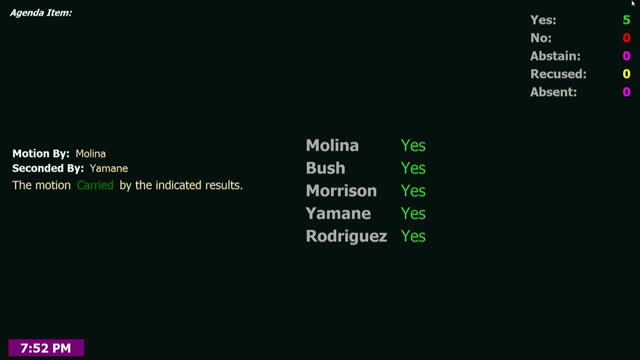
Council introduces multi-year sewer rate ordinance after public hearing; 4–1 vote
Summary
After a public hearing and technical presentation, council introduced a five-year sewer-service‑charge ordinance and accepted protests; the motion to introduce passed 4–1 (Rodriguez opposed). Staff said six written protests had been received, fewer than a majority of parcels.
The National City Council held a public hearing and introduced an ordinance setting sewer service charges for fiscal years 2025–2030, following a rate study and a consultant presentation on May 6. Assistant Director Martha Juarez and consultant Carmen Kasner (Artura Group) explained the study’s methodology: estimate revenue requirements, allocate costs among customer classes using Sweetwater Authority water-delivery data as a proxy for sewer flows, and design rates that balance capital needs, Metro (regional treatment) pass-through costs and reserve usage. The introduction was approved on a 4–1 vote, with Councilmember Rodriguez dissenting.
Staff and the consultant said the city uses a hybrid approach common in the region: a flat monthly charge for residential customers (single-family, multifamily, mobile home parks) with water-use-derived prorations to reflect relative flow, and flow/strength-based billing for many commercial users. The consultant said single-family customers average about 155 gallons per day; multifamily averages about 80% of single-family use and mobile-home parks about 60%, and those proportions factor into the proposed rates. Staff also said reserves were being used to smooth rate impacts while capital needs for the collection system increase.
Public speakers raised technical and equity questions. Several residents and technical commenters urged the council to consider an alternative allocation based on bedroom or unit size rather than the flat residential categories. Others asked whether accessory dwelling units (ADUs) should be treated differently; Danielle Kish, an ADU owner, said the proposal would charge some homeowners substantially more for small ADUs and could push more units to remain unpermitted. The city clerk reported six timely written protests (five mailed and one submitted during the meeting), “manifestly less than half” of parcels served, so no majority protest blocked the ordinance introduction.
Council discussion noted trade-offs among methodologies: flow-based billing can be more equitable but requires more data and administrative cost; a flat-rate system is administratively simpler. Council directed staff and the consultant to provide additional information before adoption, including responses to technical questions and possible follow-up studies focusing on ADUs. The item will return for a second reading and adoption; staff said the ordinance—if adopted after the second reading—would take effect 30 days later and appear on the tax roll in June.