Get Full Government Meeting Transcripts, Videos, & Alerts Forever!
Get email alerts on the School Finance topic
No spam. Unsubscribe anytime.
Assembly debate sets a floor for school funding as mayor's proposed FY26 budget is presented
Summary
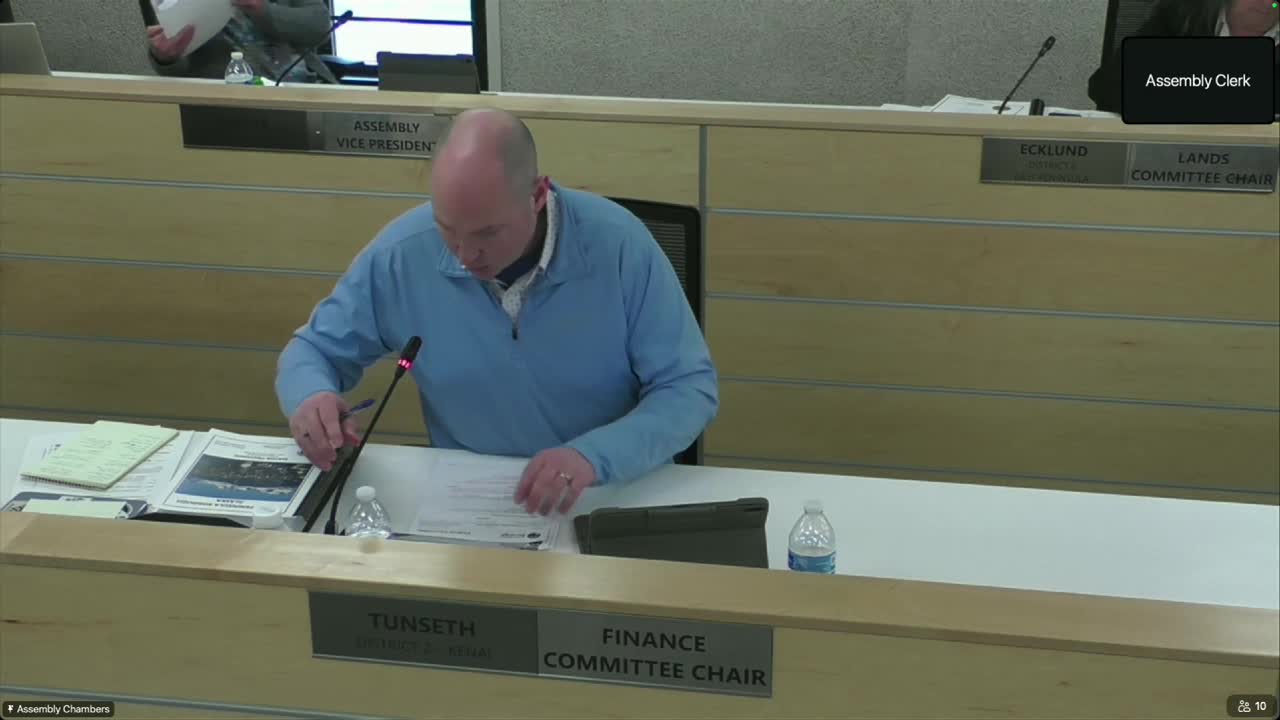
The Kenai Peninsula Borough Finance Committee on Wednesday heard the mayor's FY26 budget and debated a resolution that sets the minimum local contribution to the Kenai Peninsula Borough School District; no final committee vote was taken.
The Kenai Peninsula Borough Finance Committee on Wednesday heard the mayor's proposed fiscal year 2026 budget and considered Resolution 2025-021, which sets the minimum local contribution the borough will provide toward the Kenai Peninsula Borough School District's (KPBSD) preliminary budget.
Brandy Harbaugh, the borough's finance director, told the committee the school district submitted a proposed total budget of $157,041,526 and that the resolution before the assembly would set the statutory floor — the minimum local amount the borough must make available — at $57,634,015. "This is an annual resolution that we as the borough bring forward, per statute," Harbaugh said, adding the district has until May 1 to request funding and the borough then has 30 days to respond.
Why it matters: education consumes the bulk of the borough general fund and rising assessed values are rapidly increasing the local share of school funding. Harbaugh showed that assessed values have risen significantly in recent years and said the borough currently provides near-cap funding compared with similar Alaska boroughs; she warned that continuing to fund to the legal cap would push local taxpayers' obligations higher and could require mill-rate increases over time.
During committee discussion, Assemblymember Johnson proposed an amendment to "set the floor at the cap," arguing the timing of current state budget negotiations in Juneau makes it strategically useful to show the full local gap now. "That puts pressure on them then to raise the BSA," Johnson said, referring to the state's Base Student Allocation used to calculate state aid. Johnson said the borough has fund balance capacity this year to provide the higher local amount and framed the move as supporting teachers and families.
Several other members urged caution. Assemblymember Cooper said she supported education but called the request large and said she had just received the district's materials that day and wanted time to review them before committing to a higher floor. "I think it's irresponsible for me to make this decision today," Cooper said. Assemblymember Morton asked procedural questions about the floor/cap timeline and whether changes could be made later; Harbaugh confirmed the floor would allow the assembly to increase funding later during the May 20 and June 3 hearings but not fall below the floor set by the resolution.
Mayor Michicky urged the assembly not to tie the borough's hands by automatically funding to the cap during an active state negotiation. "Representative Ruffridge does not support us funding to the gap at this time," the mayor said, describing a negotiating strategy of leaving room for state action. He and other members said the process allows the assembly to revisit the number later and urged letting Juneau negotiations proceed.
Several assembly members and Harbaugh outlined the local budget arithmetic: assessed values are projected to rise (Harbaugh cited an assumed 4.33% increase used in the proposed FY26 budget), the borough proposes to reduce the mill rate from the prior year to keep general fund revenue growth modest (Harbaugh said general fund revenues are projected to rise about 2.7%), and education receives nearly all sales tax and a large share of property tax revenue. Harbaugh showed scenarios that, under current assumptions, funding to the cap each year would exhaust the borough's targeted fund balance within a few years and would require incremental mill-rate increases (she presented a model showing a hypothetical move from a 3.85 mill rate to about 5.1 mills by 2034 if the borough funded to the cap under the stated assumptions).
No final committee vote was recorded. The committee received the presentation and debated two amendments: Johnson's proposal to set the floor at the cap and a separate clarifying amendment from Assemblymembers Cooper and Morton asking that the record explicitly show the body was setting a floor (not the final total). Harbaugh and others said the assembly could amend funding during the May 20 and June 3 hearings, and that the resolution as discussed today would establish the minimum that could be provided later in the process.
The finance committee also discussed technical points about how the borough's in-kind contributions to schools are counted and how year-end fund balances in specific funds have in the past been made available to the school district as cash. Harbaugh said roughly $1.4 million is currently in the fund she described as "241," part of which is reserved under the fund-balance policy and part of which the school district had historically been able to request as cash.
What's next: Resolution 2025-021 and related amendments will return for consideration at the borough's main meeting and on the May 20 and June 3 hearings, where the assembly can change the total funding above the floor. The finance committee proceeded to consider additional agenda items including the mayor's proposed FY26 ordinances and capital items.