Get Full Government Meeting Transcripts, Videos, & Alerts Forever!
Get email alerts on the Land Use Rv Storage Cup topic
No spam. Unsubscribe anytime.
Bullhead City council affirms planning commission on contested RV storage conditional-use permit
Summary
After public comment and months of neighborhood dispute, the Bullhead City Council voted to affirm the Planning and Zoning Commission's conditional-use permit allowing a 29-unit RV/boat storage structure on Chapel Drive with deed restrictions reserving a majority of units to nearby neighborhood residents.
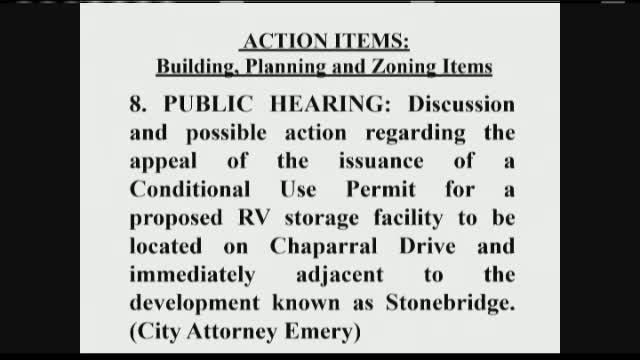
Bullhead City Council on May 6 affirmed a Planning and Zoning Commission decision to approve a conditional-use permit (CUP) that allows a 29-unit, metal storage structure intended for RVs and boats on Chapel Drive adjacent to the Stonebridge/Chaparral Terrace subdivision.
The CUP approval requires that 51% of the storage units be deed-restricted to residents or owners within the Chaparral Terrace area (including Stonebridge) and that the remaining 49% be available to owners/residents within the broader area shown as Exhibit A. The council action affirmed the commission's approval after more than an hour of public testimony and debate.
City Attorney Garren Emery explained how the CUP process works and told council members they had discretion to affirm or reverse the commission's action or to issue a new decision. Emery said the commission's findings were that the restricted allocation (51% Chaparral Terrace/49% Exhibit A) would limit the project's external reach and that deed restrictions would be recorded to enforce the allocation.
Residents who live adjacent to the proposed site urged council members to deny the CUP or limit use strictly to Stonebridge/Chaparral Terrace. Deborah Johnson, the appellant who filed the appeal, said the proposed metal storage buildings would be "commercial storage units" inconsistent with the residential character and raised concerns about traffic, safety at the narrow site entrance and long-term enforceability of the allocation.
Developers representing the project said they purchased the parcel with the plat showing RV storage and sought the CUP only because they planned to sell some units to buyers outside the immediate subdivision; one developer said they opened sales to nearby neighbors so those households could buy units.
Council members pressed staff and the developers about what the plat allowed without a CUP, the limits on signage and on-site commercial activity, and how deed restrictions would be enforced. Planning staff said the PUE (public utility easement) that once restricted structures there was abandoned in 2002; under current zoning the owners could build a site-built storage structure but the CUP was required only because the owners sought to market units beyond the subdivision.
After discussion, a council member moved to accept the Planning and Zoning Commission's decision. The motion passed; a city attorney summary for the record stated the council had affirmed the commission's action.
Why it matters: Neighbors said the structure will increase traffic, add safety hazards where school buses and pedestrians use the street, and change the residential character of the block. Developers and others said some neighborhood residents want storage and that without the CUP a structure limited to Chaparral Terrace could be built anyway. The decision leaves the approved CUP and the 51%/49% deed-restriction framework in place, subject to the deed-restriction recording described by staff.
The council's action was limited to the conditional-use permit and did not change zoning on the parcel. The CUP includes restrictions: no on-site sales or commercial office, limited signage (address only), and deed restrictions identified at permit/recording to reserve the 51% units to the designated area for 20 years, according to staff.
Next steps: The developers would select which units are deed-restricted at the time of building permit and are responsible for recording and maintaining those deed restrictions. Any further change to the allocation or other conditions would require future council or commission approvals.