Get Full Government Meeting Transcripts, Videos, & Alerts Forever!
Get email alerts on the Urban Forestry topic
No spam. Unsubscribe anytime.
City unveils street tree inventory and seven‑year community forest management plan
Summary
Arbor Pro presented a citywide street tree inventory and a Community Forest Management Plan (CFMP) that inventories 15,590 city trees, identifies 2,233 potential planting sites, sets a short‑term planting target and outlines a seven‑year maintenance and renewal program tied to equity and climate goals.
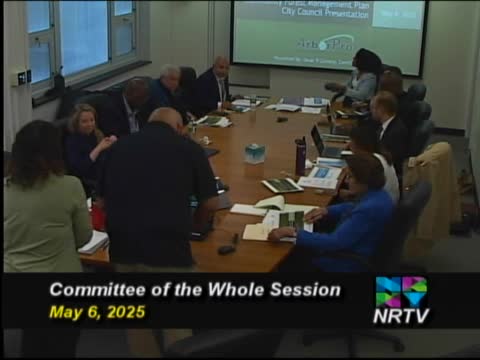
Arbor Pro, the firm contracted by the City of New Rochelle, presented the final street tree inventory and a Community Forest Management Plan (CFMP) to the City Council’s committee of the whole on May 6.
Oscar Corbera, a certified arborist with Arbor Pro, said the inventory (collected beginning February 2024) recorded 15,590 street trees and 2,233 potential public‑planting sites, representing 212 tree species and assigning a replacement value to the urban forest of more than $73 million. The work was funded in part by a New York State DEC tree‑inventory grant New Rochelle received in December (approximately $100,000), Corbera said.
Nut graf
The plan reframes trees as public infrastructure: it prioritizes safety removals and backlog pruning in years 1–2, transitions to proactive cycle‑based maintenance in years 3–7, and ties future plantings to neighborhood equity and climate‑vulnerability data. Arbor Pro also recommended an expanded, regularly reviewed planting palette to reduce reliance on overrepresented genera (maples were identified as over‑dominant) and proposed a potential municipal nursery at Ward Acres to grow native stock.
Key details and next steps
- Inventory highlights: 15,590 street trees; 2,233 potential planting sites; 212 species diversity; estimated replacement value > $73,000,000.
- Priorities and schedule: Years 1–2 — address immediate safety by removing dead trees and completing backlog pruning; Years 3–7 — move to proactive cyclical maintenance, young‑tree training and targeted canopy expansion in underserved neighborhoods.
- Equity and targeting: Arbor Pro said more than 50% of planned plantings will be located in disadvantaged or high‑need neighborhoods identified by the City’s climate vulnerability assessment and other datasets.
- Programs and tools: proposals include a resident tree‑giveaway program, a protected‑tree registry, a draft revised tree ordinance (sample ordinance provided for council consideration), and a public community‑viewer website that will show the tree inventory and per‑tree ecosystem benefits (stormwater capture, air‑pollution mitigation, carbon sequestration).
- Nursery viability: Arbor Pro reported a positive early viability assessment for a municipal nursery at Ward Acres; the nursery would allow the city to grow durable, climate‑adapted stock at lower cost over time.
Council discussion and clarifications
Council members and staff asked implementation questions. Councilmember Sarah Kaye—identified in the presentation as a driving force behind the grant application—asked for consolidated metrics and recommended sharing a draft with community stakeholders for feedback before final adoption. Arbor Pro and staff said a planting program of 300 city trees will be implemented this year using ARPA funds to start the multi‑year planting goal; the CFMP is intended to support future grant applications by documenting inventory, maintenance plans and equity metrics.
Arbor Pro cautioned that the long‑term canopy targets should be paired with sustainable maintenance funding: newly planted trees require most care in the first three to seven years to survive and deliver city benefits. The firm also noted localized parks with natural forest character (Ward Acres, Carpenter’s Pond) require distinct management approaches from street‑tree maintenance and recommended signage and a park‑specific plan for those areas.
Ending
Council members praised the interdepartmental effort and the public‑engagement elements in the CFMP. Staff said the plan will be used immediately to prioritize safety removals and to support grant applications for planting and nursery development.