Get Full Government Meeting Transcripts, Videos, & Alerts Forever!
Get email alerts on the Land Use Temporary Commercial topic
No spam. Unsubscribe anytime.
Council approves ordinance allowing limited temporary commercial uses on vacant residential lots; 60-day permits, major-road access required
Summary
Riverton's City Council adopted an ordinance permitting limited temporary commercial uses on vacant residential lots that have direct access to major arterials; permits will be valid for 60 days and must provide on-site parking and meet lighting and safety standards.
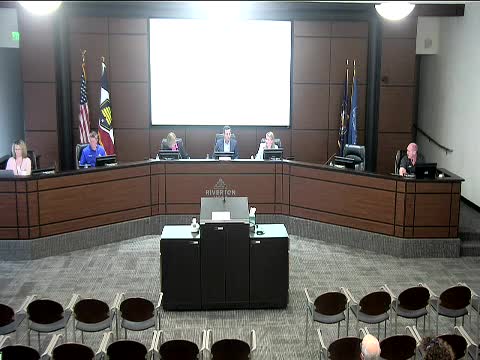
Riverton's City Council voted to adopt an ordinance allowing limited temporary commercial uses on vacant, undeveloped residential parcels that have direct access to major arterials. The measure passed after a public hearing in which nearby residents raised concerns about traffic, safety and long-term impacts.
What council approved
The ordinance allows temporary commercial activities such as seasonal sales, fireworks stands, landscaping/tree lots and similar short-term uses on qualifying vacant residential lots. Staff clarified the finished ordinance does not require a conditional-use permit; instead, each use must obtain a temporary commercial permit from city planning staff. Under the ordinance a permit is valid for a single 60-day period, and each future use requires a new permit.
Key restrictions and conditions
- Access: permitted uses must access the site from a designated major roadway (the code defines major arterials); side-street access is not allowed unless an existing condition makes major-road access infeasible. - Parking and circulation: parking must be self-contained on the property; the permit review will assess on-site parking, emergency access, traffic circulation and safety. - Lighting and signage: lighting must follow the city's temporary-commercial lighting standards (no flashing or movement that would impact nearby residences) and be directed downward and away from adjacent homes. - Fireworks and hazardous materials: fireworks stands and other hazardous displays are subject to Unified Fire Authority permitting and inspection under the International Fire Code; staff noted Unified Fire requires separation and storage standards for fireworks stock. - Permit revocation: staff may revoke or decline future permits if a property is out of compliance with city code or if a permitted use creates nuisance or safety issues.
Public comments and staff responses
Several nearby residents testified at the public hearing, citing concerns about local traffic, parking overflow into residential streets and the effect on adjacent homeowners. Resident Jay Salter opposed a potential fireworks stand at a specific location, describing parking and access conflicts at a three-lane section near Redwood Road and warning of potential impact to a nearby house. Other residents asked whether the ordinance could increase crime, and Unified Fire's fire marshal confirmed fireworks storage and sale are covered by the International Fire Code and would be inspected.
Staff emphasized that the permit review will consider noise, dust, odor, lighting, parking and emergency access and that permits are revocable for noncompliance. Planning staff also said the permit model lets the city consider site-specific conditions rather than approving blanket dispensations.
Council vote and outcome
A substitute motion to adopt the ordinance carried on a roll-call vote: Council members McDougall, McKay, Hammond and Perucci voted in favor; Council member Broker voted no. The ordinance passed and permits will be handled at staff level per the newly adopted code language.
What happens next
Staff will implement the permitting process, coordinate with Unified Fire Authority for fireworks-related permits and prepare a standard communications page for residents that explains the permit requirements and appeal process. Several council members requested regular enforcement reporting and asked that neighbors be notified when a temporary permit is under consideration.
Why this matters
The change balances private property use on vacant residential lots that front major roads with neighborhood protections: permits are time-limited, must be self-contained and may be denied or revoked for violations. The council tied adoption to stronger enforcement and inspection procedures to address resident safety and nuisance concerns.