Get Full Government Meeting Transcripts, Videos, & Alerts Forever!
Get email alerts on the Solid Waste Fees topic
No spam. Unsubscribe anytime.
Committee hears overview of solid-waste fees as council prepares residential trash vote
Summary
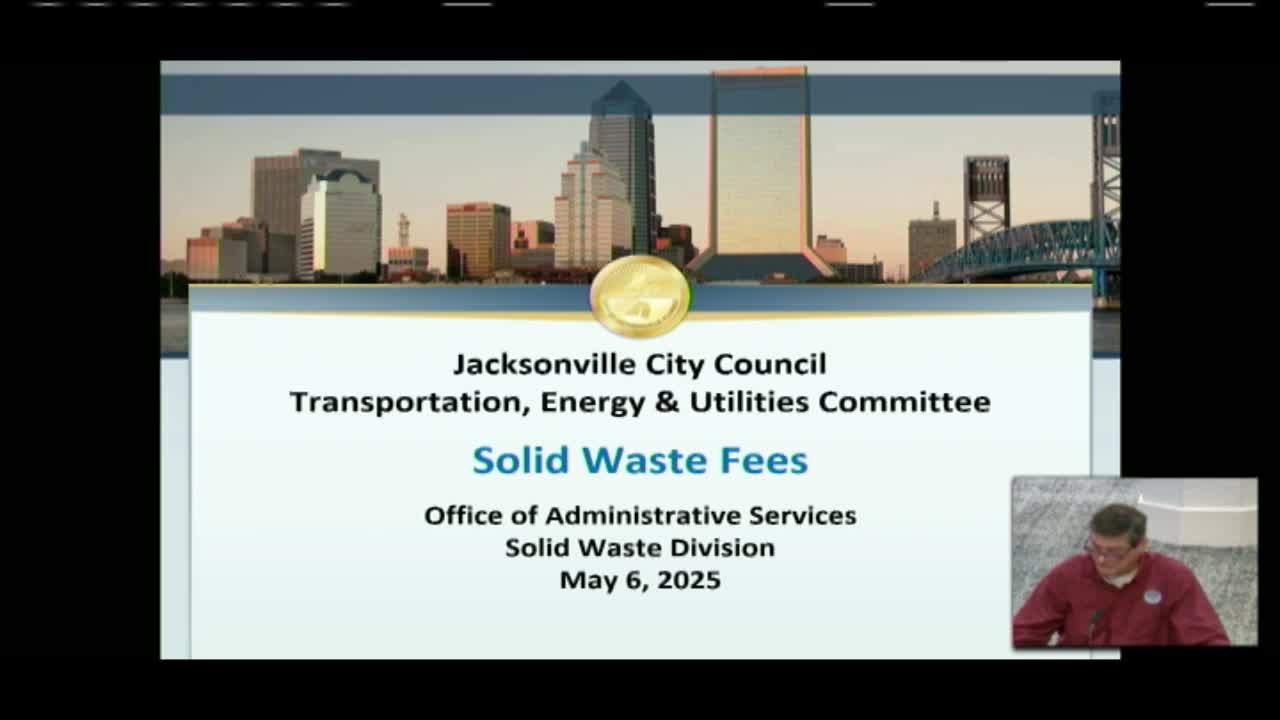
The Transportation, Energy and Utilities Committee on May 6 heard a briefing on the city’s solid-waste fees and services and was told several charges have not been updated in years as council prepares for a pending vote on the residential trash fee.
The Transportation, Energy and Utilities Committee on May 6 heard a briefing on the city’s solid-waste fees and services and was told several charges have not been updated in years as council prepares for a pending vote on the residential trash fee.
Eric Fuller, environmental programs manager with the Solid Waste Division, told the committee the division handles residential and small-commercial curbside service for about 300,000 premises, weekly garbage and yard trash collection, recycling, bulk waste pickups and specialized collections such as appliances, tires and household hazardous waste. Fuller said the system has the potential for more than 3,000,000 collection points per month and that the division’s dashboard shows roughly a 99% successful-collection rate.
The presentation focused on how the city’s fees are structured and what they support. Fuller said tipping and host fees are set in the city code (examples cited during the briefing included ordinance references to the tipping- and host-fee language) and showed current rates: residential curbside disposal billed internally at $29.93 per ton, a commercial rate of $30.30 per ton and a construction-and-demolition (C&D) rate of $22.71 per ton. Fuller said the Trail Ridge landfill’s host fee is $7.59 per ton and that half of that money is allocated to a mitigation fund (including Taie Brown Park), with the remainder divided among contamination-assessment, enterprise and landfill-closure accounts.
Fuller also reviewed other fees: a 17% franchise fee on commercial haulers (which he said generates about $15 million annually), a small-commercial curbside fee of $14.90 per month (about $178.81 per year), a downtown collection fee of $46.70 per month per city-supplied can, and application and registration fees for private facilities and haulers (a CON facility application fee of $1,200 with a $900 renewal, and a $1,500 initial franchise application and $1,500 annual registration). Fuller described hazardous-waste charges for small commercial generators as $4.25 per gallon for flammable materials and $1.25 per gallon for latex paint, with a 27-gallon-per-material cap; residents may use the household hazardous waste facility at no charge.
Council members pressed how the city’s rates compare with neighboring counties and whether fees cover actual costs. Fuller said the city’s disposal rates are on the lower end compared with other large counties and that less than about 2% of material received at Trail Ridge is from outside Duval County, noting that out-of-county disposals require permission. Fuller also said tipping fees generally have not changed since 2008, aside from specific legislative changes in 2019 and 2021 that adjusted how C&D host fees and permit fees are handled.
Councilmember Matt Carlucci and others stressed the importance of confirming whether specific fees fully cover service costs or are being subsidized by the general fund. Edward Linsky, Council Auditor’s Office, told the committee he would follow up with data on revenue and cost coverage. The administration confirmed several of the fees discussed are being actively reviewed.
Committee members also raised operational and public-education issues. Councilwoman Pittman asked how crews and landfill staff identify inappropriate materials at the curb and whether the city conducts outreach in schools; Fuller said crews reject unsafe items at the curb, the city can inspect or separate material at the facility, and while some private companies host field trips, the Solid Waste Division has not run a systemwide K–12 program.
Councilmember Carlucci recapped the schedule for the residential trash fee: notices to affected households have begun going out by mail, public hearings are scheduled during upcoming council meetings (committee members cited hearings on the 13th and 14th), and the council is slated to take a vote on the fee on the 27th. Fuller confirmed mailed notices began the prior Saturday. Committee members asked for another briefing or follow-up packet showing revenue totals by fee line and whether each fee is self-supporting.
Fuller concluded by reiterating the division’s role in running the Trail Ridge landfill, closed-landfill monitoring, contaminated-site assessment and remediation, household hazardous waste collection and permitting for private haulers.