Get Full Government Meeting Transcripts, Videos, & Alerts Forever!
Get email alerts on the Environmental Preservation topic
No spam. Unsubscribe anytime.
Miami HEP board defers decision on tree removals and site plan at 3939 Leafy Way after neighbors seek more canopy protection
Summary
Property owners seeking to redevelop 3939 Leafy Way in Coconut Grove revised their tree removal plan after staff review and neighbor concerns. The board deferred final action to July so applicants can refine the landscape mitigation, reduce mitigation payments and explore design changes to keep more canopy on the site.
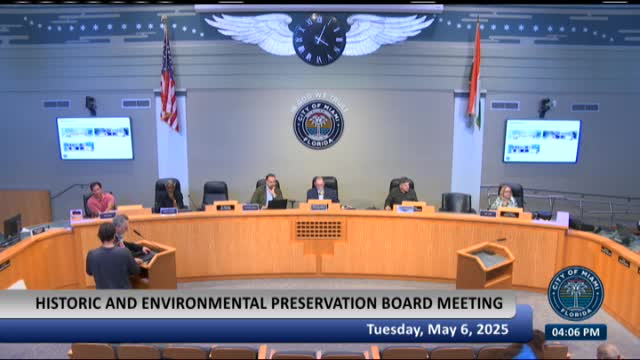
The Miami Historic and Environmental Preservation Board on a unanimous vote deferred a special certificate of approval for tree removal and site work at 3939 Leafy Way, citing neighborhood concerns about canopy loss and the need for additional review by environmental resources staff.
Applicant updates and the staff position
The applicant’s team, represented by attorney/representative Carlos Diaz and architect/landscape consultants, told the board they had revised an earlier plan after meeting with staff and neighbors. They said they reduced the number of royal palms proposed for removal from 14 to 6 by relocating or preserving eight on site where feasible, and proposed to add 17 native trees and two street live oaks increased from 4‑inch to 6‑inch caliper to produce a larger, longer‑lived canopy.
Staff said the application is consistent with Environmental Preservation District No. 74 rules where the proposals replace many non‑native, exotic palms with native tree species. Adrian Espinosa, preservation planner, noted the revised planting plan and said staff had not yet had time to coordinate the newest information with Environmental Resources.
Neighbors sought stronger preservation and clearer mitigation
Nearby residents testified that the property currently provides a lush canopy to the block and that earlier submittals appeared to remove large numbers of trees across the site. Residents asked how many mature trees would remain after construction and called for more on‑site planting rather than payments to the city’s tree trust fund.
Douglas O’Keefe (3975 Leafy Way) pressed for clarity on final tree counts and the amount of open space after construction. Landscape architect Robert L. Martin and the project arborist described the plan: roughly 71 trees proposed to be removed (many small, non‑regulated palms), 21 new trees proposed on site and six new palms; in other words, a net increase in native canopy species though many removed specimens were small non‑regulated palms that do not count the same under the code’s mitigation calculation. The arborist said several of the royal palms originally proposed for relocation were poor candidates for transplanting because of root limitations and proximity to other structures.
Mitigation, street trees and next steps
The team told the board that, with the larger caliper live oaks and the added native planting, the mitigation payment to the tree trust fund could fall from earlier figures (strewn through the submittal materials) to about $11,000–$13,000. Board members questioned whether the footprint of the house and drainage fields limited places where large canopy trees could be planted and asked the applicants to explore further design adjustments to increase on‑site canopy.
The board deferred the item to July to give staff and the applicant more time to coordinate with Environmental Resources, to refine the planting plan and to reduce mitigation payments by maximizing onsite large‑caliper trees where feasible. The motion to defer passed by unanimous roll call.
Why it matters
Leafy Way is inside an Environmental Preservation District valued for its canopy and native tree cover. The board’s deferral reflects the challenges of reconciling lot‑level redevelopment, septic/drainage and the policy aim of preserving or restoring tree canopy synthetically by replacing many small, non‑regulated exotic palms with fewer, longer‑lived native trees.
What’s next
The applicant will work with staff and the neighborhood to submit a revised landscape and mitigation plan for the July meeting, including exact counts of removals and replacements, updated mitigation calculations and explanation of constraints created by drainage fields and other site utilities.