Get Full Government Meeting Transcripts, Videos, & Alerts Forever!
Get email alerts on the Courthouse Donation Hunter Square topic
No spam. Unsubscribe anytime.
Stockton council approves donation of Hunter Square for new Superior Courthouse
Summary
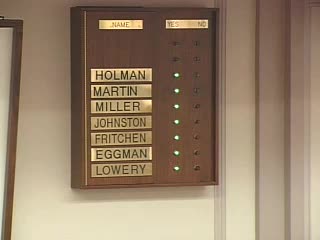
The Stockton City Council voted 7-0 to approve a donation agreement, CEQA findings and a statement of overriding considerations to transfer Hunter Square to the state for a new 12‑story Superior Courthouse, with construction proposed to begin in 2011 and an estimated cost of about $260 million as presented.
The Stockton City Council voted 7-0 to approve a donation agreement transferring Hunter Square to the Administrative Office of the Courts and to adopt the environmental findings and a statement of overriding considerations needed for construction of a new Superior Courthouse in downtown Stockton.
City staff described the proposed courthouse as a roughly 325,000–330,000 square‑foot, 12‑story building with about 30 courtrooms. Jason (staff) told the council the project would be “more secure” and called the preferred location “an important project for downtown.” Presiding Judge Veil Murray and Steve Sundman, project manager for the Administrative Office of the Courts, spoke in support of the agreement and outlined the funding, design process and community outreach to date.
The council was asked to approve CEQA findings and a statement of overriding considerations because the certified program environmental impact report identified three categories of significant impacts that the city could not mitigate below a level of significance: cultural resources, traffic and circulation, and construction‑period noise. City staff said the state will purchase an environmental insurance policy naming the city as an additional insured, and the Administrative Office of the Courts must obtain Public Works Board approval before the state takes title. The donation agreement, as described to the council, also preserves the city’s current parking and management of Hunter Square until construction begins and gives the city the right to retake ownership if work has not started by Jan. 1, 2015.
Judge Veil Murray said the courthouse funding would not come from the state general fund but from fees and fines accumulated since 2002 under the statute cited in the meeting; Murray warned the council that the legislature had taken $40 million from that fund in March. Murray said the court had conducted public outreach, including about 26 focus groups involving more than 300 people, and that a Project Advisory Group (PAG) required by the California Rules of Court will continue to provide input. The architects named in the presentation were NBBJ of Seattle.
Steve Sundman, the Administrative Office of the Courts project manager, said local hiring and local outreach would be part of the contractor selection criteria for the construction manager at‑risk; he said there was “no set dollar amount or percentage” attached but that selection would give weight to firms’ local‑hire commitments.
Council members offered unanimous praise for the project as an economic anchor for downtown and for improving courthouse safety and security. Council discussion touched on project scale, proximity to Hunter Square and expectations for local hiring; several members invited ongoing participation in the PAG and future design presentations.
Next steps, as described to the council, include the Administrative Office of the Courts seeking Public Works Board approval (presenters said that hearing was scheduled for Sept. 11) and the city’s later abandonment of Hunter Street as a public right of way as part of site preparation. The council’s vote to approve the CEQA findings, the statement of overriding considerations and the donation agreement carried 7‑0.