Get Full Government Meeting Transcripts, Videos, & Alerts Forever!
Get email alerts on the Homestead Exemption topic
No spam. Unsubscribe anytime.
City staff proposes doubling Colleyville homestead exemption to 14% to offset public-safety pay increase
Summary
City staff recommended increasing the homestead exemption from 7% to 14% for fiscal year 2026 and said the additional revenue to offset that change would largely come from commercial property tax increases; staff plans an ordinance first reading May 13.
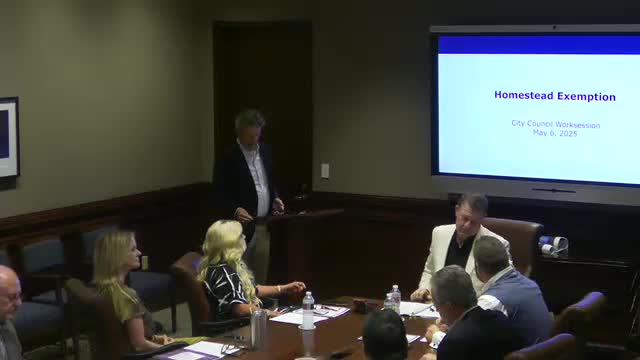
City staff presented a financial analysis proposing that Colleyville double its residential homestead exemption from 7% to 14% for fiscal year 2026 and said the recommendation is intended to offset revenue raised for a citywide compensation adjustment, most of which would go to public-safety employees.
A staff presenter told the council that last year the council approved a 7% homestead exemption. The presenter said state statute requires homestead-exemption action be approved before the city adopts its budget and tax rate, which forces the exemption decision ahead of the full budget process.
Staff described the financial mechanics: the city could adopt a 14% homestead exemption and simultaneously raise additional property-tax revenue so the average residential homeowner sees effectively no change in next year's tax bill. Using preliminary values provided by the appraisal district, staff said the average home value is about $791,000; under the staff's scenario that includes additional revenue, the average homeowner would see about a $2 decrease compared with the current bill. If the council increased the exemption to 14% without raising new revenue, staff said the average homeowner would see about a $150 decrease.
Staff said the additional revenue target is roughly $750,000 to $800,000 to implement a citywide compensation study, and that approximately 75% of the new compensation dollars would go to police and fire. The presenter summarized: increasing the exemption while creating offsetting revenue shifts more of the immediate tax burden to commercial property rather than to residential property alone.
Staff outlined the timetable: bring an ordinance for the first reading on May 13, hold the required second hearing June 3, file the change with the appraisal district by July 1 if adopted, and adopt the budget and tax rate in the usual timeline later in the summer and fall. The presenter noted the Texas tax code allows a city-level homestead exemption up to 20%. Staff emphasized the city's desire to remain competitive in public-safety compensation while maintaining a relatively low municipal tax rate.
Council discussion included questions about how much of the residential burden would be preserved, and how the change shifts costs to commercial taxpayers (a staff figure cited an increase of about $220 per $1 million of commercial value). The council did not take a formal vote at the work session; staff will bring the ordinance forward for the scheduled first reading.
No formal action was recorded during the work session; the item will return to the City Council with ordinance language and budget recommendations for formal consideration.