Get Full Government Meeting Transcripts, Videos, & Alerts Forever!
Get email alerts on the Parking Management Rpp topic
No spam. Unsubscribe anytime.
City staff outline proposed director’s rules for Residential Permit Parking; commissioners signal interest in a June recommendation
Summary
City Transportation Public Works presented a draft director’s rules package for the Residential Permit Parking program on May 6, proposing clarified application rules, new contextual review factors, an eligibility and reevaluation framework, and a hybrid meter-plus-resident model used in South Congress.
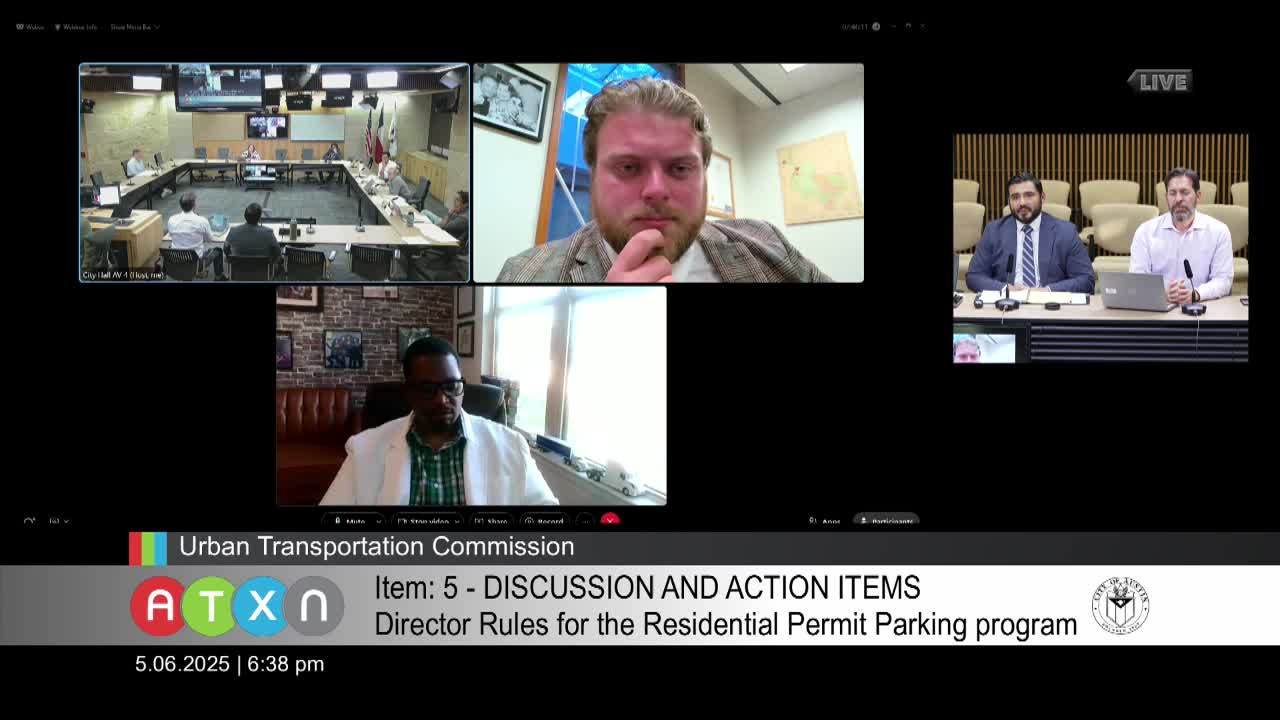
City of Austin Transportation Public Works (TPW) staff presented a draft set of director’s rules on May 6 to formalize the Residential Permit Parking (RPP) program and to create a more consistent, citywide approach to eligibility, surveying and reevaluation of RPP zones. Commissioners gave detailed feedback and several volunteered to draft a commission recommendation for the June meeting.
Assistant Director Lewis Lehi and Joseph Hajri, parking enterprise manager, said the rules project responds to a February City Council directive enabling formal rules development and to years of informal or guideline-based administration dating back to 1997. TPW staff said roughly 6,000 RPP spaces exist citywide and that the department issued approximately 3,413 permits in the most recent reporting period they cited.
The proposed rules would clarify who may apply (homeowner or an approved designee), require staff-produced petition signage during public petitions, formalize several contextual factors (including proximity to amenities, corridor status and nearby off-street parking) to guide whether a traditional 24/7 RPP zone or a targeted/‘hybrid’ solution is appropriate, and add a re-evaluation process for legacy zones. TPW said the hybrid option — used in South Congress — blends paid metered parking for visitors during peak hours with resident-only restrictions at other times.
TPW proposed raising the share of nonresident/commuter occupancy used in the parking-study threshold (previously 25% of occupied spaces) and refining the parking survey requirement (moving from a requirement that two days meet 75% occupancy to a clearer average-based approach). Staff also proposed eligibility changes aimed at preventing permit misuse (additional verification steps such as vehicle insurance showing the address) and new enforcement and appeal procedures for chronic misuse.
Commissioners asked detailed questions about enforcement, costs and equity. TPW confirmed the RPP program does not fully cover its operating costs and that fee and enforcement decisions would be handled in the City’s budget and fee-schedule process. Commissioners pushed staff to consider mechanisms to ensure multifamily residents and workers are not unfairly excluded from curb access and to explore ways to use hybrid or other programs to extend visitor and worker parking benefits to multifamily households. Staff said the director already has authority under Code (12-3 and 12-5 cited during the hearing) to implement discounted or coded parking for specific groups, and that more detail on pricing would be resolved in budget cycles.
Several commissioners raised the need for a transparent reevaluation process for legacy RPP zones; staff said they plan a phased approach in which new zones would include periodic review schedules while legacy zones would be assessed over time with data-driven parking studies. Commissioners also advocated incentives to reduce household car parking demand (transit passes or other rewards) rather than relying solely on curb restrictions.
Staff said the draft rules were still under legal and internal review and that the posting timeline was pushed back by one week (from May 12 to May 19 in the materials reviewed by commissioners) to allow time to digest a large volume of public survey responses. Commissioners Schumacher, Prasad and Jacobson volunteered to work with staff and other commissioners on a proposed commission recommendation for the June 4 meeting; staff confirmed that input received at the June 4 meeting could be incorporated into the public comment process for the rules before adoption.
No formal vote was taken on the draft rule set at the May 6 meeting. TPW staff asked for public comment in the post-publication comment window and indicated they will return with staff responses to public comments and a proposed final rule for adoption in mid-July.