Get Full Government Meeting Transcripts, Videos, & Alerts Forever!
Get email alerts on the Municipal Budget topic
No spam. Unsubscribe anytime.
Coventry council corrects budget numbers, directs staff to model smaller nonunion raise and continues final vote to May 13
Summary
The Coventry Town Council amended arithmetic errors in its proposed fiscal 2025–26 budget, approved corrections to property tax revenue and the resolution total, debated nonunion salary increases (moving from a 3% proposal toward a 2% compromise), directed the town manager to calculate revised figures, and continued final adoption to May 13.
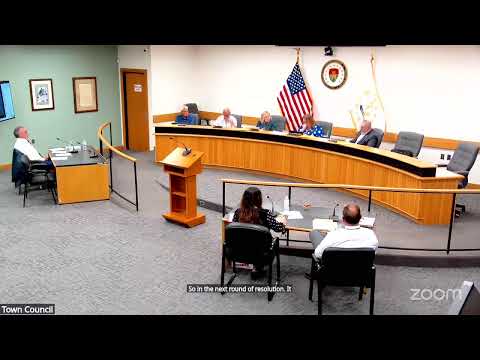
At a meeting of the Coventry Town Council that began at 6:04 p.m., councilors amended the proposed fiscal 2025–26 budget to correct arithmetic errors, debated nonunion salary increases and directed the town manager to calculate the financial impact of reducing a proposed 3% across‑the‑board nonunion raise to 2%. The council continued final action on Resolution 2025‑49 (final adoption of the FY2025–26 budget) to its May 13 meeting.
The action followed public comment urging fiscal restraint. "This budget matters," resident Britney Boyer told the council, adding that small raises can “snowball” into larger pension and payroll costs over time. Town Manager Pirlo responded to a public question about pensions, saying three employees discussed by the council “are not in a defined benefit system. They are in a defined contribution system... it's like a 401(k) type of system,” and therefore the raises do not directly increase defined‑benefit pension payouts.
Council members identified and corrected arithmetic errors in the draft resolution during deliberations. Councilors approved amendments that set anticipated general property tax revenue at $83,308,125 and adjusted the resolution total to $127,135,068. Vice President Verducci and others noted the budget’s overall tax increase was modest: Manager Pirlo said the current draft shows roughly a 1.48% tax increase (about $94 annually for a $400,000 home), while councilors noted that each percentage point in the levy equals about $700,000 in revenue.
Much of the council discussion centered on employee compensation for nonunion positions. The original draft included a 3% cost‑of‑living increase plus targeted additional increases (for example, a 7% bump tied to added duties for the director of public works). Vice President Verducci circulated a salary‑comparison sheet and proposed amendments that would preserve some role‑specific increases as stipends while reducing the blanket cost‑of‑living increase. Council members debated whether raises should be automatic or tied to performance evaluations and recommended moving toward position salary ranges and merit‑based reviews in future budgets.
Procedurally the council took several votes on the budget package and related items: - The council adopted arithmetic corrections to Resolution 2025‑49 (property tax revenue $83,308,125; resolution total $127,135,068). Vote: 5–0 (Council members Brown, Pasquale, Capaldi, Vice President Verducci and President Lima voted yes). - The council accepted Vice President Verducci’s salary report into the record for further consideration. Vote: 5–0. - The council voted to table the specific proposed amendment to department head increases that had been introduced by the vice president. Vote: 5–0. - The council directed the town manager to calculate the budget effect of changing the nonunion increase from 3% to 2% and return those figures for the council to review. Vote: 5–0. - The council approved an amendment to the amended resolution to reflect a 1% reduction in the blanket nonunion increase (i.e., changing 3% to 2% across nonunion positions) so staff can prepare a revised resolution for consideration. Vote: 5–0. - The council continued final consideration of Resolution 2025‑49 to the May 13 meeting. Vote: 5–0.
Council members and town staff emphasized this round of changes is both corrective (fixing calculation errors in the published resolution) and preparatory. Solicitor Angel advised that the budget resolution is organized by position line items and that any future policy changes about discretionary, performance‑based pay or salary ranges would be implemented through position descriptions and budget line allocations rather than ad hoc personnel actions.
Less urgent matters aired during the meeting included questions from residents about senior tax freezes and requests for more line‑item detail in future budgets (for example, professional services, website/hosting, and hardware expenditures). Councilors asked staff to provide clearer line‑item breakdowns in next year’s budget documents and to develop a performance‑evaluation process and salary bands for department heads for future budgets.
The council did not adopt the budget outright at this meeting; instead it corrected numeric errors, provided direction to staff on the raises question and set the matter for a follow‑up vote on May 13.