Get Full Government Meeting Transcripts, Videos, & Alerts Forever!
Get email alerts on the Community Development Block Grant topic
No spam. Unsubscribe anytime.
Gallatin holds first public hearing on HUD CDBG entitlement; sidewalks and homelessness services emerge as priorities
Summary
Gallatin City planners held the first of two required public hearings on pursuing HUD Community Development Block Grant (CDBG) entitlement status, outlining eligible uses, estimated funding of about $309,000 a year, a 15% cap on public services and possible sidewalk and homelessness-related projects.
City planners in Gallatin held a public hearing on the Community Development Block Grant (CDBG) process and sought public input on how the city should use an expected annual allocation as it pursues entitlement status with the U.S. Department of Housing and Urban Development (HUD).
Brian Rose, city planner for Gallatin City, opened the session by describing the objective: “What we have is, basically an entitlement to a little bit over $3,300,000 to be able to work with, low to moderate income areas within the city,” and said the meeting was the first of two required public hearings for the citizen participation process.
Planner Jim Carpenter, the project lead, walked through what CDBG money can and cannot pay for and how the city will structure a consolidated plan and a first-year annual action plan. Carpenter said HUD allows a wide range of activities — from housing rehabilitation and down-payment assistance to public facilities such as water, sewer and sidewalks — but imposes limits including a 15% cap on public services and a 20% cap on planning and administration. “That funding source has been around since 1974,” Carpenter said, and it is governed by HUD rules including labor standards and environmental review requirements he identified as likely to affect timing and scope.
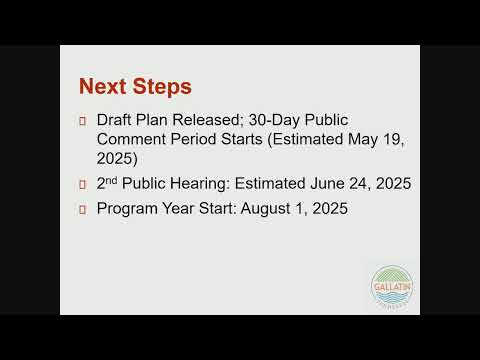
Carpenter said the city’s current estimate is about $309,000 per year in entitlement funding, and that 15% of the allocation would equate to roughly $45,000 a year for public-service grants. He noted the program year for the first plan is projected to begin Aug. 1 (possibly Sept. 1) and that a draft plan would be released for a 30-day public comment period, with a second public hearing currently projected for June 24.
Members of the public urged planners to consider both sidewalk and homelessness priorities. Carpenter outlined several potential sidewalk projects that city staff has identified for neighborhoods within the city’s low- and moderate-income census tracts, including connections near Guild and Union elementary schools and extensions along Bly Avenue and South Water. On the feasibility of sidewalks where ditches and narrow roadways exist, Carpenter said preliminary reviews suggested sufficient right-of-way to build curb-and-gutter and sidewalks on at least one side without acquiring new easements, but that final plans would require engineering design.
Several speakers urged use of the public-service portion to support people experiencing homelessness. An attendee who identified herself as former LifeNav program staff described outreach and short-term hotel placement paired with assistance obtaining identification and housing vouchers as effective uses of small grants. Chaplain Deborah Austin of the Stay Warm Shelter said she has run local homelessness services for two decades and criticized the absence of outside funding: “Nobody has helped the homeless here in Sumner County,” she said, calling for coordinated use of available resources.
Carpenter cautioned that CDBG public-service funds are typically “one-shot” allocations that cannot be used for ongoing operational costs, and that the program’s reporting and federal requirements limit what can be sustained year to year. He also said HUD requires environmental review and compliance with rules such as the Davis-Bacon Act that apply to construction projects.
Planners described next steps: staff will prepare a draft consolidated plan and annual action plan, post it for a 30-day public comment period (targeted for release around May 19), hold a second public hearing after the comment period (targeted June 24), and submit the plan to HUD at least 45 days before the program-year start. The city previously signed a letter of intent in December to pursue entitlement funding directly from HUD.
The public hearing closed with planners inviting written comments and stakeholder follow-up to refine a draft list of projects the city could fund under CDBG rules.