Get Full Government Meeting Transcripts, Videos, & Alerts Forever!
Get email alerts on the Personnel Compensation topic
No spam. Unsubscribe anytime.
Council advances FY2025–26 budget on first reading after extended pay-study briefing and debate
Summary
Council advanced the proposed FY2025–26 budget on first reading after staff presented a new five-step pay structure and a merit-based approach beyond step five; councilmembers requested further details on evaluation metrics, distribution safeguards and training incentives.
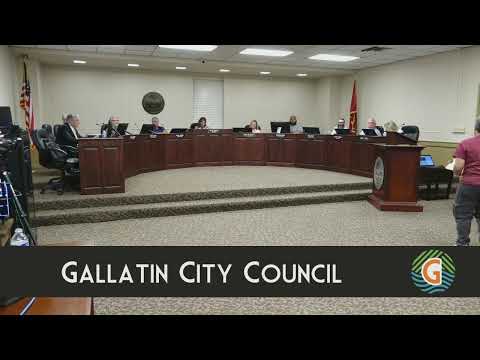
Gallatin City Council on May 6 held an extended discussion of the proposed fiscal year 2025–26 budget and the personnel pay-study that accompanies it, advancing the ordinance on first reading and requesting additional detail before a second reading.
Vice Mayor Hayes moved the budget ordinance (02505-29) for first reading and a city staff presenter delivered a summary of the pay-study and the proposed compensation structure. The pay package before the council included a five-step grade structure with 2.5% between steps, a baseline budgeted 3% pool plus a $1.00-per-hour component staff said department heads could apply in varying combinations to balance merit and cost-of-living adjustments.
Staff (presenter): “The pay scale is comprised of five steps per grade representing minimum requirements to position to proficiency... we have budgeted for 3% plus a dollar per hour. That is where the department heads would have discretion to use some merit influence.”
Councilmembers asked numerous questions about how employees who already exceed five steps would be treated, how often evaluations would be conducted, and what safeguards would exist to prevent inconsistent application among departments. Several members said they supported merit-based rewards but asked for clearer evaluation metrics, a gatekeeping or appeal process and examples of how the $1.00/hour element would be applied.
Councilmember questions focused on timing of step movement (annual versus more frequent), whether the dollar-per-hour allotment could be treated as a recurring salary element rather than a one-time bonus (and the tax/benefit consequences of each approach), and whether signing or training incentives would require reimbursement clauses if an employee departed early. Staff said they are updating evaluation forms to be department-specific and plan to provide an explicit matrix tying performance scores to percentage or step increases.
Vice Mayor Hayes said the budget had received feedback from department heads and that the administration had made several small adjustments; the ordinance was moved on first reading and advanced for later consideration. During the first-reading vote an abstention was recorded; staff committed to returning a more detailed pay-plan packet and an updated personnel rules recommendation before the next reading.
Ending: Council directed staff to return with a written pay-plan, sample evaluation matrices and a detailed explanation of how the proposed merit allocations would be administered and appealed. The budget will return for a second reading with the requested materials.