Get Full Government Meeting Transcripts, Videos, & Alerts Forever!
Get email alerts on the Fraud Prevention topic
No spam. Unsubscribe anytime.
DFL lawmakers say fraud-fighting measures are advancing across budget bills, criticize special committee as politicized
Summary
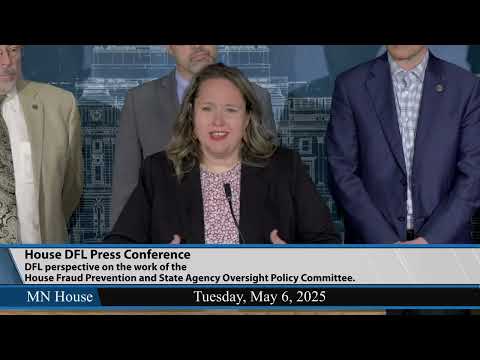
State representatives leading Minnesota’s anti-fraud work told reporters that many of the policy changes aimed at reducing fraud are being advanced inside individual budget bills, and criticized a dedicated fraud-prevention committee for becoming politicized and failing to move substantive proposals.
State representatives leading Minnesota’s anti-fraud work told reporters that many of the policy changes aimed at reducing fraud are being advanced inside individual budget bills, and criticized a dedicated fraud-prevention committee for becoming politicized and failing to move substantive proposals.
“Again, we agree fraud is bad and let's take action on it in a well informed and concrete way,” State Representative Dave Pinto, DFL lead on the Fraud Prevention and State Agency Oversight Committee, said at the press event. Pinto added that most anti-fraud language is being incorporated into appropriations and policy bills across committees rather than through the stand-alone committee.
Representative Emma Greenman, DFL of south Minneapolis, said Republican actions around the committee undercut its stated purpose. “What this says is this is a political project from the beginning,” Greenman said, criticizing a pre-hearing letter and public tactics she described as aimed at political opponents rather than at describing fraud patterns and protecting vulnerable Minnesotans.
Why it matters: lawmakers said the practical work to detect and prevent fraud is progressing through specific budget and policy bills in Human Services, State Government, Jobs and related areas. They singled out steps such as expanding cross-agency data sharing, enforcing pre-award risk assessments for legislatively named grants, continued use of investigative units that pursue Medicaid fraud, and proposals to create or clarify inspector general (OIG) authority.
Details and proposals
- Data sharing: Representative Steve Elkins said Minnesota IT Services (MNIT), through its technical advisory commission and a data-sharing subcommittee, is examining how to make authoritative income, employment, birth and death records more available across agencies to support fraud detection. “This work will be ongoing and supported by legislation that we’re poised to pass this year as well,” Elkins said.
- Pre-award risk assessments: Speakers said the state already requires a pre-award risk assessment for legislatively named grants. “It is actually law. It passed in 2023-24,” Pinto said, noting the statutory reference discussed in the session as Minn. Stat. 16B.198 for pre-award risk assessments.
- Office of Inspector General (OIG) and legislative oversight: Lawmakers described ongoing negotiations over the scope of an OIG bill and whether oversight should sit in the executive or legislative branch. Pinto said the House bill he carries places OIG in the executive branch and that the Senate is leading the current negotiations. He said members of all four caucuses have met to try to reach language that can win broad support.
- Technology vs. staffing: Representatives said the governor’s package included proposals to use artificial intelligence for early fraud detection, but that the House approach has focused on hiring and deploying more trained staff and on improving data quality before applying AI. One presenter said data integration and cleanup must precede effective AI deployment.
- Enforcement and investigations: DFL lawmakers said the Medicaid Fraud Control Unit and attorney general’s prosecutors have provided investigators’ perspectives in recent hearings and that those units are actively prosecuting cases. Pinto and others rejected assertions that there is evidence of systemic corruption by state officials; Pinto said he had seen “no evidence for that.”
Points of disagreement and committee process
Lawmakers on the panel repeatedly criticized the way the special fraud-prevention committee began its work, saying initial hearings and outside presentations sometimes focused on political claims rather than operational details and investigative patterns. Representative Greenman said she and other DFL members sought testimony from investigators about fraud business models and that some invited witnesses declined to provide tactics in public hearings; she said the Medicaid Fraud Control Unit did provide helpful, investigative testimony in a later hearing.
Representative Pinto and others said much of the tangible anti-fraud work — including measures aimed at misclassification of workers, consumer fraud, and protections for seniors and veterans — has been advanced in the substantive budget and policy committees that oversee those programs.
No formal committee votes or statutory changes were reported at the press event. Lawmakers invited follow-up questions and said negotiations on OIG language and other items would continue as budget and policy bills move through their respective committee processes.
Ending
DFL lawmakers said they expect additional anti-fraud provisions to be finalized as budget negotiations continue and urged reporters and the public to judge progress by the statutory and appropriation language moving through the House and Senate rather than by headline statements or political attacks.