Get Full Government Meeting Transcripts, Videos, & Alerts Forever!
Get email alerts on the Homeowners Association Reform topic
No spam. Unsubscribe anytime.
Minnesota Senate passes wide-ranging homeowners association reforms after lengthy floor debate
Summary
After hours of debate and dozens of amendments, the Minnesota Senate passed Senate File 1750, a delete‑all amendment addressing homeowners associations and common interest community rules that sponsors described as consumer protections and opponents said needs more technical work.
Saint Paul — The Minnesota Senate passed Senate File 1750 on May 6, 2025, a package of reforms to homeowners associations (HOAs) and common interest communities that sponsors said increases transparency and consumer protections and that critics said contains technical and constitutional problems that need committee review.
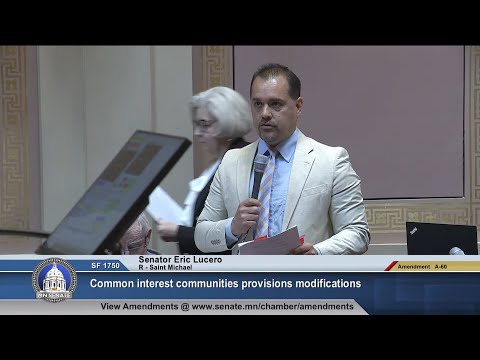
Senator Lucero moved the package as a delete‑all amendment described by the author as a product of a months‑long bipartisan work group. Lucero said the amendment is aimed at reducing conflicts of interest and curbing excessive fines and fees while increasing notice and dispute‑resolution rights for unit owners. "This is a pro consumer bill," Lucero said on the floor.
The amendment and the bill drew sustained floor debate on several issues including mortgagee consent procedures, retroactivity, conflict‑of‑interest rules for board members and management companies, and a requirement that associations solicit multiple competitive bids for contracts over $50,000. Senator Pa, a coauthor, told colleagues, "Power without accountability always opens the door to abuse," urging support for the measure as addressing gaps in state oversight of HOAs.
Opponents, notably Senator Lats and others, asked that the measure be sent back to the Judiciary Committee for further technical drafting and stakeholder review. Lats moved to re‑refer the bill; the motion failed on a roll call, 26 ayes to 41 noes. Senators who raised procedural and drafting concerns pointed to provisions they said might impair existing contracts or raise constitutional issues if applied retroactively.
Key provisions in the adopted amendments and the final bill include limits on late fees (no greater than $15 or 5% of the assessment, whichever is greater), a prohibition on charging attorney fees to owners who merely ask questions about a fine or assessment, a requirement that associations provide a schedule of fees and charges and timely notice of rule changes, an informal dispute resolution process, and a raised threshold and time limits before foreclosure for unpaid assessments (e.g., no foreclosure unless unpaid assessments exceed $1,500 and are outstanding at least 120 days when monthly assessments are under $500; $2,500 for higher assessments). The bill also requires competitive bids for certain contracts estimated to exceed $50,000, with enumerated exceptions for emergencies, warranties and when multiple bids cannot be obtained.
Floor votes on major steps included adoption of the Lucero A15 delete‑all amendment and subsequent amendments (notably A19 and A17), and several proposed amendments that failed. After debate and amendment votes, the bill passed final passage on a roll call of 44 ayes and 22 noes.
Discussion points preserved on the record included mortgagee consent procedures (opponents warned a 60‑day implied consent rule could affect mortgagees and securitization), requests for clearer retroactivity language, and whether disclosure alone is sufficient to address conflicts of interest or whether prohibitions were necessary. Multiple senators urged additional technical work by the judiciary committee and legal stakeholders; proponents said the measure was the product of many months and broad stakeholder input.
The Senate referred the bill as amended to its next procedural step; the transcript records the final vote and the bill's passage.
Ending — The passage on May 6 sends a reworked homeowners association regulatory package from the Senate forward in the process. Sponsors said the measure is intended to rebalance authority between residents, boards and management companies and produce more predictable procedures for owners; critics said the size and technical complexity of a late delete‑all amendment warranted additional committee review to avoid unintended consequences.