Get Full Government Meeting Transcripts, Videos, & Alerts Forever!
Get email alerts on the Wildfire topic
No spam. Unsubscribe anytime.
Pima County presents regional wildfire mitigation plan, calls for prevention, fuels work and coordinated response
Summary
County staff laid out a draft wildfire mitigation plan emphasizing prevention, invasive-fuel control, and cross-agency emergency response; supervisors and chiefs urged more detail on county land work and funding.
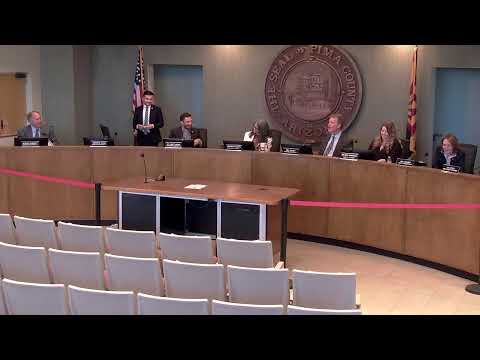
Pima County officials on May 6 presented a draft countywide wildfire mitigation plan that centers on three goals — prevention and public education, fuel mitigation and vegetation control, and emergency response coordination — and asks the Board of Supervisors to back a programmatic approach that leans on partners across fire districts, state agencies and community groups.
The plan, prepared by county administration staff and informed by workshops with the Pima County Fire Chiefs Association and other partners, says actions should include shared public information resources, a centralized digital “depository” for prevention materials, expanded invasive-grass (buffelgrass) control, incentives and pilots for innovative fuels treatments such as targeted grazing, and clearer pre-identified evacuation logistics and water sources for firefighting.
“Today’s briefing provides an introduction to the proposed wildfire mitigation plan,” county staffer Marie Vasquez told the board at the start of the presentation. “We attempted to create a practical and results-driven plan which addressed your concerns from the February 4 meeting that is tailored to our regional capabilities.”
Why it matters: The presentation emphasized that Southern Arizona faces elevated wildfire risk this season because of drought and unusually hot spring forecasts, and because invasive grasses have increased fine fuels across the Sonoran Desert. The plan aims to coordinate existing activities — such as Firewise programs and fire-district vegetation projects — into an actionable, fundable county strategy.
What the plan recommends: Among the specific proposed actions shown to the board were: - Prevention and public education: a shared calendar for regional outreach, expanded promotion of Firewise principles, a county-hosted online repository of mitigation tools and local maps, and drills/outreach to improve evacuation readiness and MyAlerts enrollment. - Mitigation: an expanded program for invasive species mapping and treatment, pilots for targeted grazing, stronger defensible-space outreach and a home-hardening promotion program. - Emergency response: cross-agency tabletop exercises and clarified operational roles; pre-identification of water sources, evacuation routes and possible utility shutoffs to speed decision-making.
County staff said they expected to work with fire districts, the state, tribal nations and community groups to implement the plan and would return with more details and cost estimates. Vasquez told the board the plan’s collaborators include county departments, the fire chiefs’ association and other regional partners who participated in interviews or workshops.
Board questions and public input: Supervisors pressed staff for more detail about several elements. Supervisor Chris Christie asked for a fuller accounting of the county’s own landholdings and whether county-owned rights-of-way, parks or conservation lands could be assessed and cleared for fire safety — a request staff said would require a separate inventory and follow-up.
Christie also raised repeated concerns from residents that some homeowners association (HOA) covenants prohibit Firewise mitigation measures; he asked staff to explore whether county or state tools could offer relief for homeowners with restrictive HOA rules. Several audience members from Green Valley and Mount Lemmon urged larger, dedicated mitigation funding for areas with heavy buffelgrass infestations.
Supervisor comments and next steps: Supervisor Christie praised the plan as “a significant start” and asked staff to return with more detail on the proposed online depository and a proposed funding approach, including whether an initial county seed grant (for example, a $50,000 starting pool mentioned by a Green Valley group during public comment) could be scaled. County administration said staff would compile written responses to board questions and return with updated materials, including an updated community risk reduction strategy and any recommended budget requests.
“By working as one regional team, we can increase our agility, effectiveness and impact,” Vasquez said. “This helps us be prepared and lead with solutions.”
Ending: The board did not vote on formal adoption of the plan at the meeting; staff said they would return with refinements and cost information and work out implementation steps with fire districts and tribal partners.