Get Full Government Meeting Transcripts, Videos, & Alerts Forever!
Get email alerts on the Development Pud topic
No spam. Unsubscribe anytime.
Ocala council approves amendment to Grand Oaks Town Center PUD concurrency agreement amid density, traffic questions
Summary
The Ocala City Council approved an amendment to the Grand Oaks Town Center PUD amended and restated site and concurrency development agreement. Staff said the change follows a recent planned development rezoning and a traffic analysis; councilmembers raised concerns about apartment density and market saturation.
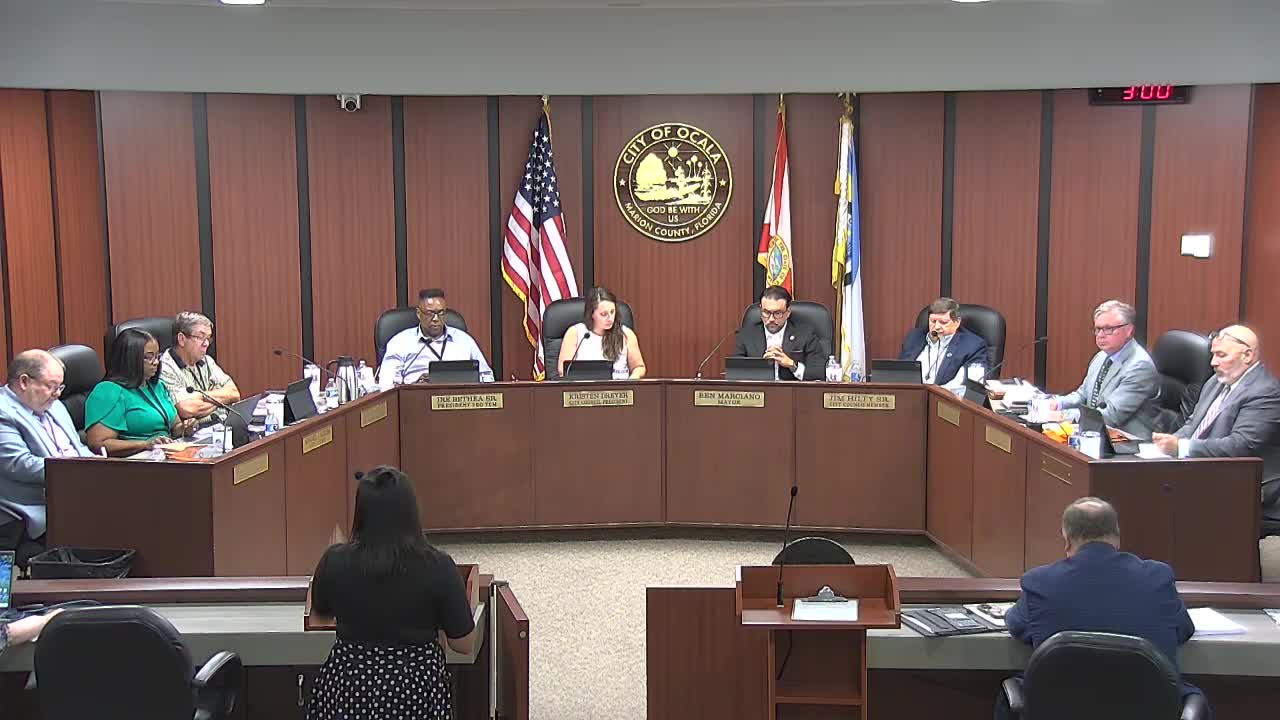
The Ocala City Council on May 6 approved an amendment to the amended and restated site and concurrency development agreement for the Grand Oaks Town Center planned unit development, a roughly 56.72-acre property at the intersection of Southwest 27th Avenue and Southwest 40th Street. The approval followed a staff presentation and public comments and passed on a roll call that recorded four ayes and one no.
City growth management planner Indira Madrivaram told council the change updates the 2013 agreement to reflect a 2024 planned development rezoning that altered architectural standards and increased residential density. Madrivaram said the amendment implements conditions requested by staff during the rezoning approval and that the Planning and Zoning Commission recommended approval unanimously after a public hearing on April 14.
Jimmy Gunning, the applicantwho identified himself as the project agentsaid the amendment is primarily a housekeeping update aligning the concurrency agreement with the recently approved rezoning and a new traffic analysis. "It's not very controversial," Gunning said, adding that the revised uses and updated traffic data drove the changes.
Council members pressed on traffic and housing-supply issues. One councilmember said the increase in apartments around the city has raised constituent complaints about traffic and an oversupply of rental units. In response, staff and the applicant cited the traffic analysis and Institute of Transportation Engineers (ITE) trip-generation figures: Madrivaram said low-rise multifamily (three stories and under) used a rate of about 2.72 residents per occupied unit in the ITE manual, while mid-rise (four stories and above) used roughly 2.5 residents per unit, which staff said reduces trip generation compared with the previously approved uses. The applicant noted that moving to four-story buildings typically requires elevators, which can make upper floors accessible to older residents and change household composition.
Gunning said the developer has submitted building plans and is seeking permits; he said construction is expected to begin fairly soon but did not give a firm start date. Council members who expressed concern said they worried about a possible future glut of apartments if multiple projects complete at once.
On the roll call to adopt the amendment, Councilmember Bethea voted yes; Councilmember Mansfield voted yes; Councilmember Holton voted no; Councilmember Musley voted yes; and Councilmember Dreyer voted yes. The motion passed.
The amendment is the second of two public hearings on this item and updates permitted uses, architectural standards and concurrency-related provisions to reflect the rezoning approved in 2024. Staff recommended approval.
The council did not adopt additional conditions at the meeting; staff said implementation will proceed under the terms of the amended agreement and applicable permitting processes.