Get AI Briefings, Transcripts & Alerts on Local & National Government Meetings — Forever.
Owner of 255 Rockville Pike seeks flexibility to build up to 550 apartments or adaptively reuse office as large retail
Summary
An applicant briefed the Mayor and Council on a project plan amendment for 255 Rockville Pike proposing either a phased multifamily redevelopment of up to 550 units or adaptive reuse of an existing office building for expanded retail; staff and council discussed parking, stormwater, BRT coordination and affordable housing requirements.
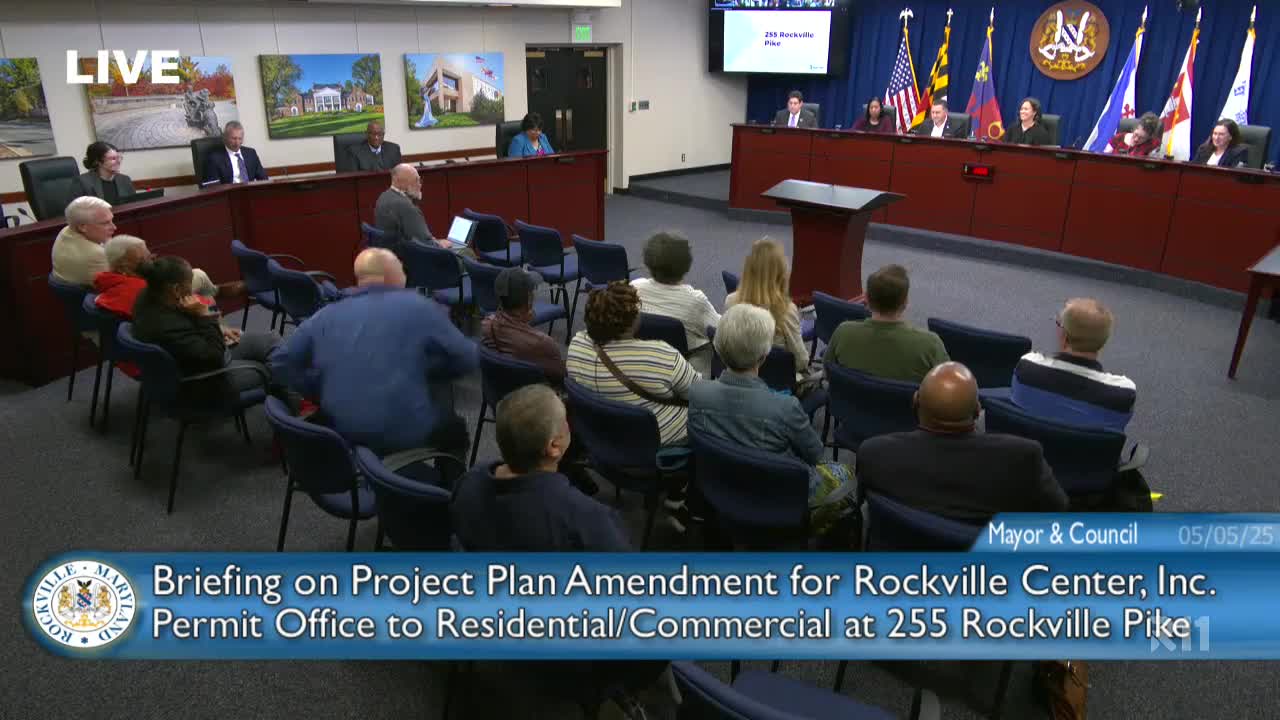
Kimia Zulfaguarian, principal planner for the City of Rockville, and Bob Elliott, representing the property owner, presented a project plan amendment briefing on 255 Rockville Pike on May 5, 2025. The applicant asked the Mayor and Council for preliminary feedback on two development paths: a phased residential redevelopment of up to 550 dwelling units with a maximum height previously vested at 217 feet, or an adaptive reuse of the existing office building for up to about 160,000 square feet of retail.
The subject property, roughly 2.5 acres at the eastern end of Rockville Town Center abutting Promenade Park and the Metro pedestrian bridge, currently carries a PDRCI (Plan Development Rockville Center, Inc.) entitlement. Kimia Zulfaguarian said the project plan amendment and a concurrent Level 2 site plan were filed March 7; Planning Commission briefed the proposal April 9 and a DRC meeting occurred April 24. The applicant described a two‑phase residential approach with an initial five‑story wood‑framed building of about 300 units over an existing three‑level parking garage (roughly 440 spaces) and a potential later tower that could add roughly 250 units.
“The idea is to get this building filled and activate the promenade and the metro gateway,” Bob Elliott said, describing the site as an “anchor” opposite the Metro station and noting the property was acquired at auction in March 2024 after a period of vacancy. Elliott said the owner’s preference is residential, but market uncertainty has prompted the applicant to retain the option for adaptive reuse to larger retail uses so the site can be reused sooner.
Why it matters: the site immediately fronts the Rockville Metro pedestrian bridge and the promenade; a large residential or retail use would affect transit access, parking, and stormwater needs and could shape the eastern approach to the town center. Council members pressed the applicant on timing, financing and potential public supports. Mayor Ashen and Council members asked whether the project team had explored state or county programs that support adaptive reuse or site‑readiness; Elliott said he was not aware of city programs but described county pilots under discussion and recommended the council consider legislation that would preserve rent‑growth predictability to attract private investment.
Council members also raised transportation and pedestrian safety. Elliott said the county has asked for significant stormwater capacity on the site to support planned bus rapid transit (BRT) station locations on Middle Lane; his team has proposed a reconfigured circulation and stormwater layout that county and city planners have reviewed. “We have created a plan … that shows a traffic circle and a turnaround that allows for about 1,700 square feet of stormwater,” Elliott said, noting the proposal could improve fire access and landscape treatment along Rockville Pike if the city and state allow right‑of‑way changes. Several council members urged staff to convene city, county and state partners to coordinate BRT stations, stormwater, and pedestrian improvements.
Affordable housing and development standards: the applicant described the housing as largely market‑rate and noted Rockville’s current MPDU threshold is 15 percent; under the state Housing Expansion and Affordability Act projects near qualifying transit may qualify for different bonus height rules if they provide higher deed‑restricted affordable shares. Council members asked staff to scan state and county programs that could help finance adaptive reuse or housing components. Elliott said the project team expects standard MPDU obligations and did not identify other subsidies at the briefing stage.
Project schedule and next steps: staff said the Planning Commission will prepare a recommendation after review; the Mayor and Council would hold a public hearing and decision on the project plan amendment and later the Planning Commission would consider the site plan. The applicant estimated that if the residential option advanced, detailed architectural design, permitting and financing would likely push construction starts into 2026–2027 at the earliest. Elliott said the owner intends to continue using at least part of the parking garage for public paid parking until construction begins.
Council reaction included support for the site being reactivated and requests for follow‑up. Councilmember Valeri asked staff and the applicant to assess state, county and nonprofit programs that might accelerate reuse or make a residential phase financially viable. Several members said they favored keeping flexibility in the entitlements so the owner can respond to market conditions but asked staff to clarify how the town center master plan height provisions and the vested PDRCI entitlements interact with any future site plan.