Get Full Government Meeting Transcripts, Videos, & Alerts Forever!
Get email alerts on the Illegal Dumping Tires topic
No spam. Unsubscribe anytime.
Neighborhood services outlines stepped-up enforcement plan after large illegal tire dumps
Summary
The Department of Neighborhood Services told a council committee it is increasing inspections, reeducation, and record-keeping after a wave of illegal tire dumping; staff proposed clearer marking, stronger recordkeeping for transporters and generators, and better interagency coordination.
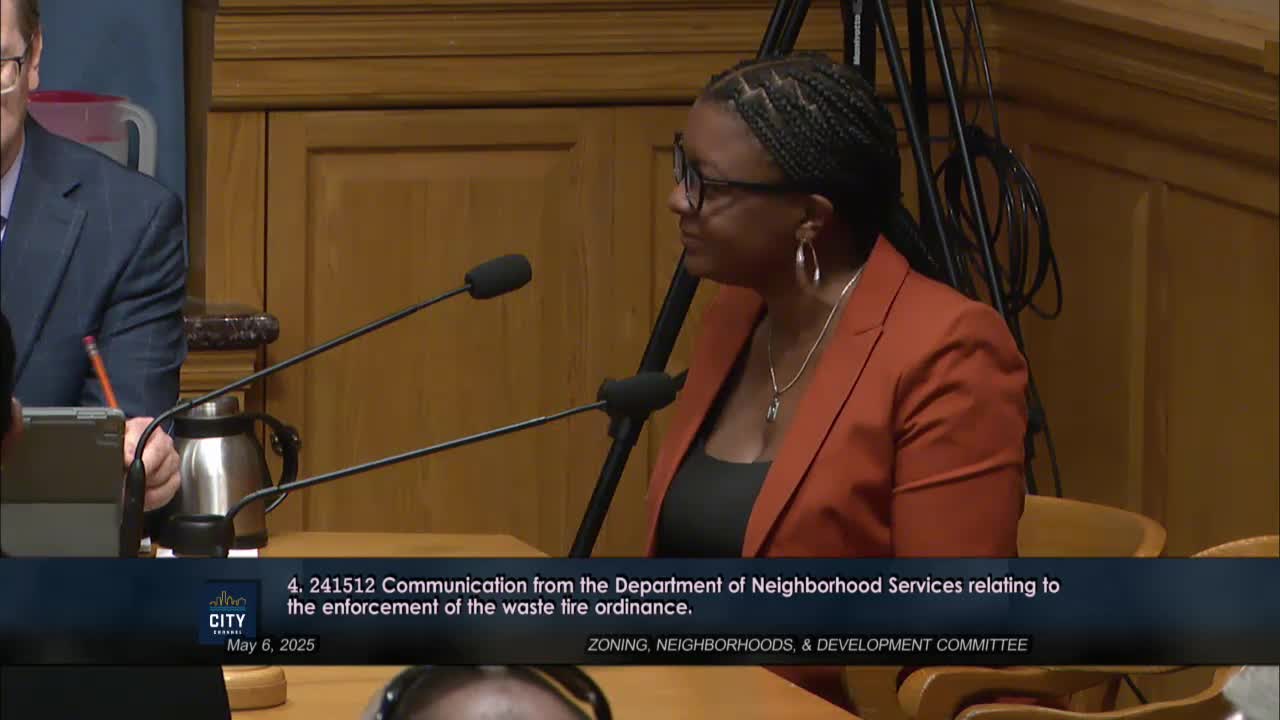
Department of Neighborhood Services (DNS) staff told a Milwaukee council committee they are ramping up enforcement and education to address repeated illegal dumping of waste tires across the city.
DNS deputy commissioner Mike Baszvanian and commercial-division manager Jumaane Cheatham outlined the department’s inspections and licensing framework. Cheatham said the "waste tire generator" requirement is part of the recycled salvage and towing (RST) licensing structure and that inspectors now perform expanded, targeted second- and third-pass inspections of tire shops. "Part of that reeducation...is a sign that says, all waste tires must be marked," he said, describing a new emphasis on visible marking and recordkeeping.
Key facts and problems DNS identified: inspectors estimate about 40 RST licenses in the city and seven locally based licensed transporters; large illegal dumps are typically associated with unlicensed or out-of-city transporters who collect tires cheaply and abandon them. Cheatham said generators are required to keep manifests showing who picked up tires and where they were taken; in recent investigations DNS found falsified receipts and unmarked tires, which undermined tracing of origins. "For the most part, there is not" marking on dumped tires, Cheatham said when asked whether field piles bear generator numbers.
DNS said its response includes: - Creation of a dedicated team of tire-shop inspectors and a checklist inspectors hand to operators. - Reeducation on marking tires and posting signage at shops to require marking of all waste tires with the shop’s RST number. - Improved records so inspector notes and dump reports specifically identify tires in the cleanup database. - Outreach to licensed local operators and multi-jurisdictional coordination with DPW, the DNR and law enforcement to pursue repeat violators and transporters operating without credentials.
Penalties and gaps: DNS staff showed a bail/penalty schedule in which the maximum cited was $5,000 in some instances; staff said they typically cite the establishment rather than issue hundreds of individual per-tire citations because prosecuting hundreds of citations is time-consuming and can be reduced by city attorneys. Staff also said RST numbers currently change every two years after license renewals, a City Clerk office practice implemented in 2010 that complicates tracing; inspectors recommended exploring a persistent identifier for each generator.
Costs and data: DNS said average cleanup of an illegal dump (all materials) runs about $335 per cleanup call on average, and cited one private-property cleanup costing roughly $5,000 for about 600 tires. Staff told the committee they will modify records to tag tire-specific cleanups and produce five-year reports on inspections, citations and cleanup costs.
Committee action: The committee agreed to hold the communication to let Alderman Pratt and staff draft additional enforcement steps and potential ordinance language requiring operators to verify generator licenses and to require consistent RST marking procedures. Chair Alderman Baumann called the item "held" for follow-up; members asked DNS to provide a list of historical inspections, the number of denied licenses that later operated, and an inventory of how many tires the city removed and how much was recovered over the last five years.
Why it matters: Large, concentrated dumps of tires create recurring cleanup costs, complicate city sanitation and are a fire and environmental concern; DNS described operational fixes that staff says can improve traceability and enforcement, but said some gaps (out-of-jurisdiction transporters, manifest fraud) require multiagency action and possibly ordinance refinements.