Get Full Government Meeting Transcripts, Videos, & Alerts Forever!
Get email alerts on the Maple Crossing Denial topic
No spam. Unsubscribe anytime.
Commissioners deny Maple Crossing rezoning after concerns over floodplain, roads and loss of commercial land
Summary
After extended public comment and technical presentations, the board voted 5–0 to deny a developer’s request to rezone a 40‑acre site for 215 townhomes (Maple Crossing), citing concerns about converting commercial land to residential, floodplain/percolation issues and school/highway capacity.
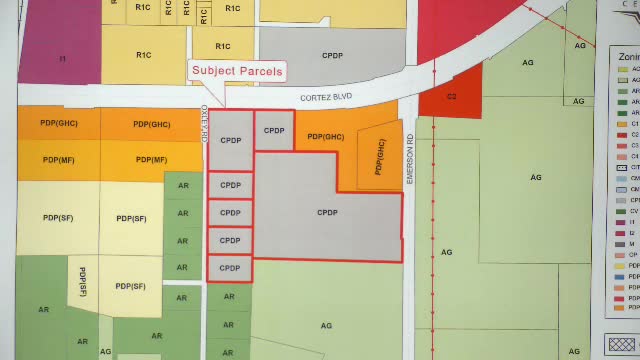
A contested rezoning petition for a planned‑development townhouse project known as Maple Crossing drew extensive board debate and public comment on May 6 before the Hernando County Board denied the petition 5–0.
Petitioner NVR Inc. and its team presented a revised master plan that reduced unit count from 245 to 215 units, increased townhouse lot widths to 28 feet with two‑car garages, and committed to sidewalk construction to Motown Elementary and other modifications. The petitioner’s civil and transportation engineers said the site avoids most floodplain impacts, proposes finished‑floor elevations above modeled flood levels, includes stormwater ponds sized to hold on‑site runoff and submitted a traffic study that county staff is reviewing. The petitioner said the townhome plan would generate fewer or comparable vehicle trips than several previously approved options for the same parcels.
Commissioners raised multiple concerns. Several members said they were reluctant to convert land currently designated for commercial or mixed uses into exclusively residential development, noting the county’s commercial/residential mix and long‑term fiscal effects. Commissioners expressed particular concern about the site’s low‑percolation soils and local flooding history; multiple residents and landowners described frequent inundation on nearby Oxley Road and downstream properties and challenged assumptions in the petitioner’s analyses. Commissioners also noted school concurrency limits — the school district estimated the development could generate about 34 students (16 elementary, 8 middle, 10 high school) — and uncertainty about wastewater capacity from the City of Brooksville.
After public comment and rebuttal, Commissioner Laco moved to deny the rezoning; Commissioner Champion seconded. The motion to deny carried 5–0.
Staff and the petitioner described several permits and technical reviews that would be required if the petitioner pursues another approach, including SWFWMD (Southwest Florida Water Management District) wetland delineation and ERP review, county engineering review of the traffic study and any roadway improvements, and conditional‑plat and utility agreements at the development stage.