Get Full Government Meeting Transcripts, Videos, & Alerts Forever!
Get email alerts on the Government Oversight Fraud topic
No spam. Unsubscribe anytime.
House fraud committee touts early wins, pushes statewide inspector general and whistleblower protections
Summary
At a Monday meeting, the Minnesota House Fraud and State Agency Oversight Committee reviewed its first-session work — including a whistleblower portal and bills on training, a state kickback statute and an inspector general — and urged continued bipartisan support to curb fraud in Medicaid-related services and legislatively named grants.
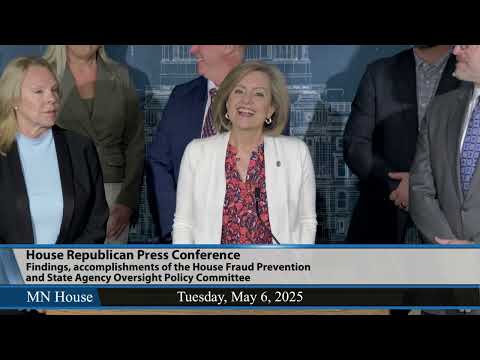
Representative Kristen Robbins, chair of the Minnesota House Fraud and State Agency Oversight Committee, opened a Monday morning meeting by summarizing the panel’s first-session work and urging lawmakers to keep the committee as a standing institutional oversight body.
“We had our last committee meeting of the session, so we just kinda wanted to get everyone together and talk about the success the committee had this year,” Robbins said, adding that fraud “is not a partisan issue. It’s a separation of powers issue.”
Robbins said the committee pursued three main goals this session: expose fraud and raise public awareness, identify gaps in statutes and agency tools, and create a public intake for allegations. The committee launched mnfraud.com as a public portal for whistleblowers and, Robbins said, received 530 submissions in the portal’s first week.
The committee has drafted multiple bills from testimony it received at hearings, Robbins said. Those include requests for a state “kickback” statute and legislation to require grants-management training offered by the Office of Grants Management. Robbins said two committee bills were filed late in the session after extended hearings with state agencies, the Office of Legislative Auditor (OLA), and the Office of Grants Management.
Vice Chair Patty Anderson (R) described bipartisan work to create a statewide office of inspector general (OIG). “We’re gonna set up a statewide office of inspector general that has full investigatory authority, that has full, essentially what we call police powers,” Anderson said, and said the Senate version of the OIG bill places the office in the executive branch and was expected to move to the floor the following day. Anderson noted differences between House and Senate proposals, saying the House bill would place the OIG under the legislative branch and — as written for the House — would not include law-enforcement powers.
Representative Walter Hudson (R) pressed agencies’ grant-management practices. He said hearings revealed agencies often accept self-attestation paperwork — “a sheet of paper from the grant recipient that says there’s no conflict of interest” — without an independent process to verify whether a conflict exists. Hudson also criticized remarks he said were made by Attorney General Keith Ellison in disclosed audio about keeping grant recipients in business, saying the comments showed the administration’s priorities appeared to favor recipients over taxpayer-protection. “We are in a battle with state agencies,” Hudson said he heard the attorney general say in testimony.
Representative Jim Nash, chair of the House Republican State Government Finance delegation, said provisions from the committee’s work were incorporated in broader finance legislation. Nash said House File 3 — described to attendees as a “fraud notes” package — would create additional capacity for oversight and that “there will be 4 full time OLAs once that bill gets signed into law,” referring to the Office of Legislative Auditor workload or positions described in the bill.
Committee members described other steps they said would reduce risk. Robbins said the committee pressed for reductions in legislatively named grants (often called earmarks), and that bipartisan letters urging committees not to include legislatively named grants produced “significant reductions” in earmarks in recent bills. She said the committee will consider procedural safeguards next session so any legislative earmark would be subject to front-end risk analysis, capacity reviews and a fraud note.
Committee members also described limits to their authority. Robbins said the panel lacks law-enforcement powers and that members have referred serious allegations to federal law enforcement when appropriate. Nash and others said the committee has convened private briefings with prosecutors and other investigators when public detail could jeopardize investigations.
Robbins and Anderson said the panel plans to continue interim work, including additional hearings on eligibility verification for programs such as Medicaid, and urged both parties in the House and Senate to keep the oversight work moving forward. Anderson said the governor had indicated willingness to sign an OIG bill if it reached his desk.
The committee did not record any formal votes during the meeting. Next steps described in the session included continued interim hearings, negotiations between the House and Senate on the OIG bill’s structure, and efforts next session to require risk assessments or other pre-approval steps for legislatively named grants.