Get Full Government Meeting Transcripts, Videos, & Alerts Forever!
Get email alerts on the State Budget And Workforce topic
No spam. Unsubscribe anytime.
House committee forwards workforce omnibus with deep cuts to investment programs; film office, fee alignments and direct appropriations debated
Summary
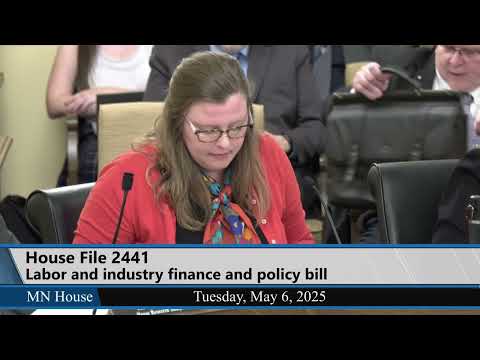
The House Workforce Development committee voted to re‑refer House File 2441 — the committee’s omnibus workforce and economic development package — to Ways and Means after hearing fiscal staff, agency testimony and more than two dozen public testifiers about cuts and targeted investments.
The House Workforce Development, Labor and Economic Development Finance and Policy Committee voted to re‑refer House File 2441 to the Committee on Ways and Means after a lengthy hearing that included a budget spreadsheet walk‑through, agency testimony and more than two dozen public testifiers.
Committee co-chairs said the committee’s target was a $50 million per‑biennium reduction and that the bill cannot draw net spending from the workforce development fund under the controlling budget resolution. House fiscal staff said the package shows a net reduction of $53,896,000 from base (the change-from‑February column) across the committee’s jurisdiction, including a $52,746,000 per biennium cut in the Department of Employment and Economic Development (DEED) accounts.
The bill mixes cuts to several core economic development programs with targeted increases to workforce training grants. House fiscal’s presentation itemized large reductions: a $16,000,000 cut to the Job Creation Fund (all base funding), a $24,740,000 cut to the Minnesota Investment Fund (all base funding), $2,500,000 per biennium reduction to Greater Minnesota business development public infrastructure grants, and a $4,000,000 base reduction to the CAN Train program. At the same time, staff listed increases intended to support worker training and apprenticeships: a $5,000,000 per biennium increase for Vocational Rehabilitation Services, a $2,888,000 per biennium increase to the Pathways to Prosperity program, a $1,500,000 per biennium increase to the Youth at Work competitive grant program, and funding for teacher registered apprenticeship grants.
Nicole Blissenbach, commissioner of the Department of Labor and Industry, testified the bill "makes several critical investments, especially in teacher registered apprenticeship and misclassification enforcement," but warned that it "falls short by not including the reasonable and necessary construction code and licensing fee adjustments," which DLI says are needed to avoid multi‑week delays in plumbing plan review, electrical inspections and other time‑sensitive services.
Evan Roe, deputy commissioner for workforce services at DEED, urged caution about deep cuts to economic development programs: "I would strongly caution against the heavy handed cuts to critical economic development programs like the Minnesota Investment Fund and the Job Creation Fund," he said, noting those programs reported creating or retaining nearly 4,885 jobs in 2024 and leveraging private investment.
Explore Minnesota’s director, Lauren Bennett McGinty, urged maintaining the agency’s budget as recommended by the governor, testifying that the state’s recent visitor numbers and film incentives support local economies. When asked what would happen if the Explore Minnesota film office lost funding, McGinty said: "Currently, the film department has 3 permanent full time employees. Should all the funding for the film office be cut, the incentive program would go unspent and it is set to renew every year, adding 25,000,000 to be spent. So, essentially no new productions would be able to gain any sort of tax credit for their production in Minnesota, which kind of renders the entire program meaningless."
Stakeholders from nonprofit economic developers, business associations, trade groups and workforce providers broadly described the local impact of proposed cuts. Testimony included concerns that eliminating or reducing direct appropriations to community organizations and cutting base funding for DEED grant programs would hamper ongoing projects, slow site cleanups and reduce small‑business assistance and loan funds in Greater Minnesota.
Industry groups and construction trade representatives urged fee changes that would let the Department of Labor and Industry increase inspection and plan‑review capacity. The Electrical Association and the Minnesota State Building and Construction Trades Council warned that without fee alignment, plumbing plan review wait times could increase to 15 weeks and electrical inspection timelines could lengthen sharply.
The committee discussed several member amendments. Representative Frazier offered an amendment to restore funding targeted at the Explore Minnesota film office; the committee took a roll‑call vote and the amendment failed on a 7–7 tie. Representative Greenman offered an amendment to remove a partial repeal of the non‑compete ban; that roll call also failed 7–7. Several other amendments were offered and withdrawn during the session after discussion.
Committee co‑chairs moved and the committee adopted the A825‑0074 amendment (committee amendment) by voice vote and then voted to re‑refer House File 2441 to the Committee on Ways and Means by voice vote. The bill will proceed to Ways and Means and then possibly to the House floor or conference committee with the committee’s content and amendments.
Next steps: the chairs said the committee intends to continue discussions as the bill moves through the process and encouraged stakeholders to engage with committee members. The Ways and Means committee was scheduled to consider companion budget language later the same day.