Citizen Portal

House Financial Services roundtable spotlights Trump-linked crypto ventures, urges tighter rules and ethics ban for officials

3200250 · May 6, 2025

Get AI-powered insights, summaries, and transcripts

Subscribe
AI-Generated Content: All content on this page was generated by AI to highlight key points from the meeting. For complete details and context, we recommend watching the full video. so we can fix them.

Summary

Lawmakers and outside experts at a House Financial Services roundtable raised concerns about President Trump's family's crypto businesses, called for bans on federal officials owning crypto, and debated market-structure options including joint SEC/CFTC oversight, KYC for wallets, and stablecoin safeguards.

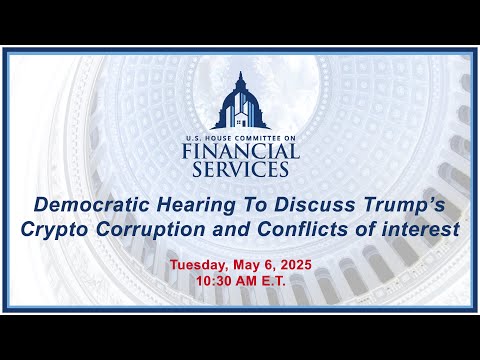
Ranking Member Waters convened a roundtable at the House Financial Services Committee to examine what witnesses called conflicts of interest and national-security risks tied to cryptocurrency ventures associated with President Donald Trump and his family.

The session featured four invited witnesses: Chastity Murphy, a visiting research fellow at the University of Manchester Law and Technology Initiative and former senior adviser at the U.S. Department of the Treasury; Timothy Massad, research fellow and director of the digital assets policy project at the Harvard Kennedy School and former CFTC chair; Mark Hayes, senior policy analyst at Americans for Financial Reform; and Jeff Hauser, founder and executive director of the Revolving Door Project.

Murphy framed the discussion around corruption and national security. "I'm here to sound the alarm about the risk posed by the convergence of unchecked crypto speculation and high level corruption, especially by President Donald Trump," she said, describing what she called "pay-to-play politics" enabled by crypto and asserting that "World Liberty Financial, Trump's major crypto venture, recently struck a $2,000,000,000 deal with a UAE-backed firm." Murphy said she supports a legislative ban that would bar the president and members of Congress from owning crypto assets or crypto firms and called for "beneficial ownership transparency, anti-evasion rules, independent audits or compliance mechanisms, and a mandatory divestment upon taking office."

Timothy Massad urged Congress to "do no harm" to existing capital markets while closing regulatory gaps for non-security digital assets. He recommended a legislative approach that directs the Securities and Exchange Commission and the Commodity Futures Trading Commission to work together to create a joint self-regulatory organization (SRO) to govern trading platforms and intermediaries that transact in major tokens such as Bitcoin or Ethereum, while preserving SEC authority over tokens that courts deem to be securities.

Mark Hayes emphasized that many of the practices exemplified by the Trump family's ventures are common across the crypto industry, including concentrated insider control and thin disclosure. He noted that code re-use can increase vulnerability, citing a platform derived from another code base that experienced a $2,000,000 hack, and warned that "many crypto platforms and offerings are similarly structured" in ways that can harm retail investors.

Jeff Hauser framed the problem in constitutional terms, citing the emoluments concerns and saying crypto is "a perfect bribery vehicle" because of anonymity and low ongoing costs for issuance. He told the committee that current ethics laws are insufficient and said Ranking Member Waters' proposal to bar officials from holding crypto assets "make[s] sense," adding it could be extended to cabinet secretaries, senior congressional staff and federal judges.

Members pressed witnesses on specific policy tools. Witnesses and members discussed several recurring regulatory and technical proposals:

- Ban on official ownership and marketing of crypto: Murphy, Massad and Hauser supported prohibiting the president, the vice president and close family members from owning or marketing crypto while in office. Murphy said such a prohibition was "not just an ethical issue" but a national-security issue because blockchain can enable hard-to-trace transfers.

- Joint SEC/CFTC framework and an SRO: Massad recommended a relatively simple, agency-led approach that uses an SRO supervised by regulators to bring trading platforms and intermediaries into a consistent oversight regime without rewriting securities law.

- Stablecoin safeguards and prudential oversight: Witnesses urged strong federal rules for stablecoins that give authorities line-of-sight into large issuers (including offshore issuers), require issuer accountability, and include freeze-and-seize capabilities for theft or illicit use.

- Controlled anonymity / identity solutions: Several witnesses and members discussed technical options to balance privacy and law enforcement access. Proposals ranged from digital identity credentials and KYC for on-chain transactions to incentives that push activity into custodial/hosted wallets rather than unhosted, anonymous wallets.

- Enforcement and market integrity: Witnesses urged stronger enforcement by federal and state regulators, cautioned against broad exemptions for DeFi, and warned that complex statutes could create loopholes exploitable by bad actors.

Committee members repeatedly cited reported transactions and figures discussed in testimony: Murphy cited reporting that President Trump had pocketed at least $350,000,000 from a Trump "meme coin" while investors lost an estimated $2,000,000,000; witnesses described a reported $2,000,000,000 Abu Dhabi investment tied to a Trump-affiliated stablecoin; and testimony referenced large concentrated wallet holdings of "Trump coin." Members also raised examples of post-election price swings in tokens such as Bitcoin and Dogecoin.

The hearing produced no formal votes. Instead, witnesses and members urged legislative clarifications and stronger enforcement. Massad urged Congress to "keep it simple" in statute so agencies can develop technical rules; Murphy and Hauser urged a ban on officials' ownership of crypto; Hayes and other witnesses urged that state regulators and private litigation remain available avenues of redress.

Ranking Member Waters closed by saying that regulatory definitions and market-structure work can be resolved but that "Trump's corruption" must be addressed with guardrails. The committee did not adopt or advance legislation during the session; members indicated continued oversight and drafting work on stablecoin and market-structure proposals.

The hearing combined ethics concerns tied to a sitting president's crypto activities with technical and policy discussion about how to regulate digital-asset markets, from identity and custody to prudential treatment of stablecoins.

Ending: Witnesses and members left the roundtable with a shared emphasis on stronger transparency, enforcement and consideration of a statutory ban on officials owning or marketing crypto assets, and with differing views on whether to prioritize new criminal or constitutional enforcement actions, agency rulemaking, or statutory market-structure changes.