Get Full Government Meeting Transcripts, Videos, & Alerts Forever!
Get email alerts on the Child Welfare Consent Decree topic
No spam. Unsubscribe anytime.
MDHHS tells House panel progress under long-running child-welfare consent decree; department outlines steps to exit oversight
Summary
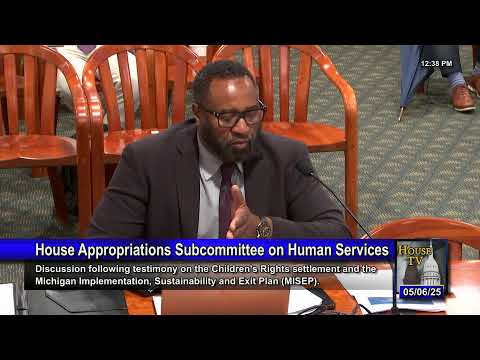
Demetrius Starling, senior deputy director for children's services at the Michigan Department of Health and Human Services, told the House Appropriations Subcommittee on Human Services that MDHHS has consolidated and reduced the number of provisions under the state's long-running federal child-welfare consent decree and outlined steps intended to move the state toward exit from court oversight.
Demetrius Starling, senior deputy director for children's services at the Michigan Department of Health and Human Services, told the House Appropriations Subcommittee on Human Services that the department has consolidated and reduced the number of provisions under Michigan’s long-running federal child-welfare consent decree and described steps intended to move the state toward exit from court oversight.
Starling told the committee that a 2024 stipulated order signed in federal court narrowed the agreement’s monitoring requirements and that, during the most recent reporting period, the court found MDHHS met or exceeded performance standards in five monitored areas. "We're way ahead of where we were even 2 or 3 years ago, and I applaud the efforts of the state and the diligence of the plaintiff for being on top of things," Starling said.
The nut of the presentation is that the department and its legislative partners have redirected resources and reorganized divisions to focus on permanency, safety and equity in child welfare. Starling said negotiated changes cut 31 provisions from active monitoring and reduced the number of provisions subject to ongoing monitoring to 23. He described new internal units and oversight functions including a Division of Continuous Quality Improvement, a centralized statewide intake unit and a maltreatment-and-care unit.
Key figures and outcomes presented to the committee included: a reduction in children in foster care from more than 19,000 in February 2008 to 9,300 today; a decline in children in congregate care from more than 1,200 to about 350; and a drop in monthly restraints in congregate care from roughly 900 to about 350. Starling also cited improvements in adoption timeliness and placement stability that have allowed the department to remove several items from active monitoring.
Starling described a targeted permanency strategy implemented in six counties — Ingham, Jackson, Kent, Muskegon, Oakland and Saginaw — that assigns Permanency Resource Monitors, increases team decision-making meetings for the selected cohort, and uses a permanency dashboard to track barriers and outcomes. Within that cohort, Starling said the permanency rate for the cohort rose from 9.9% to 22.3% comparing January–June 2023 with January–June 2024.
On maltreatment in care, Starling said the department and monitors agreed to a real-time review process in 2022 and developed a statewide remediation plan in 2024 that includes improved investigative tools, enhanced oversight of child-caring institutions, and supports for relative caregivers. He noted the MICEP requirement that the observed rate of victimization remain below 9.07 per 100,000 days of foster care during the reporting period.
Committee members pressed for explanations of remaining oversight and for specifics about how recent budgeted funds would be used. Vice Chair Edwards asked how MDHHS planned to use $10 million from last year’s budget to support exit from the consent decree; Starling said about $5 million of that was designated for adoption subsidies and had not yet been spent. He said other funds are being used to expand kinship supports, expand team decision-making statewide, bolster treatment foster care, provide targeted regional trainings for caregivers, expand discretionary county funds to address urgent needs, and pilot housing supports and independent-living supports for youth.
Starling addressed medical- and behavioral-health documentation concerns raised by members. Regarding psychotropic medication documentation, he said: "It wasn't that it wasn't being done. It wasn't being documented, and we're addressing that right now." He added that every youth entering foster care now receives Medicaid coverage and that MDHHS has created a behavioral-health division focused on children to improve access to therapy and other services.
When asked why Michigan remains under court oversight after 17 years, Starling replied that the timeline for exit depends on sustained performance in two central areas—permanency and maltreatment-in-care—and noted that other jurisdictions have remained under court oversight longer. He said the department is preparing for a July 14 check-in with the judge and plaintiffs and emphasized the department’s stated aim to exceed baseline benchmarks rather than lower them.
The only formal action recorded during the meeting was approval of the April 22 minutes on a voice vote after Representative Edwards moved approval; no objections were recorded.
Committee members asked the department to provide additional documentation, including a crosswalk of which consent-decree provisions have been removed or are no longer actively monitored and a bulleted list of the measures the department credits with reducing the foster-care population. Starling said staff would provide follow-up materials through the department’s legislative affairs office.
Starling and members emphasized remaining work on maltreatment-in-care measures, placement safety and ensuring documentation and service access for youth with behavioral-health needs. Starling told the committee the department intends to put post-exit monitoring parameters in place so progress is maintained after any end to federal oversight.
The meeting record shows no formal votes on legislation or policy changes; the presentation and questions were informational and directed staff follow-up rather than producing new committee directives.