Get Full Government Meeting Transcripts, Videos, & Alerts Forever!
Get email alerts on the County Finance topic
No spam. Unsubscribe anytime.
Humboldt County warns general fund could turn negative by FY26–27 in 5‑year forecast
Summary
Deputy County Administrator Jessica Maciel told the Board the county’s five‑year general fund forecast shows expenditures outpacing revenues and a projected negative fund balance by fiscal year 2026–27, driven by a structural deficit, pension costs and weaker sales tax.
Deputy County Administrator Jessica Maciel told the Humboldt County Board of Supervisors that the county’s five‑year general fund forecast projects the fund will go negative in fiscal year 2026–27 unless further action is taken.
The forecast, a five‑year projection limited to the general fund, shows “maintaining as‑is expenditures will continue to outpace revenues at an increasing rate,” and projects a deficit that could reach about negative $77 million by fiscal year 2029–30, Maciel said. She described the outlook as a “moderate scenario,” and said she was presenting a conservative view to the board.
Why it matters: a negative general fund balance would limit the board’s ability to adopt a budget because the county cannot adopt a budget that relies on a negative fund balance. Maciel warned that more impactful reductions or new revenue will be required to produce a balanced budget in coming years.
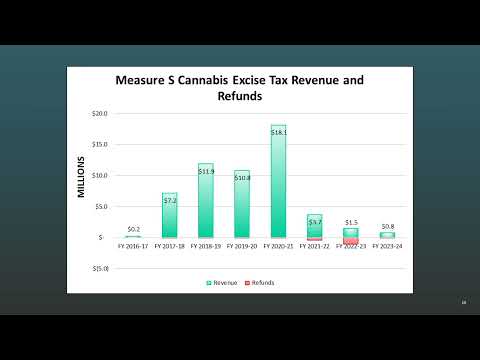
Key assumptions and drivers: the forecast relies on federal and state economic publications, Bureau of Labor Statistics CPI tables, Beacon Economics and a local Humboldt economic index. The main near‑term drivers Maciel cited were: - A structural budget deficit: expenditures (salary and benefits, operations, maintenance) expected to continue rising faster than revenue. Salary and benefits were modeled to grow about 5% per year to account for staff increases. Maciel noted the board could employ tools used previously (voluntary separation incentive, furloughs, hiring freeze) to reduce costs. - Pension costs: the county’s unfunded actuarial liability is expected to peak around 2030–2031, and short‑term drops in amortized costs (from benefit changes) create temporary relief in 2026–27 before costs return to an upward trend. Maciel said poor CalPERS investment performance could extend or worsen the peak. - Sales and property tax performance: Maciel tied forecast sensitivity to property values and sales tax. She said a 1% change in assessed property tax values could change FY25–26 revenue by roughly $590,000 (assuming collection). Sales tax performance has been weakened by changes in CDTFA allocation rules and by shifts in retail patterns since the pandemic. - Omitted or shifted revenue: the forecast excludes cannabis excise tax receipts (described as inconsistent and omitted) and excludes Measure Z and Measure O because the board moved those measures to separate funds for clearer tracking.
Context and near‑term actions: Maciel noted the board reduced the budget deficit from about $18 million to just over $15 million between FY23–24 and FY24–25, but said that was not sufficient to avoid the projected drop into negative fund balance in FY26–27. The forecast includes a $5 million one‑time contingency for labor negotiations in FY25–26. Maciel emphasized the projection does not assume future labor settlement outcomes, new laws or unexpected economic shifts; she framed the forecast as a planning tool, not a final budget.
Board reaction and next steps: board members asked for clarifications on sales tax and property tax sensitivity and discussed pension timing. Maciel recommended continued emphasis on reserves and stated the county’s plan to contribute $1 million per year to reserves aimed at meeting a Government Finance Officers Association target (~two months of expenditures). The presentation concluded with the board accepting the department reports by a recorded vote (see “Votes at a glance”).
Ending: The forecast positions the County to consider more substantive structural reductions or revenue options in the coming year; officials said outcomes will depend on labor negotiations, CalPERS investment returns, and sales/property tax performance.