Get Full Government Meeting Transcripts, Videos, & Alerts Forever!
Get email alerts on the Youth Services topic
No spam. Unsubscribe anytime.
San Mateo police present youth services unit; councilors urge schools to restore SRO funding
Summary
At a May 5 special City Council meeting, the San Mateo Police Department described programs run by its Youth Services Unit — including the Police Activities League, a diversion program, Explorer post and a therapy canine — and council members discussed seeking restored school-district funding for school resource officers.
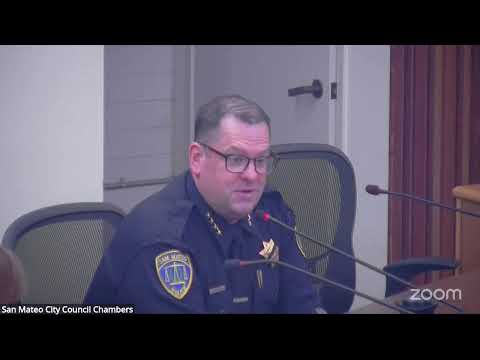
The San Mateo Police Department gave a detailed briefing on its Youth Services Unit at a May 5 special meeting of the San Mateo City Council, describing an array of programs that department leaders said serve children across the city and county and help reduce juvenile reoffending.
Lieutenant Kimber Joyce, who oversees the unit, told the council the work is guided by “mentoring today, building tomorrow, and strengthening our community,” and outlined four connected components: the Police Activities League (PAL), diversion and prevention services, the Explorer program and youth services officers (YSOs), including the department’s therapy canine, Rookie.
The presentation emphasized scope and outcomes. Joyce said PAL serves “almost 1,500 kids” and that more than 90% of PAL participants report low to very low income. Sergeant Tracy Unga described PAL’s scholarship program, which expanded from 11 to 17 recipients this year, and said PAL runs recurring community events — Backpackpalooza (more than 400 backpacks distributed last year), a mental-health 5K on May 31, Junior Giants (about 400 participants in recent years), cultural performances and seasonal events such as brunch with Santa and Santa Cop.
On prevention and diversion, department leaders described a team-based juvenile diversion program the city runs in partnership with the YMCA clinical case managers and San Mateo County probation. The unit reviews every juvenile case to determine eligibility for diversion, Joyce said; diversion is offered for first-time, low-level offenses and uses an evidence-based needs assessment (referred to in the presentation as a Jace and a CANS assessment). The program is structured as about a six-month intervention with a minimum of 10 contacts, including at least three family counseling sessions, and includes education classes, counseling and regular home and school check-ins.
Joyce and Unga said the unit’s recidivism rate is low: about 90% of participants do not reoffend after completing the program, and leaders reported referrals have risen since the pandemic. The presenters said annual referrals were roughly 25 before COVID-19; reported counts included about 20 in 2021–22, 49 participants and 16 voluntary cases in 2022–23, about 42 participants and 13 voluntary cases in 2023–24, and 56 participants so far in the current year. The presenters cautioned the team size has not increased while caseloads have grown.
The Explorer post — ages roughly 14–21 — was described as the largest in the county with about 20 active members; presenters said explorers contribute thousands of volunteer hours at city events and that some alumni have gone on to police academies. The unit’s YSOs work primarily in schools and deliver classroom presentations on topics such as vape prevention, social-media safety and violence prevention. The presentation said the city currently funds the police positions, while many support services are funded externally: San Mateo County reimburses YMCA clinical case manager positions and probation provides an in‑kind position housed at the department.
Council members asked about trends, program capacity and funding. Several councilors praised the unit and urged renewed partnerships with the San Mateo‑Foster City School District and the San Mateo Union High School District to restore earlier funding for school resource officers (SROs). Presenters and Chief Ed Barberini recounted the funding history: the city supported SROs from about 2005, the districts previously funded additional positions, the districts pulled funding during the COVID-19 period, and the city later secured a grant that temporarily added a second YSO focused on vape and tobacco education. That grant has since expired; the city currently funds two YSOs and staff said a third officer would restore the previous model of one officer at each high school and better continuity between feeder middle schools and high schools.
Chief Barberini said the department has been meeting regularly with both superintendents and continues to pursue grant opportunities and contractual arrangements with districts. Council members indicated they would continue outreach to the school districts and support grant applications to try to secure additional funding.
On the therapy canine, presenters described Rookie as a widely used trauma‑support resource who accompanies officers to calls involving children, attends court with victims, and is in high demand across the county. Presenters said Rookie’s handler will remain in the unit for the near term and the department hopes to retain the pairing for several more years.
No formal council action or vote occurred at the special session. Council members closed the meeting after directing staff to continue discussions with school districts and to provide additional program statistics requested by the council, including breakdowns of YSO calls by school level and further detail on diversion referrals.
The presentation and the council’s discussion emphasized the unit’s role in youth engagement, alternatives to prosecution for low‑level juvenile offenses, and ongoing funding challenges for school‑based officers.