
Board grants jurisdiction over 111 Taylor letter of determination after public outcry over GEO Group use
Get AI-powered insights, summaries, and transcripts
Sign Up Free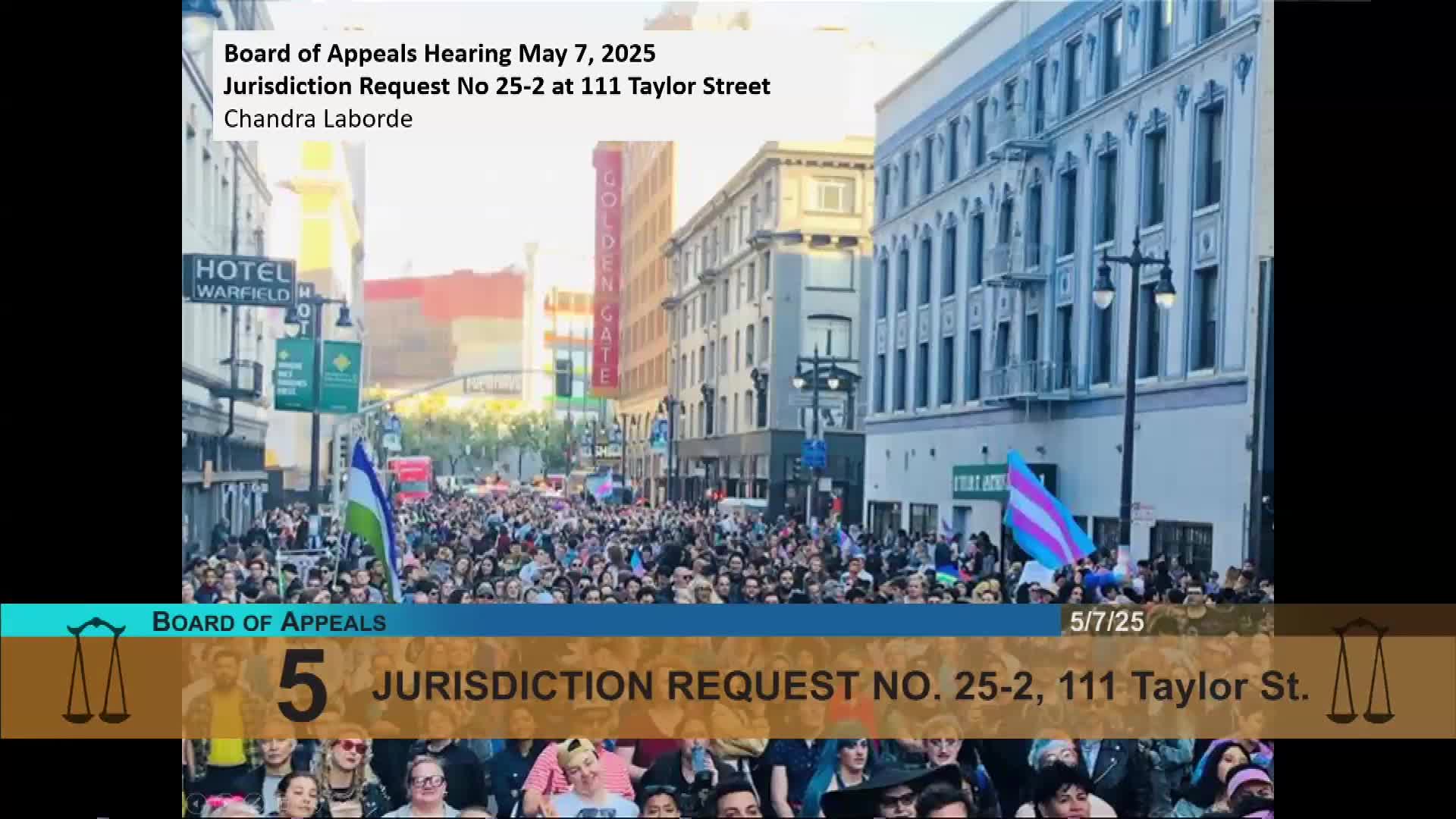
Summary
The Board of Appeals voted 4–0 to grant a jurisdiction request from Chandra Laborde regarding a January 2025 letter of determination for 111 Taylor Street, allowing a late appeal to proceed; commissioners cited public notice failures and the site's historic significance.
The San Francisco Board of Appeals on May 7 granted a jurisdiction request from neighborhood advocate Chandra Laborde, allowing a late appeal of a January 2025 letter of determination for 111 Taylor Street to proceed. The board voted 4–0 to find that the city’s notice procedures had inadvertently prevented Laborde from filing a timely appeal.
Lede
The board’s action clears the way for a substantive review of the planning department’s January 2025 determination, which classified use at 111 Taylor — currently occupied by GEO Group/Geo Reentry Services — as a form of “legal noncomplying group housing” under city code. Laborde told the board she subscribed to the planning department’s block notification (BBN) system to receive notice about 111 Taylor but received no notice of the January letter; she said the absence of notice materially deprived her of the right to appeal within the 30‑day window.
Nut graf
Laborde and scores of community speakers — including historians and representatives of the Compton’s Transgender Cultural District — urged the board to take jurisdiction, saying the site is historically significant (the location of the 1966 Compton’s Cafeteria Riot) and that the city’s notice practices had denied the neighborhood the opportunity for review. The board agreed that the department’s public‑notice practices as applied in this case were inadequate and granted relief that allows Laborde’s appeal to proceed.
What the proceedings covered
- Laborde said she subscribed to the department’s block‑book notification service (BBN) in 2024 and expected to receive notice of administrative actions affecting 111 Taylor. She said she received no notice of the January 2025 letter and only learned of the determination afterward. She asked the board to find good cause under Board Rule 10(a) — that the city inadvertently prevented a timely appeal. - Property owner’s counsel (Geo Reentry Services) argued LODs (letters of determination) are not part of the BBN notice process, and that the BBN is a department policy for development applications rather than for letters of determination. - Planning staff explained the department’s longstanding practice: LODs are not required to be noticed under the planning code, although the department does send courtesy notices in some contexts (property owners, registered neighborhood groups, and certain citywide organizations). The department said it sent copies of the LOD to 47 groups, including Tenderloin Housing Clinic and local supervisors’ offices, but that the BBN system is intended to notify subscribers about active development applications rather than every administrative zoning determination. - Dozens of public commenters, including historians, trans‑district representatives, neighborhood organizations and residents, urged the board to grant jurisdiction so the community could legally challenge the determination and obtain full transparency. Speakers connected the LOD to the site’s history as the Compton’s Cafeteria Riot location and urged a review of GEO Group’s presence on the site.
Board decision and immediate consequences
President Trezvino said the board’s authority under Rule 10(a) allows relief in “extraordinary” cases where a city action inadvertently prevented timely appeal; he found the standard met here. Commissioners noted the complexity of the department’s public‑notice system — the BBN application’s language and the distinction between development applications and determinations — and concluded a reasonable person could have expected to receive notice for this property.
The board’s recorded vote was unanimous: President Trezvino — Aye; Vice President J.R. Epler — Aye; Commissioner Rick Swig — Aye; Commissioner Jose Lopez — Aye. The board ordered that Laborde may file an appeal within five calendar days and directed staff to provide procedural guidance; the board did not rule on the merits of the underlying zoning question.
Why it matters
The action preserves the neighborhood’s ability to challenge the planning department’s classification of 111 Taylor without making any finding about the substance of the letter. The property at 111 Taylor lies in the Transgender Cultural District and is the site of a 1966 confrontation that community groups describe as a foundational moment in trans resistance. Granting jurisdiction means the community will have a formal administrative route to argue whether the current use and any permits are consistent with planning code and the public interest.
Next steps
- Laborde must file her formal appeal within five days as directed by the board and the board office. The board’s staff told Laborde to contact the board office for filing deadlines and procedural instructions. - The board did not set a hearing date for the underlying appeal at the May 7 session; if Laborde files, the normal board scheduling and briefing rules will apply.
Ending
The board’s action does not resolve the underlying land‑use question but ensures the community’s claims will be considered on the merits in a properly noticed appeal process.