Get Full Government Meeting Transcripts, Videos, & Alerts Forever!
Get email alerts on the Zoning topic
No spam. Unsubscribe anytime.
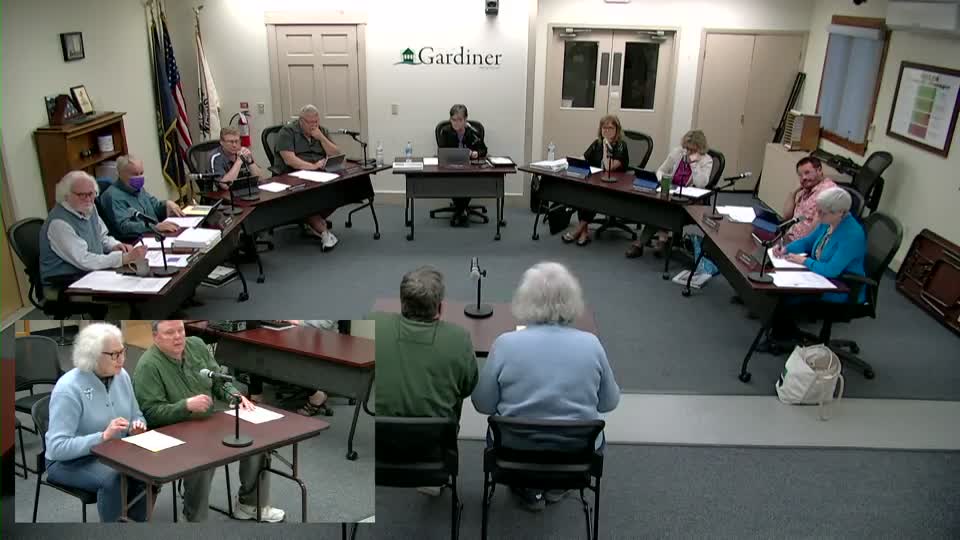
Gardiner council sends disputed Robinson Street rezoning to second reading after residents protest
Summary
The Gardiner City Council voted to send a proposed rezoning of three Robinson Street parcels from high-density residential to "in-town commercial" to a second reading after neighbors raised concerns about building height, lighting and traffic; the planning board had recommended against the change.
The Gardiner City Council on May 7 voted to send a proposed rezoning of three parcels on Robinson Street (Tax Map 34, Lots 73, 74 and 76) from high-density residential to in-town commercial to a second reading after neighbors spoke against the change and the owner of the parcels said commercial use would bring customers and jobs.
Neighbors who live overlooking the site told the council the area is still primarily residential and argued rezoning would create a “finger” of commercial property wedged into housing. "Changing it to in-town commercial will result in a finger of land that is wedged in the middle of residential neighborhoods," said Martha Harvey Webster, who said she and her husband have lived at 22 Neal Street since 1991. Webster also warned she had learned commercial buildings in that zone could be built up to 75 feet tall, a height she said would overshadow nearby two- and three-story homes.
The landowner, Mark Warren of Berry Leasing and Development, told councilors the parcels previously functioned as commercial and that extending the downtown commercial zone would provide space for businesses that need more parking or easier access than downtown storefronts offer. "All we're doing is extending the zone down the street about 300 feet," Warren said. He also said the city has strict lighting ordinances that would limit bright or intrusive fixtures.
Code Enforcement Officer Chris McNeil told the council the planning board’s vote against the rezoning was an opinion about fit with the comprehensive plan rather than a technical objection to the ordinance language. "There wasn't anything technically wrong as far as how the ordinance was written or any usability of it," McNeil said.
Mayor Patricia Hart and councilors discussed options, including sending the proposal back to the planning board after a second reading. Councilor Sean Dolly moved to send the ordinance to a second reading; the motion was seconded by Councilor Gaye Grant and passed on a recorded unanimous vote.
Why it matters: The council’s decision to advance the rezoning preserves council and public time to gather additional information — including input from Planning Board leadership and the city’s economic development committee — before any final change is adopted. Neighbors emphasized potential impacts on traffic, noise, lighting and visual scale; the landowner and developers emphasized economic development and reuse of vacant parcels.
What’s next: The rezoning will be presented again at a scheduled second-reading meeting; the council indicated it may invite the Planning Board chair and the city’s economic development director for more detailed input. City staff said property owner Mark Warren would be notified of the second-reading date.
Ending: The council did not vote on the rezoning tonight; instead it moved the item to the next stage of the ordinance process so additional testimony and technical review can be collected before a final vote.