Get Full Government Meeting Transcripts, Videos, & Alerts Forever!
Get email alerts on the Affordable Housing topic
No spam. Unsubscribe anytime.
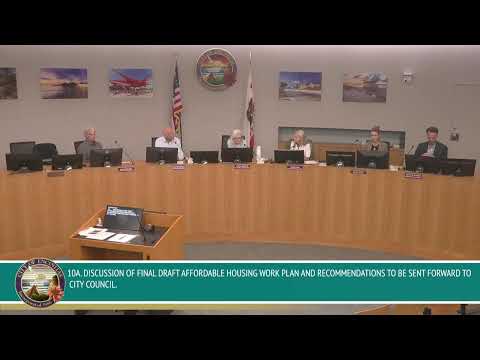
Encinitas Planning Commission forwards final affordable housing work plan to city council
Summary
The Encinitas Planning Commission voted 4-0 on May 15 to send a final affordable housing work plan to the City Council. The plan recommends RFPs, public‑private partnerships, alternative equity sources, zoning changes and incentives to produce more affordable units in fewer developments.
The Encinitas Planning Commission voted 4-0 on May 15 to forward its final affordable housing work plan to the City Council, recommending a series of strategies intended to produce more affordable units while limiting impacts on community character.
The plan, prepared by an ad hoc committee of two commissioners, recommends issuing targeted requests for proposals, pursuing joint ventures and public‑private partnerships, engaging alternative equity sources and housing agencies, and changing local code and incentives to encourage smaller units and more efficient development. "Our objective was basically to build more units in fewer projects," Commissioner Bob Pendergast said during the presentation.
The work stems from the commission's effort to help the city meet state housing obligations administered by the California Department of Housing and Community Development (HCD) and the city's regional housing needs allocation. The document reviewed financing tools such as low‑income housing tax credits, municipal finance authority bonds, and state grant programs; potential partners including the North County Transit District, school districts and nonprofits; and zoning changes to allow efficiency, micro units, clustered housing and other nontraditional unit types.
The plan lists several specific ideas: issue RFPs for publicly owned and commercial parcels; pursue joint ventures with private property owners and nonprofit housing developers; engage programs such as the California Affordable Housing and Sustainable Communities grant and the California Municipal Finance Authority; identify fee waivers and guaranteed permitting timelines for qualifying affordable projects; and explore community land trusts or limited‑equity ownership models to reduce long‑term costs.
Commissioners said the measures are intended to produce a greater number of affordable units without requiring many separate large developments, a goal they said could reduce traffic, sewer and school impacts. "If we can find a way to build more units in fewer projects, I think it would benefit. . . . we would have more units and that achieves our arena allocations," Pendergast said.
Commissioner Susan Sherrod, who coauthored the work plan, thanked her colleague for the collaboration. "I appreciated working with Bob, and his insights were very valuable," Sherrod said.
A public commenter, Ellen Burr, raised concerns during the meeting about accessory dwelling units (ADUs) and the city's in‑lieu fee program, saying relatively few ADUs are being reserved as affordable and that an opt‑out fee is too small to produce affordability. The commission did not act on ADU policy at the meeting; the work plan itself recommends examining incentives and regulations to increase affordable outcomes for a range of housing types.
After discussion, a motion to present the work plan to the City Council — with a commissioner designated to present the item — passed by a 4-0 vote. The commission's recommendation is advisory; any implementation steps would require City Council action and, where applicable, funding or approvals from outside agencies.
The Planning Commission listed a range of partners and tools in the document, including Affirmed Housing, Chelsea Investment, San Diego Interfaith Housing, Jamboree, NCTD, San Diego Unified School District and MiraCosta Community College District. The work plan cites examples from neighboring jurisdictions and state programs as possible models for Encinitas to adapt.
The Planning Commission will forward the final document to the City Council for consideration; the commission did not set implementation dates at the May 15 meeting.