Get Full Government Meeting Transcripts, Videos, & Alerts Forever!
Get email alerts on the Permitting And Code Enforcement topic
No spam. Unsubscribe anytime.
Permitting Center to absorb Department of Neighborhoods functions; $10.6M budget and staff transfers planned
Summary
Public Works said it will absorb dangerous‑buildings, neighborhood nuisance investigations and other Department of Neighborhoods functions into the Houston Permitting Center beginning FY26, adding 72 FTEs and a $10.6 million budget impact; council members asked about operations, funding sources and demolition funds.
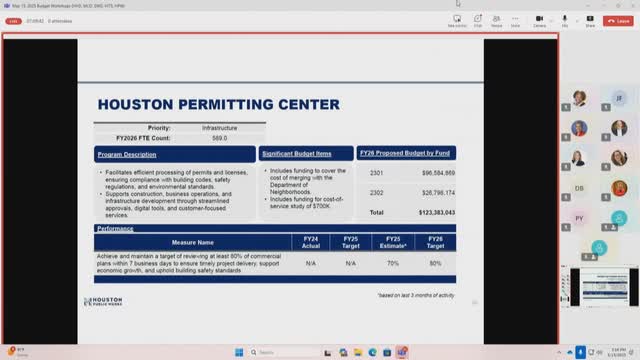
Houston Public Works confirmed that, starting in fiscal 2026, the Houston Permitting Center will absorb several functions formerly housed in the Department of Neighborhoods, including dangerous buildings, nuisance investigations, site administration and enforcement on bandit signs.
Sameer Salanki, Public Works CFO, told council the transfer consists of 72 full‑time equivalents and will carry a $10.6 million budget impact for FY26. Council members asked where the staffing and salaries will be budgeted; staff said operationally the moved functions will be within the Building Inspection Fund and some costs will draw on stormwater and related funds for specific activities.
Council members also pressed the department about demolition funding for dangerous buildings. Randy Mackey said the FY26 transportation and drainage operations budget includes a $25 million increase intended for demolition of dangerous buildings and other stormwater‑related spending; he framed the work as part of preventing infrastructure degradation when properties are left in disrepair.
On enforcement and constituent services, the department said code enforcement will now rest within Public Works’ permitting operations and that staff will provide guidance to council offices on how to refer constituent inquiries as the transition occurs. Council members asked for clarity on how constituent service continuity would be handled during the transition and where specific expenditures appear in budget tables; staff committed to provide additional detail in follow‑up materials.
Mackey said integrating Department of Neighborhoods functions into permitting creates opportunities for efficiency — for example, inspectors who can handle both commercial and residential issues on the same street — but acknowledged the transition requires close coordination to avoid service interruptions.